Rastriya Swatantra Party Unveils 'Citizen Contract' Highlighting Dual Citizenship Proposal Amidst Legal Hurdles


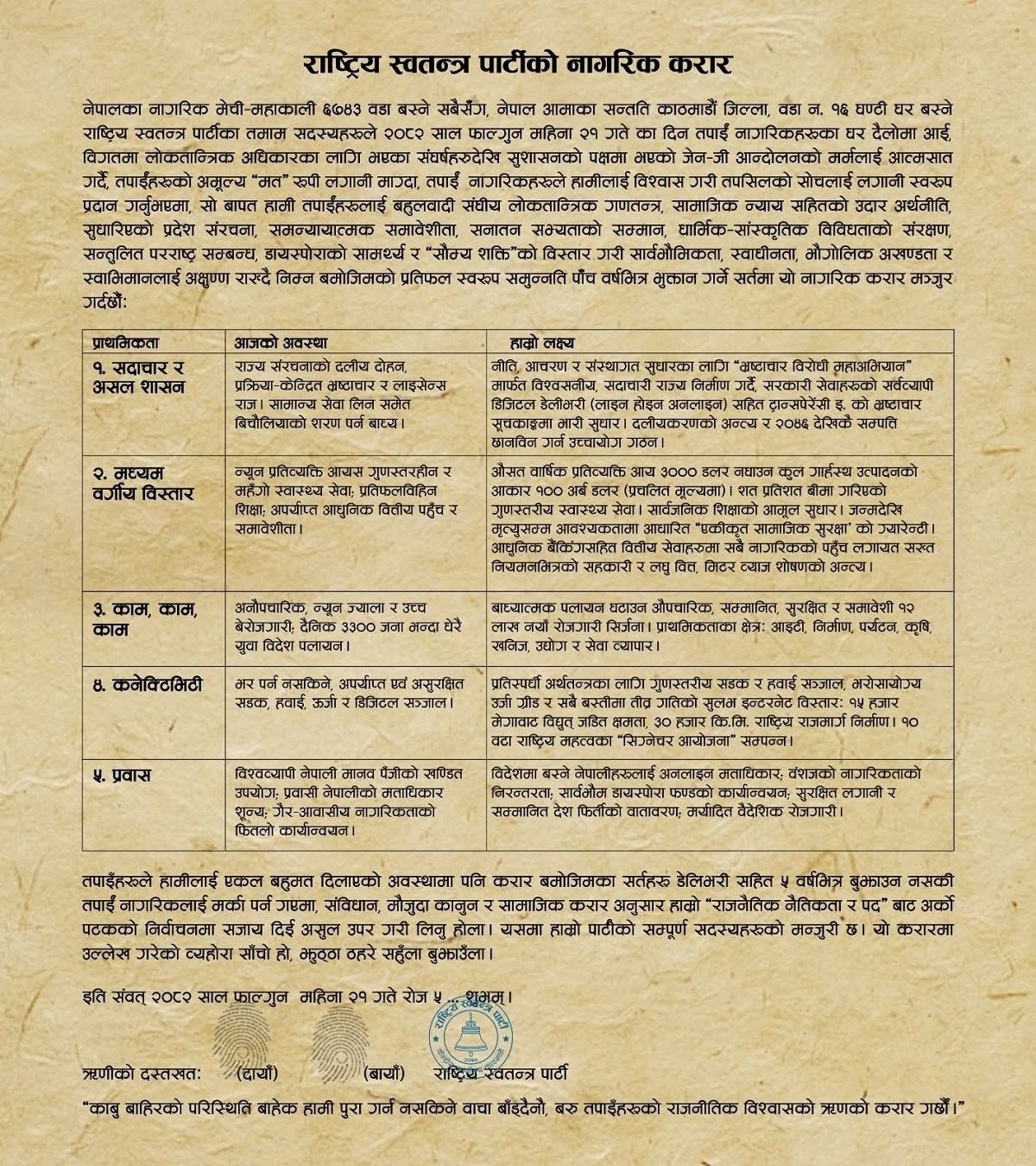
Kathmandu. The Rastriya Swatantra Party (RSP) publicly unveiled its 'Citizen Contract' on Sunday. Ahead of releasing its full manifesto, the party published this contract summarizing its key highlights.
The contract outlines five key points of work to be accomplished within five years if the party secures a majority mandate. These five points cover probity and good governance, middle-class expansion, 'work, work, and work,' connectivity, and the diaspora, detailing the current status and goals for each area.
RSP has pledged to end corruption and investigate the assets of all who have been in power since 2046 BS, increase per capita average income to $3,000 and Gross Domestic Product (GDP) to 100 trillion rupees, guarantee integrated social security, and regulate the exploitation occurring in the name of interest rates.
Ambitious promises are also included in the 'Citizen Contract,' such as creating 1.2 million jobs, generating 15,000 megawatts of hydropower, constructing 20,000 kilometers of national highways, and completing 10 national signature projects. RSP's condition for completing all these projects is to be given a single majority.
Furthermore, the contract details goals related to the diaspora. It states: 'Online voting rights for Nepalis living abroad, continuity of citizenship by descent, implementation of a sovereign diaspora fund, environment for safe investment and dignified repatriation, and dignified foreign employment.'
The most interesting point here concerns the diaspora: 'continuity of citizenship by descent.' Although not detailed, this phrase implies a provision where individuals holding Nepali citizenship by descent would retain their Nepali citizenship even after acquiring foreign citizenship. This is a provision different from what is currently in the Constitution of Nepal.
Most American and European countries have opened this provision, and dual citizenship is open in many countries worldwide. Currently, dual citizenship is open in about 130 countries globally. The US takes Nepalis to America under the Diversity Visa (DV) program, granting them US citizenship, and upon acquiring this citizenship, they are not required to renounce their foreign citizenship.
Underdeveloped and developing nations like Nepal do not envision dual citizenship for the same individual. Asian countries, including China and India, do not have provisions for dual citizenship. India even has a provision requiring a seven-year wait for a woman married into the family to receive naturalized citizenship.
However, since most American and European countries have opened this provision, dual citizenship is open in many countries worldwide. Currently, dual citizenship is open in about 130 countries globally. The US takes Nepalis to America under the Diversity Visa (DV) program, granting them US citizenship, and upon acquiring this citizenship, they are not required to renounce their foreign citizenship.
About 70 countries do not have provisions for dual citizenship. Generally, when dual citizenship is allowed, the individual who acquires citizenship in another country retains their political and administrative rights in that country. Countries often fear that this could compromise their national sovereignty.
Nepali law stipulates that upon acquiring citizenship in another country, Nepali citizenship is automatically revoked. Section 11 of the Citizenship Act, 2063, states that 'If any Nepali citizen voluntarily acquires the citizenship of any foreign country, their Nepali citizenship shall cease to exist.' Furthermore, if such a person returns to reside in Nepal, they can reacquire Nepali citizenship upon submitting proof of renouncing foreign citizenship. These two reasons have prevented Nepalis from obtaining dual citizenship so far.
To resolve this issue, the Non-Resident Nepali Citizenship provision has been introduced. According to this provision, citizens of countries other than SAARC nations who previously held citizenship based on birth or descent can obtain Non-Resident Nepali Citizenship for themselves or up to three generations (children and grandchildren).
Individuals obtaining Non-Resident Citizenship gain the right to reside, own property, and conduct business in Nepal similar to Nepali citizens. However, they are not eligible to vote, stand as candidates in any election, or receive government jobs or appointments.
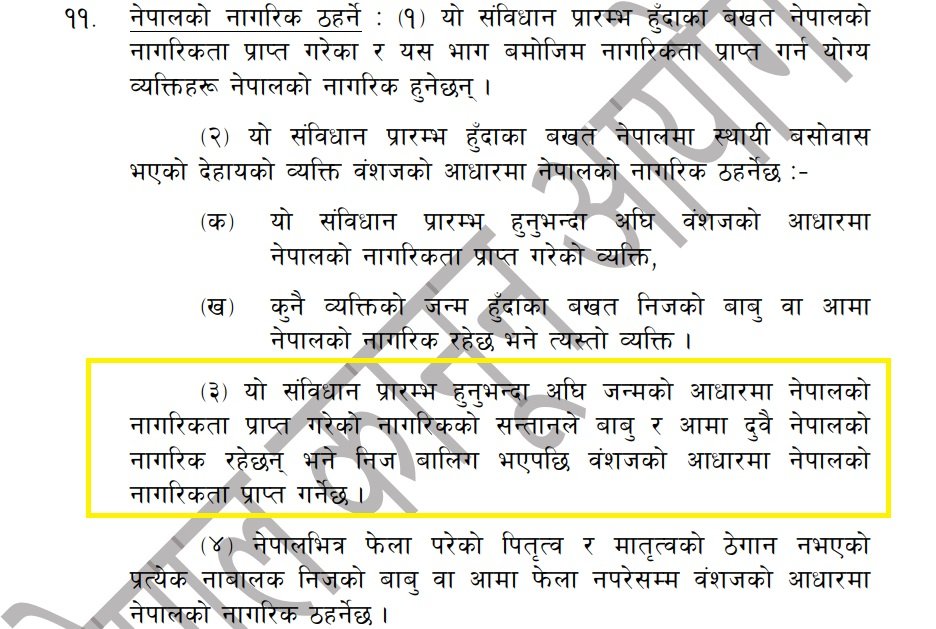
If the provision mentioned in the RSP's 'Citizen Contract'—that the previously acquired citizenship of the diaspora continues—is implemented, all rights currently restricted for Non-Resident Nepalis would be granted. If this happens, the descendants of individuals who acquired foreign citizenship would automatically receive Nepali citizenship by descent. 'The provision for any Nepali citizen's descendants to receive Nepali citizenship by descent is enshrined in Article 11(3) of the current Constitution.'
The Case That Cost Rabi Lamichhane His Parliament Seat and Home Minister Position
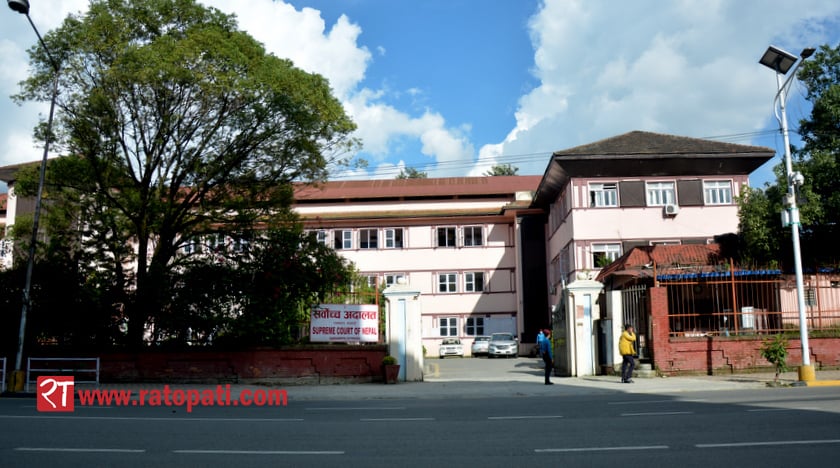
The complaint regarding Rabi Lamichhane's citizenship is still pending at the Attorney General's Office, even if the case has been shelved. Lamichhane, first elected to the House of Representatives in 2079 BS, had to step down as a Member of Parliament and Home Minister due to his citizenship status.
The Supreme Court had ruled that since Nepali citizenship is automatically revoked upon acquiring foreign citizenship according to the Constitution of Nepal, if one renounces foreign citizenship and returns to Nepal, they must reacquire Nepali citizenship. The court's verdict also stated that elections held during the period when Lamichhane had not reacquired citizenship were automatically nullified.
It is rumored that RSP is attempting to resolve Rabi's exact issue through the Citizen Contract, but the 'continuity' provision mentioned in the contract suggests a move towards allowing dual citizenship.
RSP is currently seeking a majority to fulfill the provision mentioned in the contract, which is insufficient on its own for a constitutional amendment. Moreover, given RSP's zero representation in the National Assembly, where one-third of the members change every two years, a constitutional amendment solely desired by this party does not seem possible during this term.
However, RSP has not yet provided a clear explanation on this matter. Party Joint Secretary General Bipin Acharya stated that this contract is merely a highlight and the full details will be elaborated in the manifesto.
'The contract is just a highlight; everything mentioned here will come in detail in the manifesto,' Acharya said. 'We are bringing the manifesto on Falgun 7, and this issue will be clarified in two days.'
Will Citizenship Continuity Be Achieved If RSP Wins?
The Constitution of Nepal does not explicitly state that dual citizenship cannot be granted; rather, this is interpreted in Section 10 of the Citizenship Act.
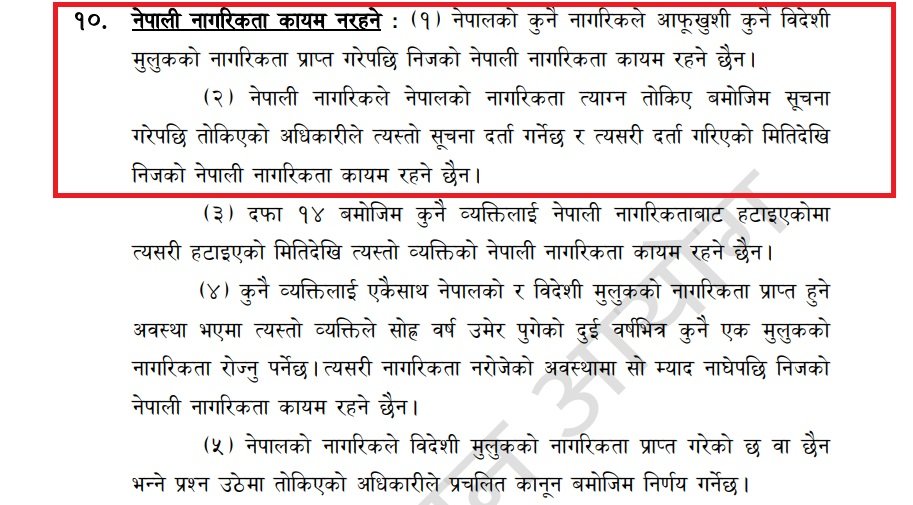
However, the underlying intention suggests that the Constitution implies the citizenship of a person who has acquired foreign citizenship becomes inactive. Article 14 of the Constitution, which deals with 'Non-Resident Nepali Citizenship,' states that a person who previously obtained citizenship based on descent or birth and resides in a country other than a SAARC nation can be granted Non-Resident Nepali Citizenship to enjoy economic, social, and cultural rights.
The provision for Non-Resident Citizenship for those who previously held citizenship, even if not explicitly stated, indicates a situation where obtaining dual citizenship is not possible. Therefore, opening the path for dual citizenship would require amending the Constitution. However, a majority in the House of Representatives is not enough for this; a two-thirds majority in both houses of the Federal Parliament is required.
RSP is currently seeking a majority to fulfill the provision mentioned in the contract, which is insufficient on its own for a constitutional amendment. Moreover, given RSP's zero representation in the National Assembly, where one-third of the members change every two years, a constitutional amendment solely desired by this party does not seem possible during this term.
However, the provision that Nepali citizenship, which was 'automatically revoked' when someone holding Nepali citizenship acquired foreign citizenship (like Rabi's case), can be reactivated upon renouncing foreign citizenship can be achieved by amending the Citizenship Act, although this matter is also unlikely to be without controversy.
In fact, many Nepali citizens currently do not renounce their Nepali citizenship when acquiring foreign citizenship. This is often because countries in Europe and the US do not require proof of renouncing prior citizenship to grant citizenship, so renouncing citizenship does not become a priority for them.
This specific news has been automatically translated by AI. As a result, there may be some inaccuracies or language errors.
_kE6hmvuewe.jpg)