Analysis of Nepal's Political Crises: From Rana Regime to the Current Federal Democratic Republic

It is being analyzed that a major crisis has emerged over the Federal Democratic Republic system, 75 years after the establishment of democracy. The 104-year autocratic Rana regime fell in 2007 BS due to the armed struggle led by the Nepali Congress. However, internal power struggles within the Congress derailed the main agenda of drafting a constitution through the Constituent Assembly. After significant wrangling, the first general election was held in 2015 BS. But within a year and a half, King Mahendra dissolved the House of Representatives and imposed the autocratic Panchayati system under his own leadership.
After a 30-year struggle against the Panchayati system, multi-party democracy was restored in 2046 BS. In 2048 and 2056 BS, Congress formed a majority government, yet failed to run it effectively. A decade-long Maoist armed insurgency took place. Eventually, the seven mainstream political parties and the rebel Maoists united in 2062/63 BS to overthrow the traditional monarchy. Twenty years after the end of the monarchy, the Congress, UML, and Maoist parties, which have been in power, failed to meet public expectations, leading to a 'GenZ movement' on Bhadra 23 and 24 against corruption and mismanagement.
The movement led by the GenZ age group has not only dismantled the executive, legislature, and judiciary but has also brought about a situation where the entire process of state-building needs transformation. The election announced on Falgun 21 by the government led by former Chief Justice Sushila Karki, formed on the strength of the GenZ movement, is being viewed as a 'referendum' between the old and new political parties.
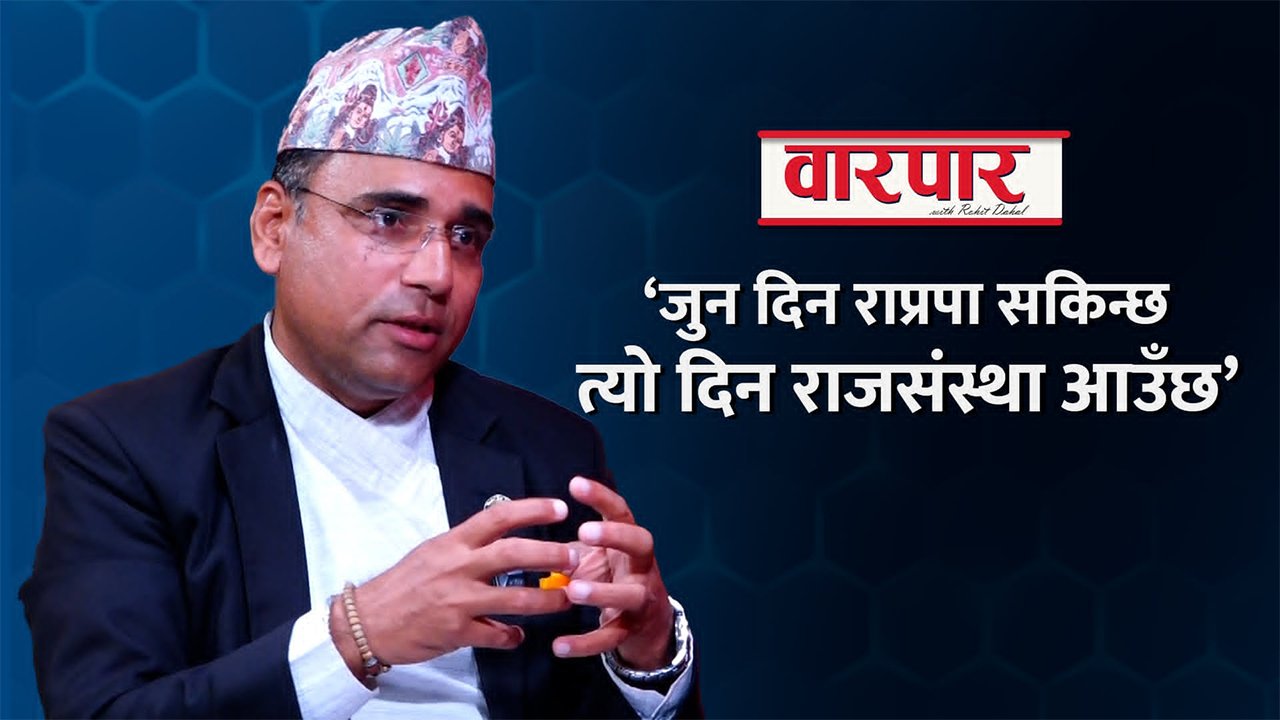
Where did the old political parties, which have been running the state for a long time, go wrong? Where will the country's politics head after the elections in Falgun? On these very issues, Ganesh Pandey, a correspondent for Ratopati, spoke with Professor Krishna Pokharel. Presented below is the edited excerpt of the conversation with Pokharel:
- Why was there a general election only in 2015 BS after the 2007 BS change?
Firstly, the political change from 2007 to 2017 BS aimed at electing a Constituent Assembly and drafting a constitution from it. That process could not be institutionalized. The political parties and leaders of that time failed in institutionalizing what was achieved as a gain. Once they gained power, they became engrossed in the game of power. Their focus shifted from the main agenda to the squabble for power.
King Tribhuvan was not particularly 'crooked'. But Mahendra played along 'intentionally'. He intentionally 'delayed' that process because the Constituent Assembly election would not result in the constitution he desired or one that served the interests of the monarchy. When the pursuit of a Constituent Assembly seemed to risk losing democracy itself, the parties compromised and accepted the constitution given by the King. Therefore, the political parties failed in institutionalizing the gains of the 2007 revolution.
- Did the internal conflict between B.P. and Matrika Koirala also play a role, or did external forces exploit it?
At that time, rather than external forces playing a role, the conflict between B.P. and Matrika was significant. In fact, there were three 'stakeholders' in the 2007 revolution: one, the Nepali Congress; two, the King—who even left the throne and stayed in India believing it would help the revolution; and three, India. Looking at the period from 2007 to 2017, India became dominant at one point. There were even instances of Indians sitting in Nepal's cabinet meetings. At one stage, things moved according to India's interests. The 'power' game was shared among all. By 2015 BS, the Nepali Congress gained the upper hand, and elections were held. The other two actors stepped aside. Initially, there were three actors; at times, the Nepali Congress held sway in politics, and at other times, India did. Ultimately, all the gains were capitalized by the King.
- Was Dr. K.I. Singh's rebellion his own ambition, or was it orchestrated according to a design?
It was not according to a design. At that time, the revolution was against the Rana regime. India had no role when the revolution began. The sequence of events then is 'interesting'. The Indian Socialist Party helped in the 2007 revolution, not the Indian government. But as the revolution began to take shape, the Communist regime was established in China and reached Tibet. Sensing that the situation might slip out of their hands, India became active in brokering a deal. The reason for this was that they had already signed the 1950 'Treaty' with then Prime Minister Mohan Shamsher.
The Indians suggested to the Nepali Congress, 'The Ranas are gradually democratizing; participate in that government.' But what happened was that the revolutionaries moved forward, aided by the Indian Socialist Party. The situation escalated significantly. As the anti-Rana forces advanced, India intervened to broker an 'agreement'. Initially, the agreement was made excluding Congress. But when Congress insisted, 'We will not leave,' the Delhi Compromise was reached in the second round of talks. Whatever happened, happened, and the King's proclamation followed accordingly.
As I mentioned earlier, India had no role in initiating the revolution; its role came in the conclusion. K.I. Singh's rebellion occurred at that point because the situation was arising where a Rana would once again become the Prime Minister. Arms were taken up, a revolution was fought, and yet a Rana was set to become PM! Singh rebelled, feeling the revolution was betrayed. Although the Communists were a small force, they supported Singh's rebellion directly or indirectly, claiming the 'revolution was betrayed' according to their capacity. That is why Singh's rebellion could not be contained. The Indian Army then intervened to bring the situation under control. There was also dissatisfaction among the Royal Guards when they were stationed at Singha Durbar. The Royal Guards were formed by integrating the fighters who had participated in the 2007 revolution. K.I. Singh capitalized on their dissatisfaction and captured Singha Durbar. When he failed, Singh escaped through the back door. The Communist Party was banned, accused of aiding Singh's rebellion.
- Congress failed to institutionalize change despite having single-party governments in 2048 and 2056 BS, didn't it?
It's not that the change wasn't institutionalized after 2046 BS because the lesson of 2007 BS was learned. Because some factions still insisted on going to a Constituent Assembly, led by figures like Madan Bhandari. Others, including components of the Left Front and Congress, argued that going to a Constituent Assembly would cause further delays and unpredictable political outcomes, so they decided to draft a constitution and institutionalize the political change. The constitution was made, thus institutionalizing it! The constitution created a democratic process. This worked to institutionalize the political change from 2017 to 2046 BS.
However, during this institutionalization, two streams emerged. Congress adopted a policy of 'all-out privatization'. This policy has some positives, but many negatives. Many industries were sold for peanuts due to the policy adopted by Congress. But this very privatization brought innovation in the civil aviation sector. A 'wave' of privatization occurred in civil aviation and education, among other areas. Concurrently, when the UML government formed in 2051 BS, it prioritized the issue of 'social justice'. Nepal's politics still revolves around these two streams. Policies like allowances for senior citizens and 'Build Your Own Village' emerged as two policy alternatives after 2046 BS.
But the main issue is that Congress governments were in power most of the time to 'deliver'. They reveled in power and failed in the act of delivery. This failure led to democracy in 2007 and 2046 BS. Dissatisfaction affected Nepali society. But the structure of society remained largely unchanged. The dividends of democracy did not reach the villages. For instance, those who were lackeys of the Ranas in 2007 BS became Congress members after the political change. After 2017 BS, their sons or family members became Panchas. After 2046 BS, they again became Congress members. The feudal power structure in the villages remained intact, and the dividends of democracy could not reach the villages. The enjoyment of democracy, or freedom of expression, remained confined to cities and markets. The cruel 'exploitation' in the villages persisted. Building upon this, the Maoist insurgency occurred. Due to the palace massacre and Gyanendra's wrong policies, the monarchy also collapsed. Change came in 2062/63 BS, and after a long struggle, the constitution was finally formed in 2072 BS. This constitution was also, in a way, a document of compromise among the political powers of that time. It 'settled the rule of the political game,' meaning it established the rules of political engagement. It stipulated how governments would be formed, what policies would be followed, and even enshrined aspirations like being socialist in the constitution.
The notion that 'change was not institutionalized' is a misunderstanding. It was institutionalized in paper form, in the form of institutions. But instead of uniting based on clear political direction and shared ideology—which is what these alliances should be—the political parties again engaged in the squabble for power for momentary political gain. The Communists had a great opportunity in 2074 BS. UML and Maoists formed a government with nearly a two-thirds majority; if they had sustained it, the Nepali Congress would have been forced to form another coalition. Ideologically, there would have been a political force leaning left from the center and another leaning right. This would have put the country's politics on the right track.
Many call Oli-Prachanda shrewd leaders; I call them naive leaders. They missed a golden opportunity that came into their hands, although other parties and leaders involved might also share some blame. But primarily, because the leadership rested with Oli and Prachanda, they failed. This resulted in an unhealthy, unprincipled coalition formed only for the immediate goal of securing the chair in government. The chaos in Nepal's politics is not due to a lack of institutionalization; it exists. But the leadership of the political parties has failed in delivering what the institutions were supposed to provide.
- What will be the result of this in Falgun 21?
They have now reached a point where they must learn a lesson. When they fail to learn from their own actions, they receive a shock. This is called 'shock treatment'. The GenZ rebellion has served as that shock treatment. The election results will deliver the biggest shock treatment. Scenarios not seen before are emerging. Look at how people are following a single leader! After 2064 BS, there was some attraction towards Prachanda in Nepali politics, but not on this scale. The scale on which youth and people of various age groups are following Balen now—people are extremely eager to see a glimpse of him. This might convert into votes tomorrow. If it converts, it cannot be dismissed by saying, 'There is no agenda, no ideology.' If they come to power and govern by saying, 'We will deliver,' then these political parties will receive that shock treatment. Ideologies are not things to be merely recited. Ideology must bring improvement in the living standards of the people in society! The improvement must be reflected in people's lives in practice. If that doesn't happen, ideology is not something to be chanted like a Gayatri mantra; chanting principles alone will not advance the country. The political parties needed treatment, and they will find that treatment in this election. This is because every movement seeks change, but those in power have failed to deliver it. The problem lay in corruption becoming institutionalized. Look at the peak of state exploitation! Selling Nepalis as Bhutanese and taking commissions from it. Policy corruption reached its zenith with cases like Giribandhu, Lalita Niwas, Patanjali, Yeti Holdings, and others.
At this point, there is what is called the 'revolution of rising expectation'; meaning every change brings a revolution of expectation among the people. If that is not fulfilled, it leads to 'revolution of rising frustration'. The GenZ rebellion was an expression of that frustration. The election will determine whether the treatment works.
This specific news has been automatically translated by AI. As a result, there may be some inaccuracies or language errors.