'Dhruve' Elephant Captured and Fitted with Advanced Satellite Collar After Killing Two

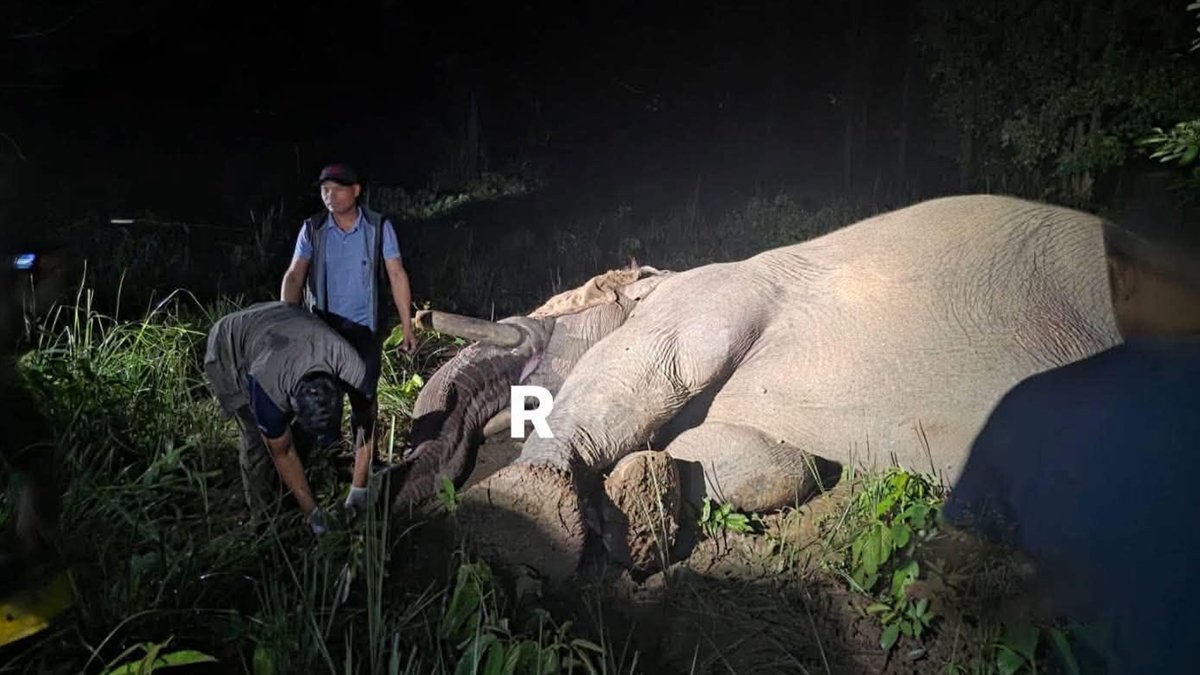
Chitwan. The elephant 'Dhruve', located deep inside the dense forest of Chitwan National Park, has been startling the surrounding human settlements, park administration, and the government and society for a long time. After two local residents lost their lives due to Dhruve's attack on the night of Asar 20, western Chitwan was once again plunged into a whirlpool of fear. Subsequently, as it continued to enter nearby houses, destroy them, and repeatedly intrude into settlements, the terrified and angry locals demanded, 'When will Dhruve's terror end?' Behind the scenes, a team from the park administration, Nepali Army, and the National Trust for Nature Conservation was working towards an invisible goal, disregarding floods, heavy rains, and overgrown bushes in the core area of the park. After ten days of relentless effort, divided into three shifts, the team successfully captured Dhruve in the Sukhbhar area at 10:30 PM on Asar 31. This is not just the story of capturing an elephant; this time it was also a complex 'medical operation' to calm its biological 'rage' and utilize advanced technology. The difficult search inside the forest and Dhruve's biological 'rage' Immediately after the incident on Asar 20, the technical team intensified the search for Dhruve. According to Avinash Thapa Magar, Assistant Conservation Officer and Information Officer of Chitwan National Park, the search was very difficult and challenging due to the rainy season and overgrown bushes. Regarding the success of the campaign and the use of technology, he said, 'Our joint team deployed two teams in three shifts. Just on Wednesday, we successfully darted it in the area 200 meters east of Sukhbhar Post in the core area of the park and fitted a 'satellite collar'. This satellite collar is slightly more advanced than the previous one.' According to Kiranraj Rizal, who has been working as a veterinary technician at the National Trust for Nature Conservation for the past 25 years, capturing this 'great maha-bali' of the forest was technically very challenging. He said, 'It is very difficult for us to identify and capture the elephant. We cannot dart it as soon as we see it in the forest because our dart does not work beyond 25 to 30 meters. It is only possible to dart the elephant after tricking it into coming into the path we have laid.' Stating that the process of tranquilizing and anesthetizing the elephant was done with great caution, Rizal informed that this work was done in two phases. Chief Conservation Officer of the park, Dil Bahadur Purjapurja, regarding the events of the night, said, 'We were continuously working on how to dart Dhruve elephant, how to control and manage it. On the evening of Asar 31, around 7:00 PM, we administered a tranquilizing drug 'Xylazine'. After administering the drug, the elephant was in a state of stupor. Then we administered another anesthetic drug 'General Anesthesia M99', and after it was anesthetized, we started the work from 9:30 PM and successfully fitted the radio collar around 10:30 PM.' Regarding the physical risks and control aspects after administering the medication that night, technician Rizal added, 'We darted it around 7:30 PM, which makes the elephant drowsy and unable to move its legs. After the elephant stood up, at 9:30 PM, we administered the 'M-99' drug for complete anesthesia, and the elephant collapsed within 10 minutes. Since it is a large animal, there is a fear of lung damage due to the stomach pressing on the lungs while falling, but Dhruve fell safely.' Technician Rizal informed that the team completed the work of fitting the collar, trimming the tusks, and administering medication within just 40 minutes, and five minutes after giving additional medication, Dhruve safely got up and headed towards the forest. According to scientific facts, an elephant attacking humans is not just its nature but is also related to its biological and physical hormones. According to Information Officer Thapa Magar, elephants are social animals, but some rogue elephants separated from the herd tend to become aggressive when they are in musth or under the influence of intoxicating substances. When they come to human settlements to eat crops like paddy and millet, encounters or resistance from humans can trigger anger and cause damage. To control this musth hormone, the technical team used a special drug this time. Technician Rizal said, 'This time, we also administered the 'GnRH analogue' drug by darting it to reduce its 'musth' hormone. This will help it return to normal behavior and graze in the forest. The effect of this drug starts after 72 hours and lasts for about a month and a half.' The secret of trimming tusks: 'Geo-fencing' technology and coexistence Technician Rizal informed that Dhruve's tusks were trimmed by six inches this time. Scientific facts state that trimming the tusks does not affect the elephant's physical condition. Information Officer Thapa Magar said, 'Its tusks were trimmed in 2080 BS as well. As they have grown a bit now, we have trimmed only six inches. It is estimated that this will reduce damage to physical structures and also bring some change in its aggressive nature. According to the latest information, Dhruve elephant is seen near Serital.' Technician Rizal clarified the psychological reason behind trimming the tusks, saying, 'After trimming the tusks, the elephant's morale decreases, and our objective is that it should not come to the settlement thinking that it has become weak.' Similarly, the satellite radio collar fitted on Dhruve's neck this time is much more advanced than before. Regarding the features and working style of this new technology, Information Officer Magar said, 'We can determine the interval at which we want to collect data. The shorter the interval, the more battery is consumed. Therefore, a longer interval can be set when it is in the core area and a shorter interval when it comes out. With the 'geo-fencing' technology that draws lines on the map, we receive a message as soon as the elephant crosses that line. This allows us to know much faster if the elephant is about to enter human settlements.' Regarding the role of the new technology in reducing human-wildlife conflict and deploying rescue teams, Chief Conservation Officer Purjapurja said, 'The radio collar fitted on Dhruve sends us information from time to time, at 10-10 minute intervals, and we are monitoring the information sent. Currently, the elephant is seen about one to one and a half kilometers east-north of Sukhbhar. If it enters the buffer zone, we will receive a message. Upon receiving that message, we will inform the locals and also engage in rescue operations and prevent further damage.' Chief Conservation Officer Pun further clarified regarding the locals' anger and the questions raised against the park administration, saying, 'In a way, it was a challenge for us. The local people were saying that the park administration and the army team were not working. But we were working internally. We had seen the elephant many times inside. We needed the dart team and the technical team to find a suitable place to manage it, and we were searching for that suitable place. Yesterday, after it came to Sukhbhar, we were successful in our work.' Officials state that while the park administration is working at its full capacity, the cooperation and awareness of the locals are equally necessary to completely reduce the conflict between humans and wildlife. This is the fourth time a satellite collar has been fitted on Dhruve's neck. The park administration has stated that this elephant has killed 25 people so far, after killing a person for the first time in Mangsir 2066 BS. Chief Conservation Officer Pun informed that previously, information about the geographical location was received at intervals of one hour, but now details of Dhruve's location will be received at short intervals of 15-15 minutes. He expressed confidence that this advanced technology monitoring and biological treatment will significantly help in confining Dhruve within the forest, freeing the people of western Chitwan from tragedy, and establishing safe coexistence between humans and wildlife.
This specific news has been automatically translated by AI. As a result, there may be some inaccuracies or language errors.
_cvUCBlwFTZ.jpg)