Controversy Over Legitimizing Imported Indian Paddy Seeds

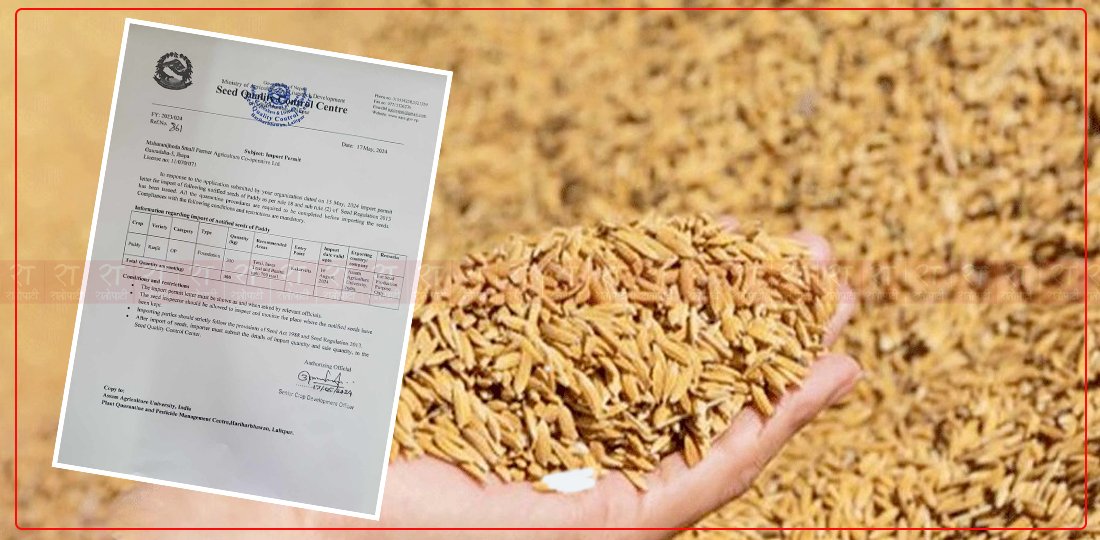
In Viratnagar, a serious issue has emerged regarding the approval of imported Indian paddy seeds. The National Seed Quality Control Centre, which operates under Nepal's Ministry of Agriculture and Livestock Development, gave permission to a small farmers' agricultural cooperative in Jhapa to import a variety of Indian paddy seed called 'Ranjit'. The permission letter, issued on Jeth 4, 2081, instructed the cooperative to import the seeds according to the Seed Rules. However, the letter also stated that all quarantine procedures must be completed before import.
The letter specified that 300 kilograms of Ranjit paddy seed could be imported from Assam Agricultural University in India for 'seed production purposes'. It included conditions such as presenting the import permit to relevant authorities upon request, allowing seed inspectors to monitor the stored seeds, strictly following the Seed Act and Rules, and submitting a detailed report of the imported and sold quantities to the Control Centre.
Sale of Certified Seeds Despite Legal Restrictions
Following this, the National Seed Quality Control Centre in Hariharbhavan, Lalitpur, began authorizing the sale of this seed as 'certified seed' from Jeth 4, 2082. This is controversial because the Seed Rules explicitly prohibit producing more seeds from any imported seed. The legal provision only allows for the import of such seeds as 'improved seed' and does not permit their use for further seed production.
An official from the Koshi Province Ministry of Agriculture explained that according to the law, an imported seed can be called 'improved' but it cannot be labeled as 'certified'. The official alleged that the federal agency has attached a 'certified' tag to the imported Ranjit seed, which is now being sold at a high price. This process has been done without any testing or certification from the provincial laboratory or the Nepal Agricultural Research Council (NARC).
_qjtzoelcco_ar5L5B3ixI.jpg)
Legal Requirements Bypassed and Federal Overreach Alleged
The law requires at least two seasons of testing and evaluation for certification, but provincial officials claim this was not completed before the tag was issued. This raises concerns about negative impacts on Nepal's own seed production, increasing dependence on Indian seeds, and questions about seed quality and safety. Provincial authorities also state that the central bodies acted beyond their jurisdiction by not even informing the provincial government.
Justification from the National Control Centre
The Chief of the National Seed Quality Control Centre, Benu Prasad Prasai, justified the move by citing the 'Seeds Without Borders' agreement. This is an agreement between countries like Nepal, Bangladesh, India, Bhutan, and Sri Lanka based on the concept that 'seed is a technical item, not restricted by political borders.' He stated that the import was done according to this agreement, which allows a country to recognize a seed developed in another country.
Mr. Prasai claimed that 'Ranjit' paddy is not an imported seed but has become popular and is being produced within Nepal, hence it was certified as a local seed. He argued that since 'Ranjit' and 'Sarju 59' varieties are registered as local seeds and not under Schedule C (for imports), they can be certified. This means farmers can now produce seeds from 'Ranjit' paddy for the next year.
Conflict with Provincial Government Actions
This federal action directly conflicts with the Koshi Provincial Government's efforts. The province had fined the same Maharanijhoda cooperative Rs 25,000 for selling what it called 'smuggled seeds' and seeds 'not on the schedule'. Provincial authorities are dissatisfied that the federal centre gave this very cooperative the responsibility to import and produce the seed.
Mr. Prasai countered that the province's action was related to the sale of other, uninformed seeds and not the 'Ranjit' paddy. He clarified that while the province can develop and register local varieties, international trade (import) matters fall outside its jurisdiction.
Expert Opinion and Widespread Use
Paddy expert and former Joint Secretary, Rajendra Uprety, stated that once a seed is listed, it can be imported and sold. He noted that 'Ranjit' paddy already accounts for 65 to 70 percent of the crop in Jhapa, Morang, and Sunsari districts, suggesting that some problems are being created unnecessarily by certain actors.
Allegations of Misconduct and Ongoing Enforcement
In a separate allegation, a source from the provincial agriculture ministry claimed that the National Centre tried to send unrelated people on a trip to Japan on the province's quota, which the province refused. The source alleged that the Centre then sent eight people, taking four individuals of their own choice on the province's quota for a study tour supported by the Japanese agency JICA.
Meanwhile, the Koshi Province Government continues its crackdown. Its Ministry of Industry, Agriculture and Cooperatives has fined 28 cooperatives and institutions in Jhapa, Morang, and Sunsari for illegal seed sales, including the Sunsari District Cooperative Association. Most have paid fines totaling around Rs 1 million so far. However, some firms are avoiding action; one firm did not pay its fine and does not answer phone calls, while another was found to have its shop closed during monitoring.
_bfwjyiujrg_apHR40184x.jpg)