
Government Unveils Mega Strategy to Boost Exports and Control Trade Deficit


Kathmandu. The government has put forward a multi-faceted 'mega strategy' to control the country's growing trade deficit, increase foreign exchange earnings, and make domestic products competitive in the global market.
With the ambitious goal of increasing the share of exports of goods and services in the country's Gross Domestic Product (GDP) to 20 percent within the next 5 years, the government has implemented separate 5-year strategic action plans for the promotion of major exportable goods.
In addition, Prime Minister Balendra (Balen) Shah has increased his initiative in direct consultation with industrialists and businessmen and in resolving problems to increase domestic product exports.
With the clear vision that 'a country cannot be built by exporting people, but only by exporting goods produced by people,' Prime Minister Shah is giving 'on-the-spot' instructions to resolve the problems of plywood, carpet, dog chew (chhurpi), shoe, and ready-made garment industrialists after discussing with them.

- Diplomatic Initiative to Reopen Blocked Carpet Exports
After a special discussion with the chairpersons of four commodity associations (carpet, chhurpi, plywood, and pashmina) at the Prime Minister's Office and Council of Ministers on Friday, Prime Minister Shah directed the removal of immediate obstacles in goods exports.
In the discussion that lasted about an hour and a half, the businessmen informed the Prime Minister about the immediate and long-term problems faced by the industries. According to Balram Gurung, Chairman of the Nepal Carpet Manufacturers and Exporters Association, Nepali carpet exports have come to a halt since July 8, when the United States mandated 'Consumer Product Safety Commission certification'.
'We do not even have a lab to test this certification here, nor is it possible to build one immediately. Due to the lack of a lab, goods going to America have been stopped for the past 15 days,' said Chairman Gurung. 'We have requested the government to facilitate this through a diplomatic note, on which the Prime Minister immediately instructed the Ministry of Foreign Affairs and the concerned bodies.'
Prime Minister Shah has directed the concerned bodies to resolve the problem immediately through diplomatic initiatives after carpet exports to America were halted.
- Hassle of Quarantine for Raw Material Imports
In the discussion, businessmen complained to the Prime Minister that the cumbersome process of the Department of Animal Services has increased costs in the import of raw materials (wool) from China. The department seeks quarantine certificates, citing the possibility of transmitting animal diseases from China, but the meetings to issue certifications are held only three times a month (on the 5th, 15th, and 25th), causing great hardship to industrialists.
'If even one document is missed for any reason, one has to wait 10 days for the next meeting. This has caused problems in the supply of raw materials and significantly increased costs due to warehouse rent, etc.,' said Chairman Gurung.
The businessmen demanded that such meetings be held at least twice a week, to which Prime Minister Shah responded positively and instructed to shorten the process.
- Complaint of Export Subsidy Being Halted for Three Years
Carpet businessmen also seriously drew the Prime Minister's attention to the long-pending export subsidy and impractical tax policies.
The businessmen complained that the government has withheld cash subsidies ranging from 5 to 9 billion rupees, which exporters should have received for the past 3 years. They stated that the government has made it a condition to provide the amount only after 100 percent tax clearance, but this is not commercially practical. They also demanded the reversal of the current government's decision to impose Value Added Tax (VAT) on processes like carpet weaving, dyeing, and washing, which were previously exempt.
For a long-term solution, businessmen have demanded the formation of a 'Carpet and Wool Development Board' as in the past. They suggest that 1 percent of the budget from export earnings should be allocated to this board for spending on international market promotion, research, and skill-based training.
In addition, a plan has been put forward to establish a 'Dedicated Carpet Zone' around Kathmandu and to promote sheep farming in Karnali and Sudurpaschim to become self-reliant on domestic raw materials.
According to Chairman Gurung, the Prime Minister has taken these issues very positively. 'Prime Minister said, bring a proposal specifying where the government or private land is available around Kathmandu, and I will implement it. We are preparing for that,' said Chairman Gurung.
- Plywood Industry in Crisis Due to Export of Raw Materials
Hom Prasad Ghimire, Chairman of the Nepal Plywood Manufacturers Association and Chairman of the Export Committee of the Federation of Nepalese Chambers of Commerce and Industry, drew the Prime Minister's attention on Friday, stating that Nepali industries could face a crisis in the future due to the export of domestic raw materials to India.
'Representatives of the Indian plywood industry have been coming to Nepal, setting up small industries, and taking raw materials from here to India,' said Ghimire. 'This will lead to a situation where plywood industries that produce finished goods in Nepal will face an extreme shortage of raw materials in the future.'
When he demanded that large plywood industries in Nepal should be encouraged, Prime Minister Shah gave 'on-the-spot' instructions to the secretary present at the time to resolve the issues that could be resolved immediately.
Encouraging Export Figures: How Much Was Exported for Which Commodity?
The government has prioritized those goods for promotion and discussion with businessmen, which have been making significant contributions to foreign exchange earnings recently.
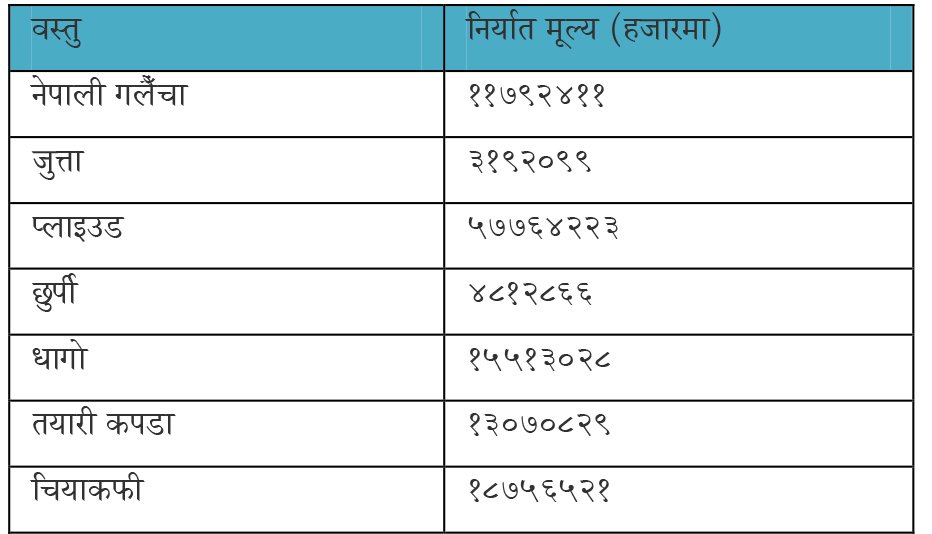
According to the data for the last fiscal year 2082/083 recently published by the Department of Customs, exports of goods such as plywood, yarn, ready-made garments, carpets, and chhurpi from Nepal have shown encouraging results.
Exports in Fiscal Year 2082/083
Source: Department of Customs
- National Action Plan: Target to Reach 20 Percent Export Share within 5 Years
In the fiscal year 2078/079, the share of exports in Gross Domestic Product (GDP) was only 6.3 percent. Concluding that the share of imports in the country's economy is excessively high, the Ministry of Industry, Commerce, and Supplies has updated the 'National Action Plan for Trade Deficit Reduction, 2079' and brought out the First Updated (2083) Action Plan. It sets an ambitious target of increasing the ratio of exports to GDP to 20 percent within the next 5 years.
To achieve this, policies have been adopted to support the 'Make in Nepal' and 'Made in Nepal' campaigns led by the private sector, to replace 30 percent of agricultural and livestock imports within 3 years, and to reduce petroleum imports by increasing the use of electric vehicles and equipment. The government plans to further increase the activity of security agencies at border crossings to control financial crimes such as Hundi transactions, under-invoicing, and cybercrime.
- Separate 5-Year Strategic Action Plan for Carpets and Chhurpi
The government has approved the 'Carpet Export: National Strategic Action Plan (2083-2088)' to bring the carpet industry, which has seen a decline of about 81 percent in volume over the past 25 years, back to its former glory. To reduce dependence on imported Tibetan wool, high-value carpets will be produced using natural raw materials available in Nepal such as Allo, hemp, banana, and bamboo fiber. The plan includes enrolling workers in this sector, which provides employment to 300,000 people, in the social security fund and developing a 'Collective Brand and Trademark for Nepali Carpets'.
Businessmen have drawn the Prime Minister's attention to implement this action plan immediately rather than just keeping it in the drawer.
Similarly, Nepali chhurpi, which was once limited to a goatherd's bag, has now become a favorite food (dog chew) for pet dogs worldwide. The government has launched the 'Chhurpi Export: National Strategic Action Plan (2083-2088)' to further elevate this sector, which exported 4.81 billion rupees last fiscal year.
Its main goals include providing farmers with advanced animal husbandry technology, registering with geographical indication (GI tag), and undertaking diplomatic initiatives to obtain separate HS codes in the international market.
- Assurance of 'No Pressure, No Tension' for Ready-made Garment and Shoe Industrialists
Prime Minister Shah has also held intensive discussions with ready-made garment and shoe industrialists. In the context of exporting approximately 13 billion rupees worth of ready-made garments and 3.5 billion rupees worth of shoes, the Prime Minister has assured the industrialists of working in an environment of 'no pressure, no tension'.
In the discussion, the Prime Minister urged the businessmen to come up with not only problems but also their solutions. The government is preparing to restart the Hetauda Garment Industry, which is currently closed, with new and modern technology. Similarly, in response to the demands of shoe industrialists, the government has pledged to facilitate the control of illegal smuggling and to implement mandatory quality testing on imported shoes.
This specific news has been automatically translated by AI. As a result, there may be some inaccuracies or language errors.

_idatiPhCi3.jpg)



_7iFaN9CSkK.jpg)