Paralympic Athletes Face Dreams and Pains

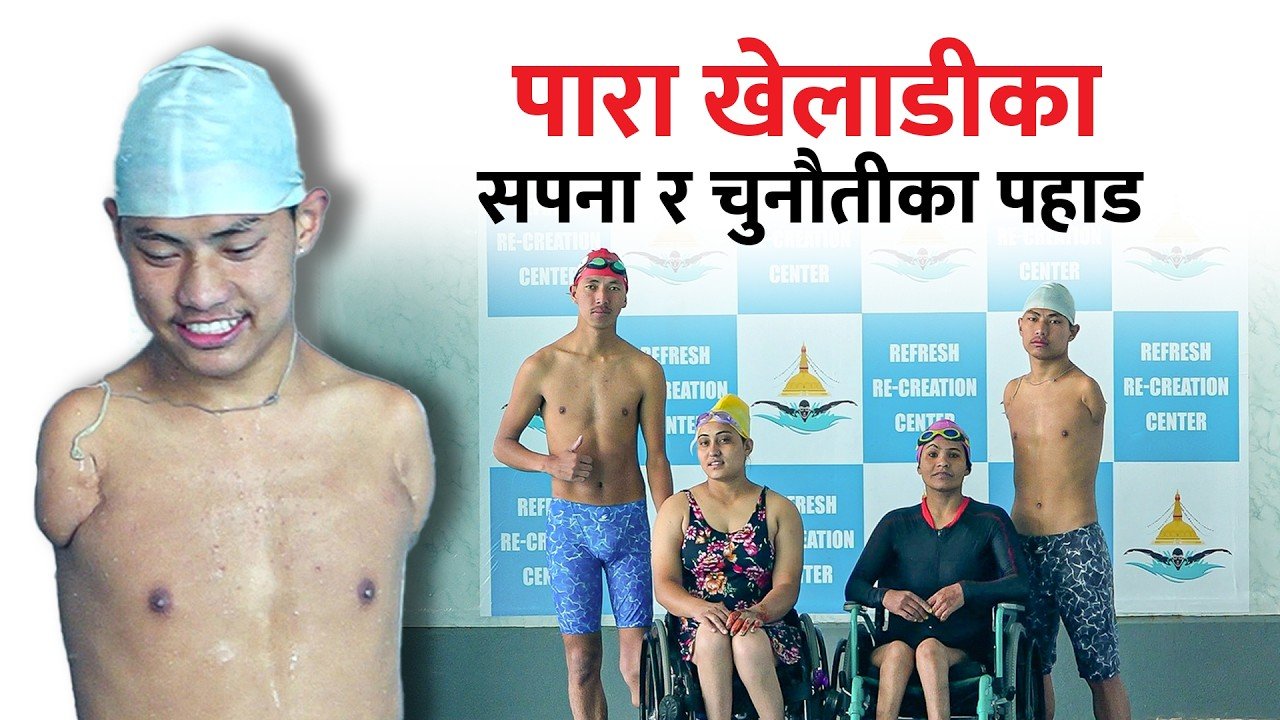
Kathmandu. It is raining outside, the weather is cold. But inside the swimming pool, some young men and women's limbs are constantly moving. They have hot energy inside the cold water, and the eagerness to represent the country and participate in the Para Asian Games.
These athletes, who are physically special, are preparing for the 5th Asian Para Games, i.e., the Para Asian Games. The Para Asian Games are being held in Nagoya, Japan from October 10, where these athletes aim to fly the flag of Nepal.
These athletes, who live with the support of a wheelchair after having a steel rod inserted in their waist due to spinal cord injury, are pursuing their goals without caring for their own health.
The struggle of these athletes is not limited to the blue water of the pool and the playground. To prepare for the sports, they have to fight a big mental and physical battle with the streets of Kathmandu, public transport, and society to reach the training center daily.
Jenisha Kathayat of Kailari, Kailali and Sirjana Sarki of Jumla are training for Para swimming while staying in Kathmandu. Sirjana has been wheelchair-bound for three and a half years due to a spinal cord injury. Jenisha can reach the training center by riding a scooter.
Sirjana's story of hardship in reaching the training center is very painful. 'Today, even people who have boarded a tempo have been made to get off. I felt so insulted that I felt like crying,' she said, 'I felt like returning to my room instead of going to training. But later, after the guru (coach) called and explained, I had to reserve an expensive taxi to come to training.'
Society's pity and negative attitude of seeing people with physical disabilities as 'poor, what can they do?' hurts the athletes more than the physical obstacles on the field. The struggle of para-athletes is many times greater than that of physically fit athletes. Challenges ranging from the hardships faced while traveling in public transport to the narrow-minded view of society stand like mountains before them.
'We are not objects of pity, we want to be the pride of the country. We are not struggling for any organization or individual, but to carry the country's flag with our body and mind,' says Jenisha. When it rains on the streets or the weather is adverse, their struggle increases even more.
Harkaman Gharti Magar of Baglung currently lives in Boudha Nayabasti. Active in swimming for a year, his game level is constantly improving. He recently returned to Nepal after participating in the International Classification held in Fujii, Japan. This classification process is considered mandatory before participating in international competitions in para sports.
Harkaman, who is very determined about sports, says, 'Foreign athletes are also human, I am also human. If they can do well, why can't I? I can definitely do it.' But his confidence is repeatedly mocked by the lack of the country's sports structure and facilities. Para-athletes lack balanced diet, proper physiotherapy, modern gym, and timely availability of sports equipment.
The story of Member Singh Syangbo of Rasuwa is also similar. Member, who lives in Balaju, has returned after completing classification in Japan. 'We play for the country, but the government has never tried to understand our situation. Para-athletes should get equal opportunities and respect like other athletes,' he says.
Shubh Shrestha has been involved in sports training for the last 15 years. For the last 6 months, he has been coaching para swimmers.
'We have to teach para-athletes from zero level. Some have no hands, some have no legs, some have no lower body movement,' Shrestha shares his training experience, 'It is very difficult to balance their bodies when they enter the water. In some cases, we have to get into the water and hold their hands and feet to teach them.'
Despite the challenges, Coach Shrestha is very satisfied with the athletes' hard work. They are training hard for one and a half to two hours daily, six days a week. 'The athletes' timing has improved a lot now. They have worked harder than before. I believe they will bring good results for the country in the Asian Games,' says Shrestha. He says that although there is some hope with the arrival of youth leadership in the Ministry of Sports, a significant change in the perspective towards para-sports has not yet been seen.
Saroj Shrestha, a board member of the Nepal National Paralympic Committee and president of the National Para Swimming Association, says that the state is irresponsible towards para-sports and athletes with disabilities in Nepal. In the upcoming fifth Para Asian Games, 35 athletes from 9 different sports will participate from Nepal. Among them, 4 people, including 2 women and 2 men, will participate in swimming.
While the state has allocated a budget of 11 crore rupees for physically fit athletes, only 3.5 million rupees have been allocated for para-sports. '3.5 million rupees is not even enough to pay for the air tickets of our 35 athletes and the daily $50 accumulation charge for staying in Japan,' says Chairman Shrestha, 'We need helpers to push our athletes' wheelchairs, help them change clothes, and assist with their food and drink. But due to lack of budget, we are not in a position to take helpers. Coaches and officials themselves have to take care of the athletes and carry their wheelchairs.'
There is also a lack of physical infrastructure required for para-athletes to train in Nepal. The government swimming pool in Satdobato is not disabled-friendly. Wheelchair users cannot go there easily. In the history of para-sports in Nepal, recently, a para-taekwondo player won a historic bronze medal at the Paris Paralympics, writing Nepal's name in golden letters on the international stage. This medal has already proven that if given opportunities and investment, para-athletes can bring success of any level to the country.
However, despite such great success, the state has not yet prioritized para-sports. The athletes say, 'We do not want to be humiliated on the streets. We want public vehicles to pick us up with respect when we come for training. The government should arrange disabled-friendly sports grounds and adequate budget for us.'
This specific news has been automatically translated by AI. As a result, there may be some inaccuracies or language errors.




_7iFaN9CSkK.jpg)