Jantar Mantar: From Astronomical Observatory to Protest Site

Kathmandu. In today's time, upon hearing the name 'Jantar Mantar' located in India's capital New Delhi, images of protests, sit-ins, and demonstrations come to people's minds. But, the interesting thing is that centuries ago, this historical site was not built for protests but for counting stars and astronomical research.
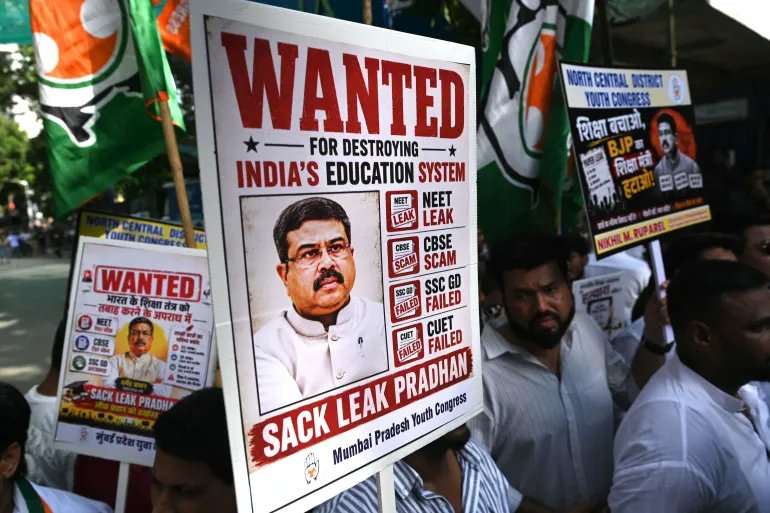
In the last more than 30 years, Jantar Mantar has witnessed many small and large popular movements and protests of the country. But, behind its establishment, a deep scientific and historical thought was hidden.
Interesting History and Architecture of Jantar Mantar
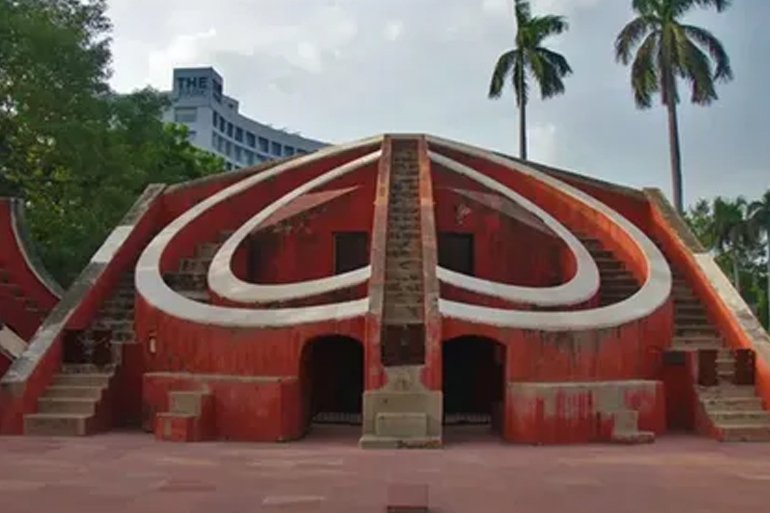
Delhi's Jantar Mantar is neither a tomb nor a temple. It has neither Mughal-style decoration nor the religious symbols of traditional Hindu temples. Painted with red lime and plaster, this monument is made entirely in a geometrical shape. At first glance, it looks like a sample of modern architecture rather than medieval.
Its real purpose was to perform astronomical calculations in the early 18th century. Delhi's Jantar Mantar was the first of the five observatories built by Sawai Jai Singh II, the Rajput ruler of Amer. Later, he also built similar observatories in Jaipur, Ujjain, Varanasi, and Mathura. The construction of Delhi's Jantar Mantar was completed in 1724, which was considered a gift to the then Mughal Emperor Muhammad Shah.
How the name 'Jantar Mantar' came about
According to historians, the name 'Jantar Mantar' is not found in the official documents of the Jaipur state. The word 'Jantra' is consistently used in the documents, which is a Sanskrit word and is related to astronomical instruments. The word 'Jantar' is possibly a colloquial form of 'Jantra' or 'Yantra'. The word 'Mantar' is speculated to have been added to rhyme or influenced by the word 'Mantra'. The first written mention of the name 'Jantar Mantar' for this observatory in Delhi is found in the description of the British Major William Thorne in 1803.
A Dispute That Laid the Foundation of the Observatory
A dispute occurred in the Mughal court in 1719. Hindu and Muslim astrologers could not agree on the most auspicious time for the then Emperor Muhammad Shah to embark on a military campaign. Sawai Jai Singh II, who had a deep interest in astronomy and mathematics, realized that accurate astronomical calculations were not possible with the small instruments used at that time. After that, he sought permission from the emperor to build an observatory.
Jai Singh had prepared a precise list of 1018 stars in his book 'Jij-e-Muhammad Shahi'. In this observatory, along with the giant sundial 'Samrat Yantra' for measuring time, astronomical instruments like 'Ram Yantra' and 'Jaya Prakash Yantra' were built.
The influence of Islamic and European astronomy is also seen in this project. Jai Singh had also sent the Jesuit priest Father Emmanuel de Figueredo to Lisbon to collect European mathematical knowledge and data. However, Jai Singh did not blindly accept European technology. Since telescopes were not easily available to ordinary people, he prioritized calculations based on naked-eye observations.
How did it become a center of science, a stage for protest?
The history of how an astronomical observatory became a major site for protests is even more interesting. Before 1993, 'Boat Club' (near India Gate) was the main center for protests in Delhi.
In 1988, about 5 lakh farmers from Western Uttar Pradesh and their cattle, led by farmer leader Mahendra Singh Tikait, camped on the lawns of Boat Club and India Gate. This movement paralyzed Delhi's daily life, and the then Rajiv Gandhi government was forced to fulfill the farmers' demands.
After this large movement, the government banned demonstrations at Boat Club for security and management reasons. The government needed an alternative location near the Parliament House but one that could be easily controlled. For this, 'Jantar Mantar' seemed suitable. The narrow road and its limited entry and exit points made it easy for the police and administration to control the crowd.
Thus, from 1993 onwards, Jantar Mantar unofficially became Delhi's main protest site. Since then, Jantar Mantar has become the main platform for raising voices for justice in the Nirbhaya case, the Lokpal movement, the farmers' movement, the wrestlers' dharna, and various educational and social issues.
This specific news has been automatically translated by AI. As a result, there may be some inaccuracies or language errors.