Bagmati Province Government Faces Potential Shift as UML Prepares to Withdraw Support


Hetauda. Political parties are actively engaged in changing the power equation of the Bagmati Province government. Following the collapse of the power-sharing agreement between the Nepali Congress and CPN-UML at the central level, efforts to form new governments have begun in the provinces.
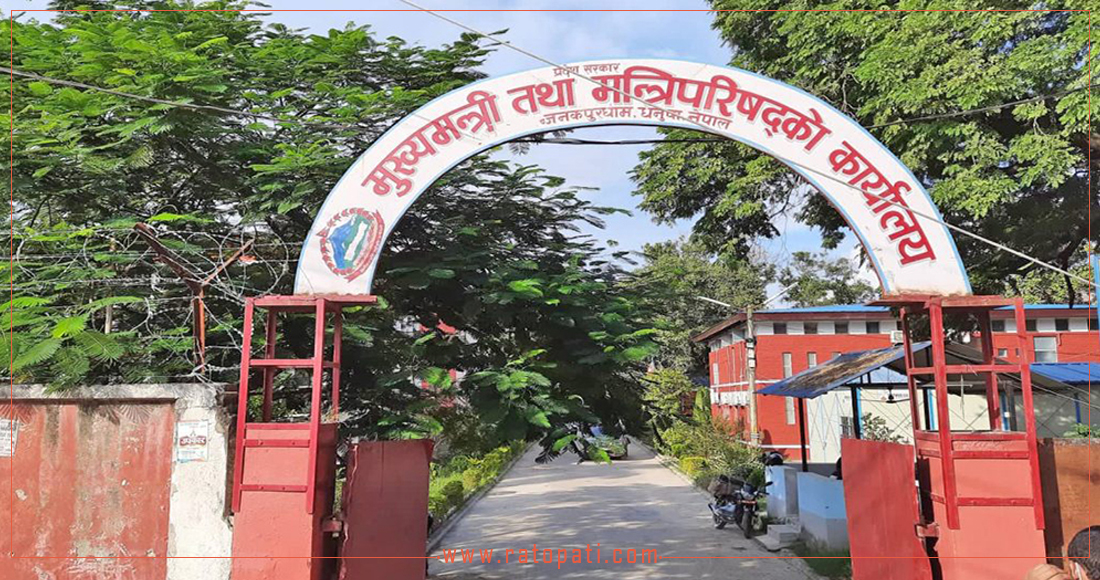
The UML, a coalition partner in the Bagmati Province government, is preparing to exit the government. Although it was said to be strategizing not to leave the government immediately, the UML is set to leave the government on Monday. The UML is preparing to withdraw its support from the government led by Chief Minister Indrabahadur Baniya on Monday.
Jagannath Thapaliya, leader of the UML's Bagmati Province parliamentary party, informed that the decision to leave the government has been made and preparations are underway to withdraw support. According to him, under the direction of the party's top leadership, the six ministers participating in the government have been instructed to submit their resignations and withdraw their support. He stated that the public holidays on Saturday and Sunday caused some delay in submitting the resignations.
In fact, UML ministers had prepared to submit their collective resignation to Chief Minister Baniya on Asar 32. However, that resignation was halted following a directive from the party center. A joint government of the Nepali Congress and UML has been active in Bagmati since Shrawan 2081. The Congress has led the government twice from this alliance, which has been in power for nearly two years. Bahadur Singh Lama initially led the government, and Baniya has been leading it as Chief Minister since August 2082.
In the government led by Chief Minister Baniya, UML representatives include Madhusudan Poudel, Minister of Agriculture and Animal Husbandry; Dr. Dineshchandra Devkota, Minister of Physical Infrastructure Development; Jayaram Thapa, Minister of Labor, Employment, and Transport; Bharat Bahadur KC, Minister of Forest and Environment; Kiran Thapa, Minister of Health; and Bindu Shrestha, Minister of Industry, Commerce, Land, and Administration.
UML Upset After Being Made Minister Without Portfolio
After the resignation was halted, UML ministers went to their respective ministries to assume their responsibilities in the restructured ministries. Following the cabinet meeting on Asar 32, Chief Minister Baniya implemented the decision to reduce the province's 14 ministries to 8.
The decision to reduce ministries, made on Baishakh 22, was mandated to be implemented from Shrawan 1. Consequently, 6 out of the 14 ministers had to be relieved of their responsibilities. By the time the cabinet meeting was held, Chief Minister Baniya had not received any formal decision from either the Congress or the UML regarding the removal of ministers. Finally, on the morning of Shrawan 1 at 10 AM, Chief Minister Baniya allocated responsibilities for the 8 ministries, including himself, 5 Congress ministers, and 3 UML ministers.
He kept the remaining 3 UML ministers and 3 Congress ministers as ministers without portfolio. Chief Minister Baniya explained that the six ministers had to be made without portfolio due to the pending Organizational and Management (O&M) survey. The decision to make ministers without portfolio created two factions within the UML. One faction insisted on leaving the government immediately, while the other advocated for continuing the alliance with their current responsibilities.
Following widespread criticism, the UML concluded that its ministers should not remain without portfolio and ultimately decided to leave the government. However, the UML had been advocating for continuing the alliance as it stood, asserting that there were no rifts within the ruling coalition.
Congress and UML Wooing CPN
With the potential for a shift in the power equation, the Communist Party of Nepal (CPN) has emerged as a decisive force in the formation of the Bagmati government. The Congress, which is currently leading the Bagmati Province government, has initiated discussions with the CPN for collaboration. On the other hand, the UML, which has been claiming leadership of the government for the remainder of the provincial assembly term within the Congress-led alliance, has also engaged in dialogue with the CPN regarding the formation of a new government.
Since the decision of the central leadership of the parties will be final regarding government formation, all parties are currently awaiting directives from the center. However, parties at the provincial level have already begun internal discussions. The UML has sent a message to the CPN about forming a government, proposing a left-wing alliance in Bagmati Province, while the Congress has been advancing discussions based on the peace process and past collaborations.
The Congress is engaged in discussions with the CPN with the strategy of maintaining its leadership of the government, while the UML appears to be making efforts to lead the government under any circumstances. The CPN, meanwhile, has been claiming leadership of the Bagmati government in its discussions with both parties. The CPN has also informed the top leadership of the party about this matter.
Shalikram Jammakattel, former Chief Minister of Bagmati Province and leader of the CPN parliamentary party, stated that informal discussions are ongoing among the parties regarding government formation. He informed that proposals for discussions have come from both the Congress and the UML. As the CPN is the decisive force in Bagmati Province, he stated that forming a coalition government comprising all three major parties (UML, Congress, and CPN) under its own leadership is his top priority.
'The honorable members of the UML have been proposing to advance a left-wing alliance, which I have taken positively. Discussions will proceed according to the party's directives. No concrete directive has been received from the central leadership yet,' he said. 'If the current government is to be changed, we will not support anyone else. As the second-largest party in the provincial assembly, we will take the initiative to form a government under our leadership.'
Cooperation Among Three Forces Necessary in the Current Situation: Leader Thapaliya
Jagannath Thapaliya, leader of the CPN (UML) Bagmati Province parliamentary party, stated that discussions are underway among the major political parties regarding the future of the provincial government and the formation of a new government. He informed that formal and informal discussions are ongoing at various levels among the UML, Nepali Congress, and CPN.
According to Leader Thapaliya, discussions are progressing for cooperation among the UML, Congress, and CPN to address the current national situation, challenges to nationalism, and development. Although cooperation between the UML and CPN, both based on communist ideology, would be easier, he clarified that there is no difficulty in cooperating with the Congress for the sake of protecting democracy and political stability.
'It is necessary for the three major forces to stand together on issues of national and international challenges and nationalism. We have already supported both the Maoists and the Congress for the Chief Minister position in the past. Therefore, it is a natural claim for the UML to form a government under its leadership,' he said. 'Our main focus is on political stability and development. The UML is ready to move forward with anyone depending on the situation.'
Here is the Arithmetic of Government Formation
Out of the 110 elected members in the Bagmati Province Assembly, 6 resigned to contest the recent House of Representatives elections, leaving the provincial assembly with 104 members. The Congress is the largest party in the provincial assembly with 36 seats. Similarly, the CPN has 26 seats, the CPN (UML) has 25 seats, the RPP has 12 seats, the Nepal Majdoor Kisan Party has 3 seats, and the Hamro Nepali Party has 2 seats.
A majority of 53 provincial assembly members is required to form a new government in Bagmati. With the Congress and CPN together, they have 62 lawmakers, securing a clear majority. If this alliance is formed, government formation appears to be quite straightforward.
On the other hand, an alliance between the UML and CPN appears somewhat difficult. With the UML and CPN combined, they only reach 51 lawmakers, which is 2 seats short of a majority. In such a situation, smaller parties would need to be included to form a government, which is somewhat challenging.
For that, the support of the 2 lawmakers from the Hamro Nepali Party would be necessary, but that party's stance does not seem favorable to the UML. On the other hand, the 12 lawmakers from the RPP are also not inclined to join or support the government immediately.
This specific news has been automatically translated by AI. As a result, there may be some inaccuracies or language errors.