New Financial Year Begins with Revised Tax Policies and Monetary Measures

_s4UAz3GPxQ.jpg)
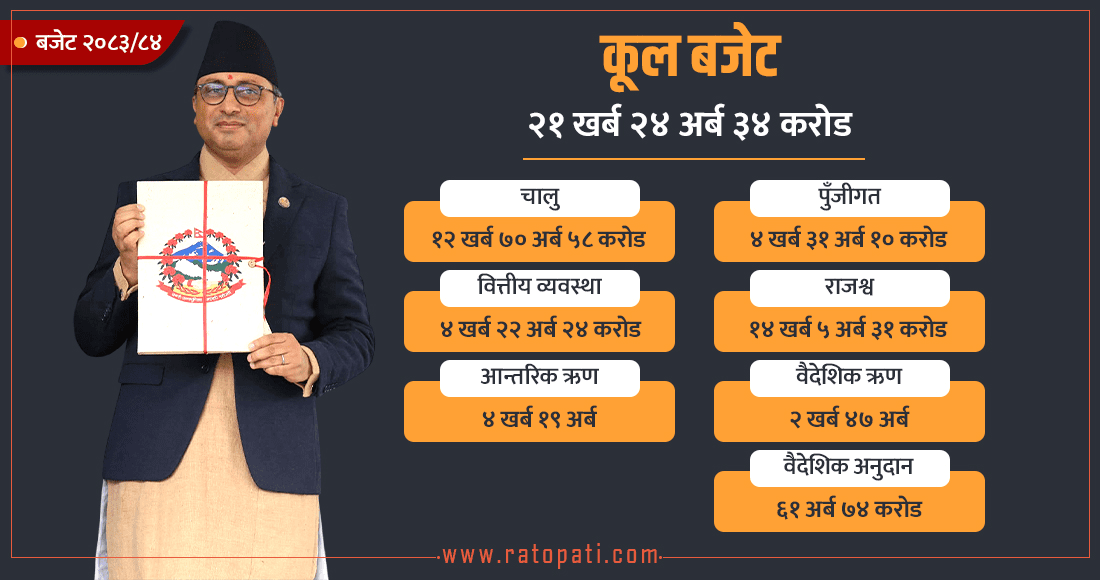
Kathmandu. The new financial year 2083/84 has started from Friday. With the beginning of the new financial year, the budget, policies and programs brought by the government and the monetary policy published by the central bank have come into implementation.
The government has removed some old taxes and provided concessions, while also adding some new tax policies. The government states that various tax policies have been changed with the objective of simplifying the tax system, expanding private sector investment, promoting industries and businesses, and making the banking system more effective.
Compared to the last financial year 2082/83, significant changes have been made in the personal income tax, customs, excise duty, green tax, and electric vehicle (EV) related tax system in the current financial year.
The biggest change has been made in personal income tax. The limit of 1 percent tax on annual income up to 5 lakh rupees has been increased to 10 lakh rupees. Similarly, the maximum personal income tax rate has been reduced from 39 percent to 29 percent.
Now, 1 percent tax will be levied on income up to 10 lakh rupees, 10 percent on income between 10 to 15 lakh rupees, 20 percent on income between 15 to 25 lakh rupees, 27 percent on income between 25 to 40 lakh rupees, and 29 percent on income above 40 lakh rupees. This is expected to provide relief, especially to middle and high-income taxpayers. Also, the government has increased the salary of employees by 21 percent.
New arrangements are also being implemented regarding customs duty. The customs duty, which was previously in 11 tiers, has been reduced to 7 tiers. Additionally, customs duty has been reduced on 273 types of industrial raw materials. The government expects this to reduce the production cost of industries. Significant changes have also been made in the excise duty system. Excise duty will now be levied on 360 items. However, excise duty has been increased on liquor, cigarettes, tobacco products, junk food, juice, and some luxury items. The increased tax has already come into effect.
From the new financial year, an integrated green tax, including infrastructure development tax, road maintenance fee, and other various headings, has been implemented. Similarly, with the objective of promoting agricultural production and commercialization, a provision has also been implemented to provide up to 40 percent incentive grant to farmers investing up to 2 crore rupees.
With the objective of making the capital market modern and competitive, the government has adopted a policy to operate intraday trading, short selling, and derivative trading in phases. The provision where capital gains tax from the sale of shares of listed companies will be the final tax has also come into implementation.
According to the Economic Act, 2083, various new fees have also come into implementation from today. A 3 percent 'Education Equity Fee' on fees charged by private educational institutions and a 3 percent 'Health Equity Fee' on services of private health institutions have come into implementation.
Similarly, a decision to implement a 5 percent Value Added Tax (VAT) on domestic electricity consumption has also come into implementation. Now, families consuming more than 50 units of electricity will have to pay 5 percent VAT. Although the government has stated that it will make alternative arrangements so that the burden does not fall on the final consumer, a clear arrangement in this regard has not been published yet.
Now, a 2 percent 'Luxury Fee' will be levied on five-star or higher hotels and luxury resorts, and imported liquor. The annual royalty paid by mini casinos has been increased from 1 crore 50 lakh rupees to 3 crore rupees. Those buying gold and silver jewelry will also have to pay additional tax. Those buying gold and silver jewelry will have to pay a 0.5 percent 'Skill Promotion Fee'. Additionally, a 5 percent service fee has been added to ride-sharing services (Pathao, Indrive, etc.).
The monetary policy for the financial year 2083/84 published by Nepal Rastra Bank has also come into implementation from Friday. The implementation of the new policies and arrangements by the government and the central bank is expected to increase credit flow. The economy is expected to become dynamic due to the stability in the interest rate corridor in the monetary policy, the provision allowing commercial banks to invest in foreign government bonds, and the facilitation made in the provision of blacklisting due to check bouncing. The monetary policy aims to keep inflation within 5.5 percent, private sector credit expansion at 11 percent, and broad money supply at 14 percent.
This specific news has been automatically translated by AI. As a result, there may be some inaccuracies or language errors.