Farmers Protest Low Prices Amidst High Consumer Costs

Kathmandu. There has been a problem in the Nepali agricultural sector for years: real farmers do not get even the cost price of their produce.
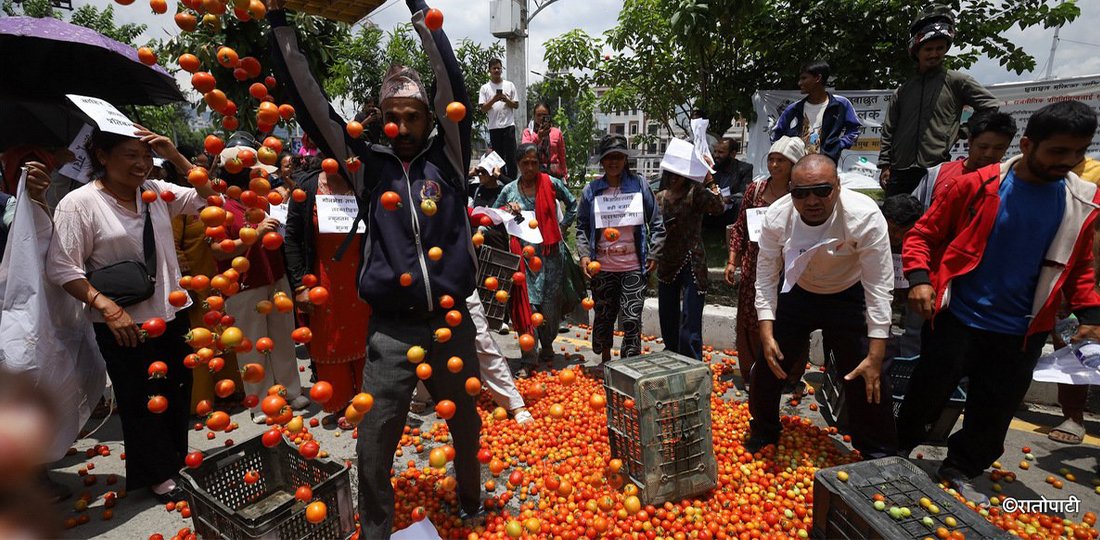
On Wednesday, after a sharp decline in the price of locally produced tomatoes in the Nepali market, farmers in Kathmandu Valley and surrounding areas were forced to take to the streets in protest. Farmers are forced to continue in this profession even when they cannot recover their investment, while consumers in the retail market are also suffering from high prices.
The farmers, who are victims of the unprecedented low wholesale price of Nepali tomatoes in Kalimati Fruits and Vegetables Market, the main center of the Nepali market, have spontaneously taken to the streets in protest. Due to the uncontrolled import of vegetables from the Indian market at cheap prices, domestic production is being displaced, leading to a pathetic situation where Nepali tomatoes rot in the fields and have to be thrown on the streets. Traders are reluctant to buy Nepali tomatoes and offer very low prices even when they do.
According to the daily price list published by the Kalimati Fruits and Vegetables Market Development Committee, the minimum wholesale price of small local tomatoes in the market today has been set at only 8 rupees per kg, while the maximum price is only 12 rupees. Overall, while the average wholesale price of small local tomatoes is only 9.50 rupees per kg, the average price of small tomatoes produced using tunnel technology is 14.60 rupees per kg, and the average price of large Nepali tomatoes is 38.75 rupees per kg. Although consumers have to pay high prices in the retail market, the farmers who directly produce them are not even getting 10 rupees per kg.
According to farmer leader and businessman Shriram Ghimire, who led the protest today, victimized tomato producers from various districts around Kathmandu Valley, including Kakani, have taken to the streets to protect their existence without the banner of any formal institution or committee. He says that real farmers are on the verge of migration as the government's slogan to promote domestic agricultural production and make the country self-reliant in agriculture remains just a slogan.
Vegetable Market in the Labyrinth of Middlemen: Sweat is Cheap, Kitchen is Expensive
The trend of vegetable prices increasing manifold from the field to the consumer's plate highlights a major weakness in the agricultural market. When the supply of vegetables in the market is abundant or production is high, farmers' produce is sold at throwaway prices, but consumers always have to buy at high prices. During winter, due to excessive production, farmers in areas like Kavre, Dhading, and Nuwakot had to hand over local cauliflower to collectors at a low price of only 15 to 20 rupees per kg. However, when these same vegetables reach the market, they become prohibitively expensive for consumers. Local cauliflower, which left the farmer's field for 20 rupees, reached the Kalimati wholesale market for up to 115 rupees in mid-June, while consumers had to buy it in the retail market for 150 to 180 rupees per kg.
_leskHdRQGd.jpg)
According to the Kalimati Vegetable Market, in February, when production was high, farmers who received only 5 to 7 rupees per bunch (15 to 20 rupees per kg) for mustard greens could not even recover the investment in seeds and fertilizers. In stark contrast, by the time it reached the consumer's kitchen, mustard greens cost up to 90 rupees per kg, and in the retail market, 35 to 50 rupees per bunch was charged. Although local carrots produced in Bhaktapur and surrounding areas were sold to traders by farmers for only 25 to 30 rupees per kg in March, they reached 110 rupees in the wholesale market, and the general public had to buy them for more than 130 rupees per kg in the retail market.
Button mushrooms, sold by farmers from their farms for 100 to 120 rupees per kg, reached 280 rupees in the wholesale market and over 300 rupees in retail, while peas, which are usually available at normal prices, reached up to 190 rupees in the wholesale market in May and June, forcing consumers to pay up to 220 rupees in the retail market. Despite good tomato production in the Terai and mid-hill districts, farmers have not been able to get more than 30 to 35 rupees per kg for large Nepali tomatoes. Farmers who faced pressure to clear old stock before the arrival of new potatoes and lack of cold storage sold their white potatoes to intermediaries at a low rate of 20 to 25 rupees per kg.
Uncertainty Shown by 6 Months of Price Fluctuations
According to the Kalimati Fruits and Vegetables Market Development Committee, the price list for the last 6 months, from Magh 2082 to Asar 2083, further confirms this instability. During this period, the price of large (Nepali) tomatoes has seen some decline. The average price of this tomato, which was around 75 rupees per kg at the beginning of Magh 6 months ago, remained around 55 rupees from February to May, and by the end of Asar, it further decreased to about 39 rupees. However, the consumer price still remains high.
The price of local cauliflower, however, saw a huge fluctuation. Cauliflower, which was around 105 rupees per kg at the beginning of Magh, became cheaper in February and March, dropping to 20 rupees, then soared again in May and June, reaching 115 rupees in mid-June, and settled at 50 rupees by the end of the month.
_AWWsNSycsy.jpg)
According to the data for white potatoes, potatoes priced at 28 rupees per kg on Jestha 23rd dropped to 24.7 rupees on Jestha 24th, with the average price remaining stable around 29 rupees throughout Asar. Similarly, the market price of mustard greens has almost doubled in the last 6 months. Mustard greens, which were around 36 rupees per kg in Magh, dropped to 15 rupees in February but became expensive in March and May, reaching up to 90 rupees, and by the end of Asar, its price remained around 73 rupees.
The sharp increase in the prices of peas and mushrooms has further burdened consumers. Peas, which were around 62 rupees per kg in Magh, reached a maximum of 190 rupees by the end of May, and by the end of Asar, their price settled around 130 rupees. Similarly, the price of button mushrooms, which was around 130 rupees per kg at the beginning of Magh, increased in March and May to a high of 280 rupees, which decreased slightly by the end of Asar, trading at around 245 rupees per kg.
The prices of carrots and tubers, regularly used in consumers' kitchens, are also higher compared to 6 months ago. Local carrots, which were in the range of 64 to 74 rupees per kg in Magh, dropped to 25 rupees in February and March, but have been continuously increasing in May and June, stabilizing around 110 rupees.
The price of tubers has also remained stable in the range of 115 to 122 rupees per kg from Magh to March, but increased continuously in May and June, reaching up to 150 rupees in mid-June, and then decreased slightly to 145 rupees by the end of Asar. This price analysis shows that although the prices of some seasonal vegetables have decreased in the wholesale market, consumers have not received the direct benefit in the retail market. Even when farmers receive low prices, consumers have to pay high amounts.
Central Bank Report: Consumer Market Sees Inflation Surge
Not only this vegetable market chaos, but the overall consumer inflation and price rise in the country has nearly doubled this year in June compared to the previous year. According to the report on the current economic and financial situation of the country published by the Nepal Rastra Bank, the annual point-to-point consumer inflation reached 5.22 percent in June, while in the same month last year, such inflation was only 2.72 percent.
According to the Central Bank, the inflation of the food and beverage group was 4.95 percent in June, while the inflation of the non-food and service group reached 5.37 percent. During this period, the price of fruits used in consumers' kitchens increased by 17.40 percent, and ghee and oil increased by 15.10 percent.
Similarly, the price of fish and meat increased by 5.26 percent and vegetables by 4.14 percent, while the price of pulses and legumes decreased by 0.93 percent. Geographically and regionally, the highest inflation was observed in Koshi Province at 5.75 percent, while the lowest was in Sudurpashchim at 4.61 percent. Madhesh and Lumbini have the same 5.62 percent, Gandaki 5.05, Karnali 4.89, and Bagmati 4.79 percent inflation. Regionally, the Terai has the highest inflation at 5.74 percent, while the hills have 5.07 percent, the Kathmandu Valley has 4.98 percent, and the Himalayas have 3.71 percent inflation. Along with consumer inflation, wholesale inflation has also increased significantly.
'As Long As There Is No Farming Calendar, The Problem Will Persist'
The main reason for the abnormal increase in prices from the farm to the consumer's kitchen is the activity of multi-layered middlemen between farmers and consumers. The price escalates as arbitrary profits are added at each point after passing through many levels such as local collectors, transporters, wholesalers, and retailers.
_SErimgt9zw.jpg)
Agricultural market expert Avinash Silwal says that farmers themselves should be aware of the problems they face in the agricultural market every year. He states that when all farmers bring their produce to the market at the same time in the same season, the balance of demand and supply is disrupted, leading to the problem of not getting a fair price. For this, he suggests that farmers should manage their production calendar properly and increase their storage capacity to send produce to the market according to the season.
According to expert Silwal, when farmers grow any vegetable or fruit, instead of insisting on selling only the raw produce, they need to think about value addition or alternative products. 'Instead of plowing cauliflower in the field and destroying it when there is no market, or throwing tomatoes on the street, options like making pickles, Gundruk, Achar, sauce, or other processed items should be considered,' says Silwal.
He argues that instead of waiting for the state to do everything for the farmers, they should develop the habit of farming systematically according to the annual calendar and arranging storage according to their capacity. 'To address the lack of necessary cold storage and warehouses in rural areas, and to end the labyrinth of middlemen, the concept of cooperative markets or farmers' markets that directly connect producers and consumers should be made nationwide, and the government should take concrete legal steps for market regulation,' said Silwal.
This specific news has been automatically translated by AI. As a result, there may be some inaccuracies or language errors.