Bagmati Province Government Faces Challenges in Cabinet Reshuffle Amidst Ministry Reduction

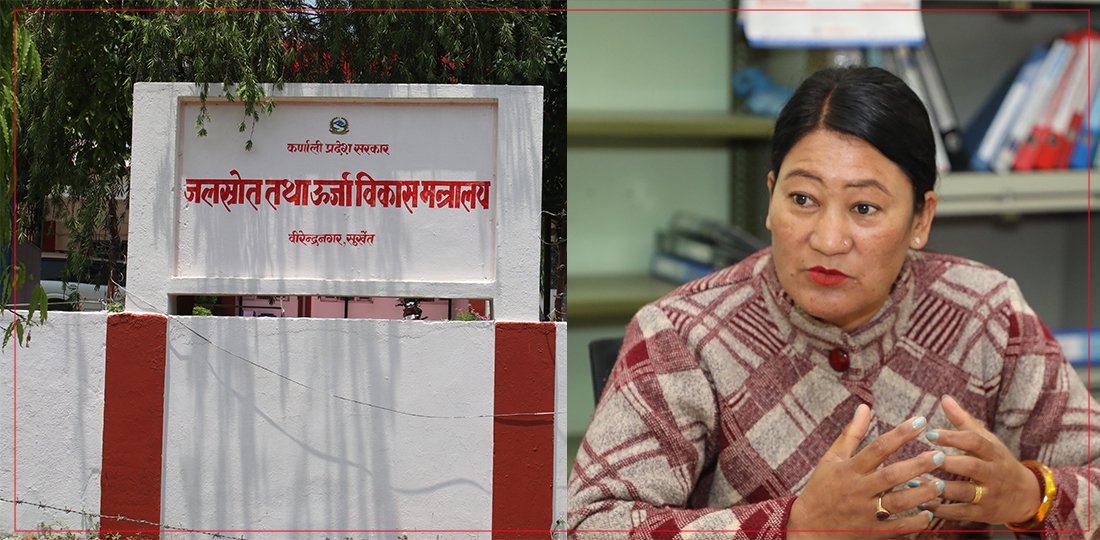
Hetauda. The management of the Bagmati Province government's cabinet appears extremely challenging. Despite the decision to reduce 14 ministries to 8 from July 1st approaching, the government has not been able to reach a concrete conclusion in managing the cabinet.
The issue was not even discussed in the cabinet meeting held on Thursday. According to the decision made by the government, only 8 ministries are to remain in the province from the upcoming July. Amidst this challenge, the provincial government is facing difficulties in cabinet management.
Out of the 14 ministers currently in the province, 6 ministers will have to make way. However, none of the ministers seem ready for this, making it challenging for the government to manage the cabinet.
The provincial government currently has 6 ministers from UML and 8 from Congress. According to the coalition's power-sharing, a decision must be made to recall or remove ministers. While the government is moving forward to establish 8 ministries by July 1st, cabinet management does not seem to be proceeding smoothly. Specifically, Congress will have to recall 3 ministers and UML 3 ministers.
Chief Minister Indra Bahadur Baniyan has already instructed Congress ministers Urmila Nepal (Youth and Sports), Binu Rayamajhi (Cooperative and Poverty Alleviation), and Shivraj Adhikari (Home Affairs and Law) to be ready to step down.
According to one minister, the Chief Minister will decide whether new Congress ministers will join or if current cabinet ministers will be retained. The Chief Minister is consulting and discussing this matter with the party's top leadership. With the aim of balancing power, preparations are being made to recall 3 ministers immediately to resolve this issue. Accordingly, Chief Minister Indra Bahadur Baniyan has given instructions, and the ministers were prepared before the budget, he stated.
The government has merged the Ministry of Cooperative and Poverty Alleviation into the Ministry of Home Affairs and Law, and the Ministry of Youth and Sports into the Ministry of Social Development. Accordingly, Congress plans to recall 3 ministers and assign responsibilities to ministers from the coalition based on their share of ministries.
On the other hand, UML has not taken any preparatory steps so far. UML's strategy is to first resolve the issue of leading the government and then proceed with cabinet reshuffle. Among the currently existing ministries, the Ministry of Forest and Environment has been merged with the Ministry of Agriculture and Livestock Development, while the Ministry of Industry, Commerce, and Supplies and the Ministry of Labor, Employment, and Transport have been merged into the Ministry of Culture, Tourism, and Civil Aviation.
Accordingly, either Madhusudan Poudel (Agriculture and Livestock Development) or Bharat Bahadur KC (Forest and Environment) will have to give up their responsibility, while either Jayaram Thapa (Transport) or Bindu Shrestha (Industry) or Suresh Shrestha (Tourism) from Congress will have to give up their responsibility. Among these, Congress's Shrestha is considered a strong contender, while UML's two ministers do not seem to be in a position to easily relinquish their ministries.
According to the government spokesperson and Minister for Economic Affairs and Planning, Prabhat Tamang, there has been no significant discussion regarding the management of the current ministers. He stated that the respective parties will decide whether to recall or retain the ministers who have taken responsibility for now. He added that the decision regarding government change, leadership, and the cabinet cannot be made solely by the provincial government but will be decided by the party's top leadership.
“There has been no such discussion for now. For the time being, ministers of the merged ministries will step down. The respective parties will manage it,” he said, “As there is no situation of government change, the current government will continue. In this, UML and Congress will distribute ministries. Based on the distribution, ministers will be changed or current ministers will remain. The new cabinet and the continuation of ministers will be decided in coordination with the party's top leadership.”
“Cabinet Matters Will Proceed Only After Government Leadership is Decided”: Leader Thapaliya
Jagannath Thapaliya, leader of the CPN-UML Bagmati Province Parliamentary Party, stated that the process of cabinet expansion and management will proceed only after the issue of government leadership and power-sharing is finalized according to the new political alignment. Leader Thapaliya claimed that a new government will be formed in Bagmati Province within the first week of July based on the agreement between the Nepali Congress and CPN-UML.
He stated that there has been no discussion so far regarding the implementation of the previous decision to reduce the number of ministries to 8 and the management of ministers. He said that the matters of the government and the cabinet will proceed according to the understanding between the two parties. He mentioned that this matter cannot be resolved at the provincial level.
According to leader Thapaliya, the top-level political consensus will be decisive rather than the provincial level. He stated that it would not be appropriate to comment on the continuity or change of ministers as provincial matters will be decided based on the national position.
“First, there will be consultations between the Nepali Congress and UML regarding government leadership and power-sharing. Only then will the matter of the cabinet proceed,” he said, “Whether the number of ministries will be reduced from July 1st or it will take a few more days depends on the agreement. Since the power balance of all six provinces needs to be managed, the understanding between Nepali Congress President Gagan Thapa and UML Chairman KP Oli at the center will guide this matter.”
He mentioned that some ministers may be retained or new faces may come in based on performance and the immediate political needs. Regarding the implementation of decisions made by the previous government, leader Thapaliya stated that the government is an institution with continuous succession and will proceed based on suitability and necessity.
This specific news has been automatically translated by AI. As a result, there may be some inaccuracies or language errors.