
Constitutional Amendment Debate Paper Task Force to Submit Report Without Political Party Consensus

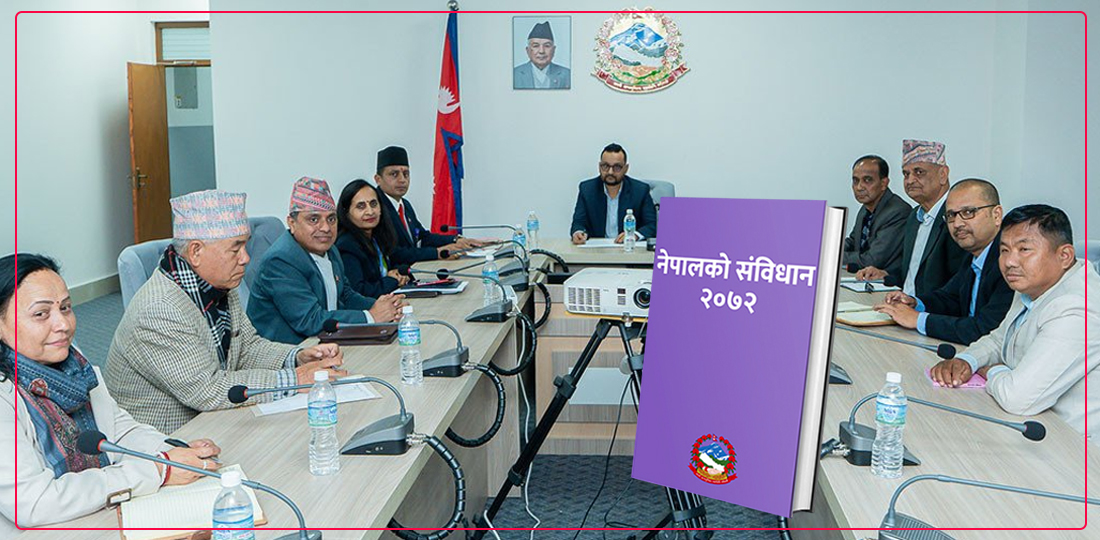
Kathmandu. The 'Constitutional Amendment Debate Paper Preparation Task Force-2082' is preparing to submit its report to the government without the consensus of the political parties that played a role in constitution-making.
The task force was formed on Chaitra 16, under the convenership of Asim Shah, political advisor to Prime Minister Balendra (Balen) Shah. In its first meeting on Chaitra 25, the task force proposed an action plan for suggestions on the form of governance, electoral system, federalism, judiciary, constitutional bodies, and other issues.
The task force collected suggestions by holding discussions with politicians, constitutional experts, legal experts, and various stakeholders involved in constitution-making for three months. Based on these suggestions, the report writing is in the final stage, informed Lilaadhar Subedi, secretary of the task force.
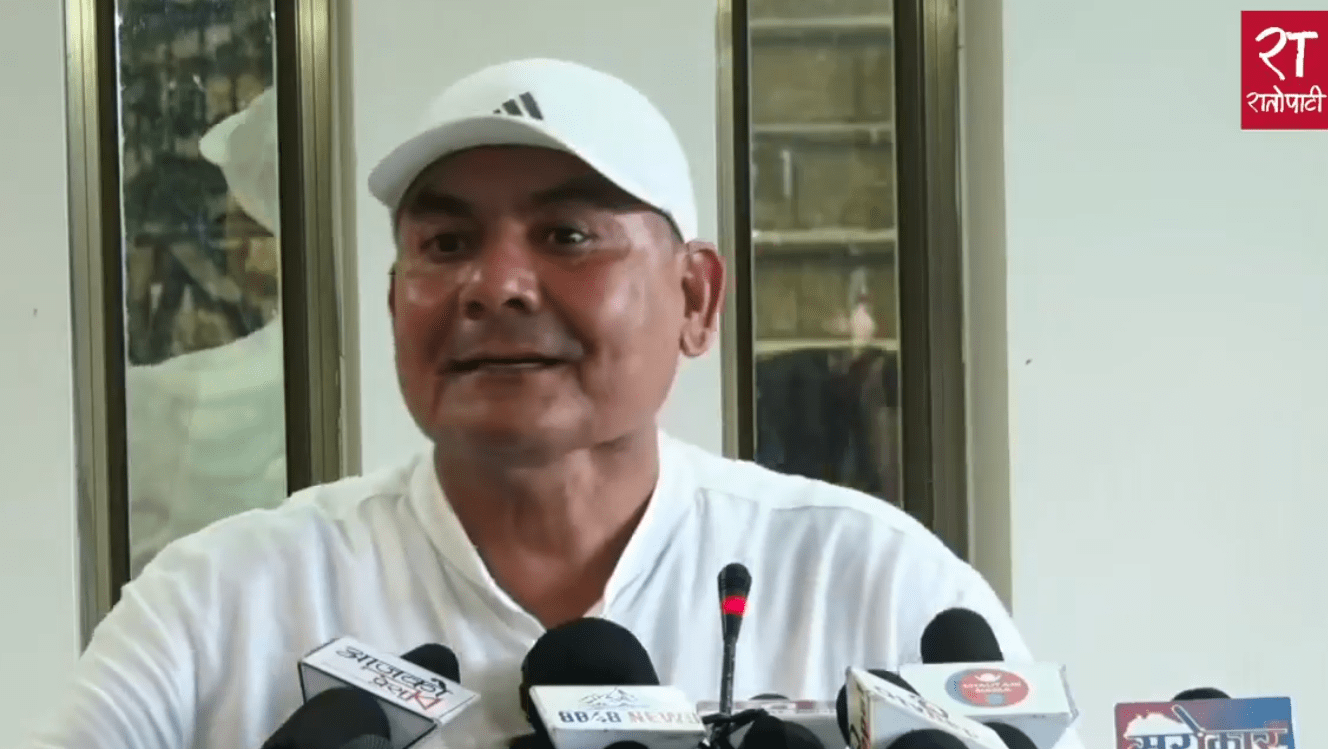
According to Subedi, the report is being prepared to be submitted to Prime Minister Balen by the end of Ashar. 'We have received 44,600 suggestions from the general public. We have prepared the report by taking opinions and suggestions from political parties, constitutional experts, legal experts, those involved in constitution-making, and various stakeholders. Only the proofreading of the report writing remains. We will submit the report to the Prime Minister by the end of Ashar,' Secretary Subedi told Ratopati.
He informed that although some parties have withdrawn from the task force, suggestions have come from some parties. However, he stated that important suggestions from stakeholders will be included in the report and will not be made public at this time.
'Important suggestions have come from the concerned parties on issues related to the constitution, including the form of governance, electoral system, federalism, provinces, judiciary, and constitutional bodies. Since we are preparing to include them in the report, we cannot say anything at the moment,' he said.
In the initial meetings of the task force, Mohanlal Acharya from the ruling party Rastriya Swatantra Party (RSP), Dr. Bhishma Raj Adhikari from CPN (UML), Dev Gurung from CPN, Dhruvalal Rai from Shram Sanskriti Party, Gyanebdra Shahi from Rastriya Prajatantra Party (RPP), Dr. Surendra Jha from Janata Samajwadi Party (JSP) Nepal, Dr. Abhas Labh from Loktantrik Party (LoSapa), and Durga Poudel from Rastriya Janamorcha were present.

The Nepali Congress did not send its representative to the task force. The Congress argued that there was no point in sending a representative from the party until the ruling parties came up with a clear stance on the issue of constitutional amendment.
The Congress had demanded a clear stance from the party on the jurisdiction, scope, and role of the task force in four points. The Congress had formed an expert committee under the convenership of Vice-President Pushpa Bhusal to study constitutional amendment and submit suggestions. Committee member Yadunath Khanal informed that the work of collecting opinions and suggestions for review, ten years after the constitution was made, is underway. Khanal asserted that the task force's relevance was questioned, hence no suggestions were given to the task force.
'It seems the government is trying to rewrite the constitution, not review its shortcomings. We are collecting necessary suggestions for constitutional review,' Khanal said, 'General discussions have been held on issues like the form of governance, electoral system, federalism, and the judiciary. We are also taking opinions from the provinces. We have not yet entered into the subject matter.'
The UML had initially sent its central office secretary Dr. Bhishma Raj Adhikari to the task force to provide suggestions. In a secretariat meeting held in the first week of Jestha, a constitutional amendment suggestion task force was formed under the convenership of Vice-Chairman Bishnu Prasad Paudel. In the first meeting of the task force held on Jestha 31, a subcommittee was formed under the convenership of former Attorney General Agni Prasad Kharel. Ramesh Badal, Mahesh Bartoula, Krishnabhakta Pokharel, Tikaram Bhattarai, Rajendra Ghimire, and Amar Thapa are members of the subcommittee.
Coordinator Paudel is currently under investigation after being arrested by the Department of Money Laundering Investigation. Task force member Krishnabhakta Pokharel stated that the government had appointed an ordinary person as the convenor for a serious issue like the constitution, and therefore, a decision was made not to provide any suggestions.
'A decision was made not to provide suggestions to the task force formed by the government. A constitutional amendment suggestion commission should have been formed under the convenership of a senior justice of the Supreme Court or a senior constitutional expert, but that was not the case,' Pokharel said, 'Since it did not seem appropriate to provide suggestions to the government, we withdrew our representative. The government did not provide a clear mandate for constitutional amendment. We are discussing the strengths and weaknesses of the constitution among ourselves. We have not reached any conclusion yet.'
Meanwhile, the Nepali Communist Party, Loktantrik Samajwadi Party (LoSapa), Janata Samajwadi Party (JSP) Nepal, and Rastriya Janamorcha, who are other important stakeholders in constitution-making, have withdrawn from the task force, stating that the government has not clarified the relevance and validity of the debate paper.
The four parties alleged that the suggestion collection process of the task force appeared to be an attempt to rewrite the constitution by opening up all its articles and sub-articles.
'Looking at the suggestion collection process, it seems like they are trying to rewrite the constitution by opening up all its articles and sub-articles. The plan is to collect those suggestions and take the agreed-upon issues to the amendment process and the remaining issues to public debate as a debate paper. We have strongly objected to this matter. Because in a multi-party system, parties have the freedom to publicize different views,' the statement said.
The parties asserted that the government, which took an oath on this very constitution, does not have the right to open up fundamental issues of the constitution, including the preamble, which the constitution does not envision amending, for debate. The statement said that it would be against the constitution for a government without jurisdiction to prepare a debate paper.
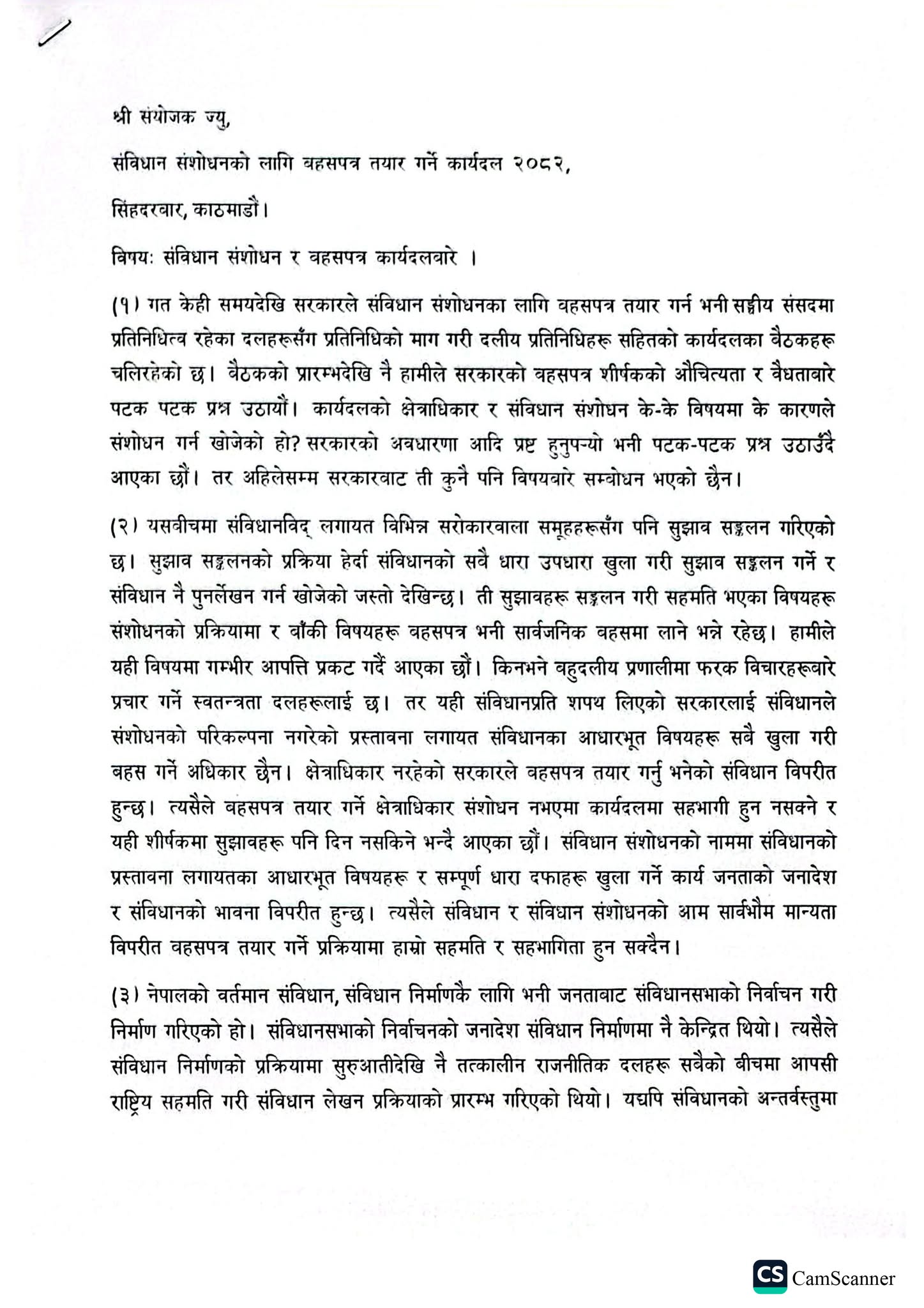
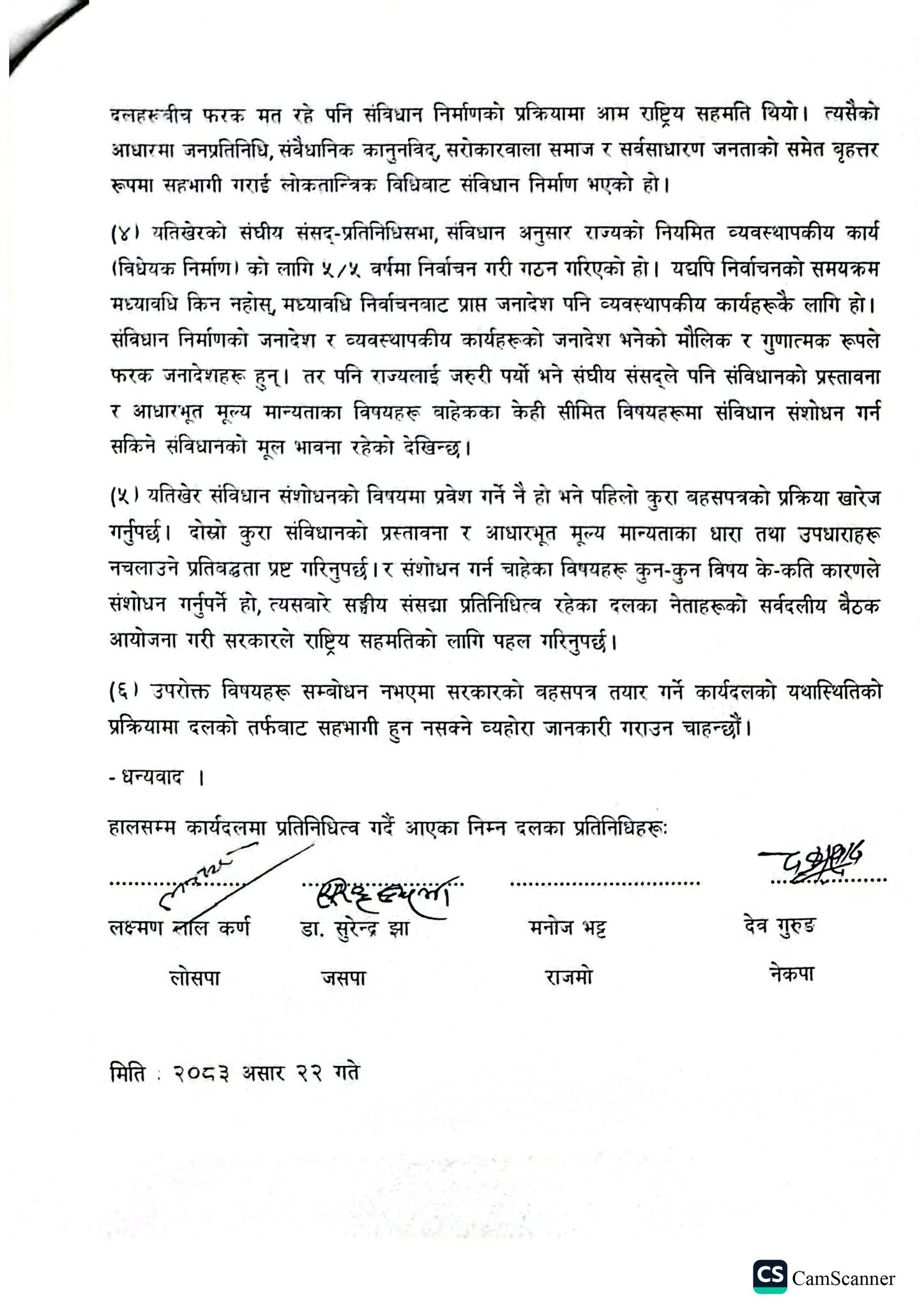
The Nepali Communist Party (CPN) has formed an 11-member task force under the convenership of Dev Gurung for constitutional amendment suggestions. Task force convenor Gurung questioned the relevance of the task force formed by the government. He asserted that they withdrew from the task force because three things were not clear.
According to Gurung, the cabinet's decision to form a task force to prepare a debate paper is against the constitution. He stated that the current government, formed by parties represented in the House of Representatives, does not have the jurisdiction to publicly debate all articles and clauses of the constitution.
'The government, which should stand to protect the constitution, has opened up all articles, clauses, the preamble, and all fundamental pillars of the constitution for debate, which is against the constitution,' he said.
He clarified that the fundamental pillars of the constitution cannot be dismantled. 'The preamble of the constitution cannot be touched. Republic, federalism, secularism, democracy, supremacy of the constitution, independence of the judiciary, separation of powers, rule of law, and other fundamental issues cannot be touched now. These appear to be in an unamendable state,' he said.
Gurung suggested that if the government needs to make amendments, it should clearly convene an all-party meeting and a meeting of parties represented in the parliament.
'If there are minor issues, articles, clauses, or sub-clauses that need to be amended, the process should be initiated with national consensus,' he said, 'Even minor articles and clauses cannot be amended without national consensus.'
Gurung informed that they have given suggestions on these three points to the government. He clarified that it is not possible to work in the task force because the amendment process itself appears to be against the constitution. 'We have told them to correct these issues if they can, and if not, we will not remain in the task force. Since the government is unable to make corrections, all parties except RSP and RPP have withdrawn,' he said.
However, Mohanlal Acharya, representing RSP, asserted that amendments have been made to issues other than the preamble of the constitution, federalism, and Nepal's territorial integrity and sovereign power as provided in Article 274 of the constitution.
'We have not touched the provisions in Article 274 of the constitution. We have not touched the preamble. We have not touched federalism,' Acharya said, 'We have clarified issues in Schedules 5, 6, 7, 8 that were conflicting or overlapping.'
He clarified that they have suggested holding a referendum on the form of governance.
Acharya said, 'Regarding the form of governance, it would be appropriate to recommend holding a referendum on whether to move towards a directly elected executive or if the current parliamentary system is appropriate. We have not discussed monarchy.'

What are the suggestions from CPN?
According to CPN leader Gurung, suggestions have been made to clarify issues in the common and exclusive lists that are conflicting, overlapping, or triply overlapping. He also informed that it would be appropriate to remove the District Coordination Committee, as there are questions about its effectiveness.
'Apart from that, we have suggested some improvements in the structure of the Constitutional Council and the Judicial Council,' he said, 'Especially, it would be appropriate to consider the commissions in Part 27 of the constitution as umbrella commissions. There are suggestions that the number is too large and it is not effective.'
Gurung shared that suggestions have been given regarding reforms in the judicial structure, appointment and qualifications of judges, and the themes of the Supreme Court, High Court, and District Court.
'Regarding the executive, our party's manifesto also includes a directly elected executive. Therefore, we have also provided an option for a directly elected executive. We have given suggestions that can be implemented through a referendum,' he said.
Gurung stated that suggestions have also been made to reduce the number of members of parliament in the provincial and federal parliaments regarding provinces.
'We have not touched the preamble of the constitution or the issue of constitutional amendment. There were many suggestions to make the Speaker of the National Assembly the Vice President, which we also agreed with,' he said.
Gurung said that some parties have also raised questions about whether the debate paper, once prepared, will be presented to the parliament as a bill or if there is another way, and stated that it would be appropriate to clarify this matter.
'If the government needs to make immediate amendments to the constitution, it should bring a bill to the parliament. Discussion on the bill in the house is a separate matter. It will be discussed there, go to committee, and then go to the public. After that, it will be passed,' he said. 'We have recommended taking complex issues like the form of governance and electoral system to debate or as a subject of debate.'
Gurung asserted that all flexible constitutions in the world have survived, and it is not right to say that the constitution made by the Constituent Assembly should not be changed, touched, or debated at all.
'It is not that debate should not happen. We should continue to agree on agreed-upon matters and discuss the remaining matters where there is no agreement. If an agreement is reached on a point tomorrow, it will move forward with consensus. Therefore, we have recommended a referendum,' he said.
He stated that no one can say 'we do not accept' what the referendum decides. He said, 'If the people bring something through rebellion or referendum with a majority tomorrow, can you stop it? The provision for holding a referendum exists in the constitution itself.'
He stated that regarding the form of governance, suggestions have been given that it would be appropriate to hold a referendum on whether to move towards a directly elected executive or if the current parliamentary system is appropriate.
This was the proposal submitted by the task force for constitutional amendment
1. Form of Governance
Is the current system good, or is it fully parliamentary or amended parliamentary?
Directly elected executive President/Prime Minister
Expert as minister/Member of Parliament not as minister
Formation of Council of Ministers and accountability of ministers
2. Electoral System
Directly elected or fully proportional or mixed
Electoral system: How to make it more democratic and inclusive?
NOTA (None of the Above)/'Right to Recall'/Voting rights for citizens living abroad
Reform of the legislative bodies of the federal, provincial, and local levels
Role of the Speaker and Deputy Speaker of the National Assembly
How to manage the coalition culture in elections?
3. Federalism
How to make administrative and financial federalism, including federal, provincial, and local levels, effective?
Regarding Provinces
Number of provinces, structure in provinces
Directly elected Chief Minister and ministers/Number of representatives
How to make provincial ministries and structures lean and efficient?
Provincial Chief and their role/How to perform their duties from within the province in their absence/What happens if a bill is not authenticated?
Regarding Local Levels
Local level with the current party system or local level based on individual competition without parties
How to make local levels accountable?
Reform in judicial committees
4. Judiciary
Reforms needed to make the judiciary independent, impartial, and capable
Appointment, qualifications, tenure, age limit, high moral character, conduct, discipline, or similar issues of the Chief Justice, Supreme Court Justice, High Court Justice, and District Court Judge.
Controlling corruption and irregularities in the judiciary and intermediaries, as raised by various reports from the judiciary itself
Ending political interference in the judiciary and re-appointing judges at all levels
Structural reform of the Judicial Council, presence or absence of the Minister of Law, a legal expert appointed on the recommendation of the Prime Minister, and a representative of the Nepal Bar Association in the Judicial Council
Whether the Chief Justice should be a member of the Constitutional Council
Subject related to competitive appointment of judges and the procedure.
Balancing career development of officers and employees working in the Nepal Judicial Service and the appointment of legal practitioners in judicial appointments.
Subject related to the necessity and justification of the Constitutional Bench.
Subject related to granting more authority to the High Court to reduce the caseload in the Supreme Court.
Other Subjects
5. Constitutional Bodies
Number of constitutional bodies
Number of office bearers
How to make the appointment of office bearers excellent?
How to balance the autonomy and accountability of constitutional bodies?
Justification of impeachment/parliamentary hearing
Implementation of recommendations and reports
Necessity and justification of Provincial Public Service Commission.
6. Other Miscellaneous Subjects
Making parliamentary sessions automatic
Non-resident Nepali citizenship and their rights
Qualifications and age limit of people's representatives/How many terms?
Progressive implementation of Directive Principles of State Policy under Article 54
Reform in the federal management procedure under Article 111(5)
Provisions related to commutation, postponement, alteration, or reduction of punishment
Provisions related to bill authentication
Related to the implementation of fundamental rights
Removal of Attorney General or granting prosecution authority
7. Expert Suggestions
This specific news has been automatically translated by AI. As a result, there may be some inaccuracies or language errors.

_K8Ud1q08iF.jpg)