Mustang Manages Waste Amidst Climate Change Concerns

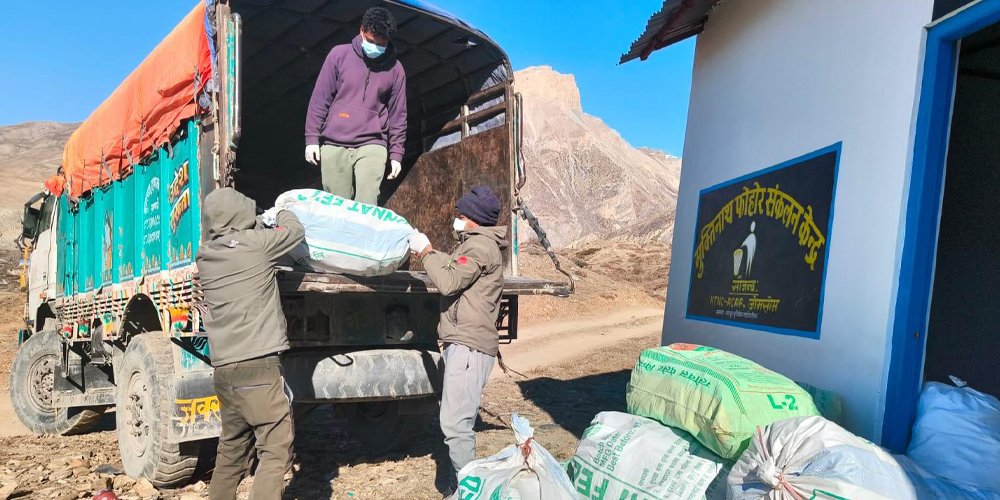
Mustang. To mitigate the effects of climate change, the Annapurna Conservation Area Project (ACAP) Jomsom, under the National Trust for Nature Conservation, has given high priority to waste management. ACAP Jomsom has been managing the waste collected in the Gharpaung, Waragung Mukti Kshetra, and Thasang rural municipalities of the district since last year.
According to ACAP Chief Rajesh Gupta, 22,189 kg of non-biodegradable waste of various types collected in the three rural municipalities of the district from the beginning of fiscal year 2082-83 (Saun) to the end of Asar was transported out of the district for management. ACAP Chief Gupta informed that waste collected in Mustang over the twelve months of the current fiscal year was packed in two thousand 581 sacks and transported to Pokhara.
According to the ACAP Jomsom office, 644 kg in Bhadra, 860 kg in Kartik, 1,556 kg in Mangsir, 1,351 kg in Pusa, 1,888 kg in फागुन, 2,462 kg in Chaitra, 2,230 kg in Baishakh, and 10,659 kg of waste collected six times in Asar were sent to the Green Road Waste Management Pvt. Ltd. processing center in Pokhara.
ACAP had transported 10,190 kg of waste collected in three rural municipalities of Mustang out of the district last year. ACAP Chief Gupta stated that 117.75 percent more waste has been transported out of Mustang in the current year compared to last year.
ACAP has constructed four waste collection center infrastructures in three rural municipalities of Mustang, a religious and tourist district, in the current year. Of these, one waste collection center has been relocated. Last year, ACAP had constructed eight waste collection centers in the tourist areas of Mustang.
Office Chief Rajesh Gupta mentioned that the amount of waste collected is increasing annually in line with the increasing number of tourists arriving in Mustang. Non-biodegradable waste generated by tourists visiting Mustang and locals is sent to the processing center in Pokhara. ACAP Chief Gupta stated that there are partial problems due to the inability to segregate and collect the non-biodegradable waste accumulated in various collection centers here. Although local mother groups, village societies, and conservation area management committees have been collecting waste through monthly clean-up drives, there are problems because tin/cans, glass, and plastic waste are not collected separately, he said.
Two years ago, tourism entrepreneurs and the community in the district used to dispose of the non-biodegradable waste generated here by burying it in pits, but since last year, ACAP office has been bearing the cost of transporting the collected waste out of the district. A policy has been adopted to build more collection centers in the coming years to make the district clean, tidy, and environmentally friendly.
To reduce climate crisis, ACAP has been distributing induction stoves and various equipment to targeted groups in Mustang, and is also working on signposting in various places about the effects of pollution from waste on human health.
This specific news has been automatically translated by AI. As a result, there may be some inaccuracies or language errors.




-purbadhar-bikas_OADnJGgqAk.jpg)