Farmers Earn Millions from Cardamom Cultivation in Ilam

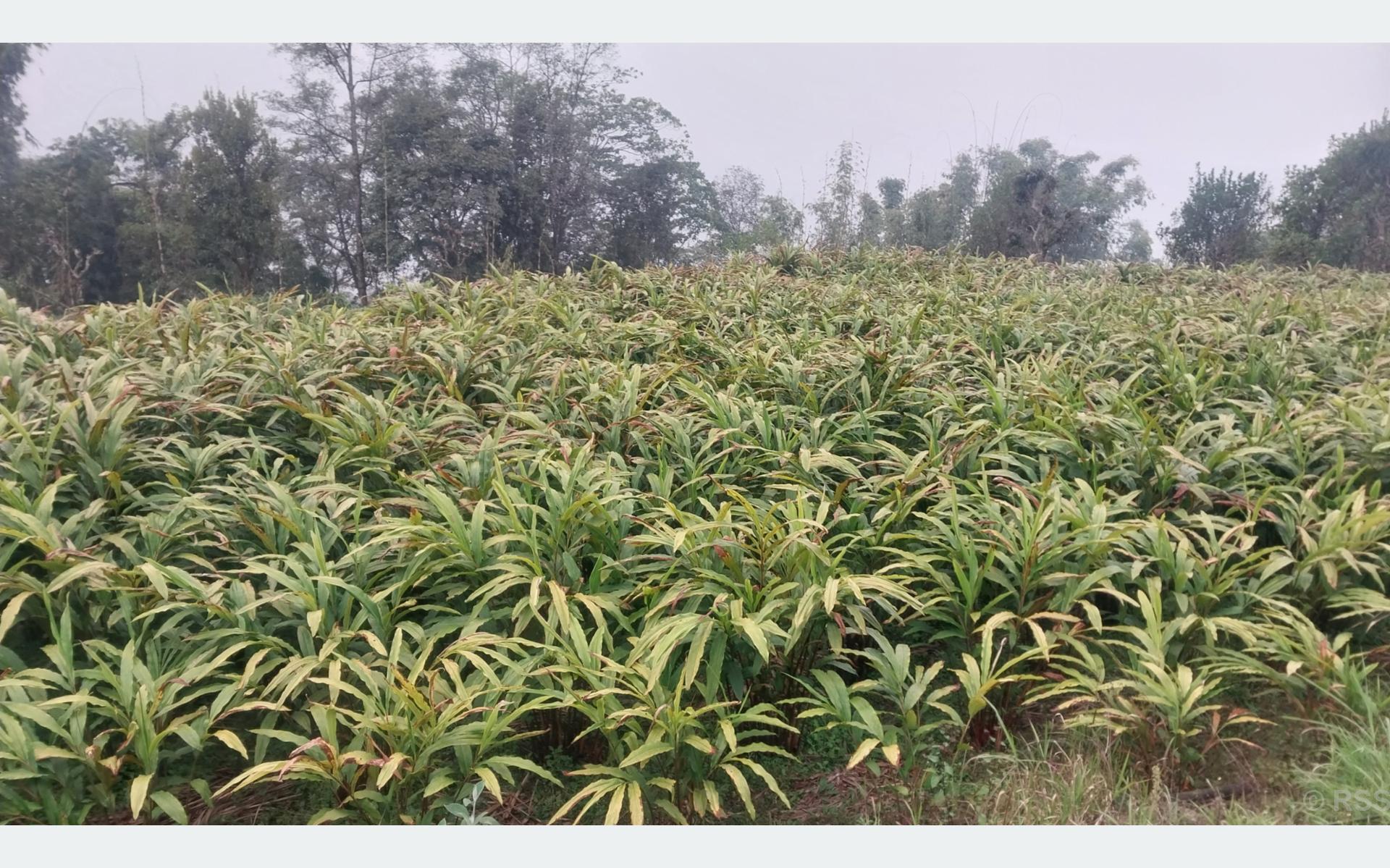
Ilam. Farmer Krishna Budhathoki of Simle, Mangsebung Rural Municipality-3, Ilam, has cultivated cardamom on 23 ropanis of land. He started cultivating cardamom three years ago, expanding his cardamom cultivation by clearing paddy fields. He earns lakhs annually by selling cardamom. This year alone, he earned Rs 1.7 million by selling cardamom. He said that he sold cardamom at the rate of Rs 100,000 per man (40 kg).
"This year, the production of cardamom was good. The price was also good," he said, "I was successful in earning Rs 1.7 million by selling dry cardamom at the rate of Rs 100,000 per man from home." He is cultivating Jirmale variety of cardamom. Having recently engaged in commercial cardamom cultivation, he said that he has stopped going abroad and is engaged in commercial cardamom cultivation due to the good market for cardamom.
Another farmer, Ganesh Limbu of Mangsebung-2, has also earned more than Rs 1.6 million from cardamom sales this year. Limbu, who has been cultivating cardamom for the past five years, has been cultivating cardamom on 25 ropanis of land. "I have been cultivating cardamom by clearing paddy fields for the past five years. This time, the price was also good, so I was successful in earning well," he said, "I am preparing to expand cardamom cultivation on an additional seven ropanis of land this year."
He said that the income from cardamom sales has been managing his daily household expenses as well as his children's education expenses. "This cardamom cultivation supports my family's household expenses and my children's education expenses," he said. He cultivates Ramshahi and Golshahi varieties of cardamom. In recent times, farmers have been attracted to cardamom cultivation as it is disease-resistant and sells at a good price. Cardamom cultivation has started to bring about a change in the living standards of the farmers here. Farmers have been successful in earning substantial income by cultivating cardamom commercially.
With the increase in the price of cardamom, farmers have also increased cardamom cultivation by abandoning paddy and other crops. Farmers' enthusiasm for this type of cultivation has increased because cardamom cultivation is more profitable than other crops. Cardamom, which was previously cultivated only on moist slopes and riverbanks, has recently been planted by farmers in fields and backyards, abandoning other food crops.
Indra Bahadur Limbu, a farmer from Mangsebung-3, Chibua, has the experience that production and income have increased with the modernization of traditional cardamom cultivation. "The price of cardamom, which has been rising since last year, has crossed Rs 100,000, and when the price increases, traders also seem to be scrambling," he said, "There was no problem in selling it either." He said that he earns lakhs annually by selling 15 man of cardamom.
He said that he plans to expand cardamom cultivation after succeeding in earning substantial income from cardamom cultivation. Farmers in various areas of Mangsebung Rural Municipality Wards No. 1, 2, 3, and 6 are cultivating cardamom commercially. The number of farmers cultivating cardamom is increasing in the villages of the hilly region. Cardamom cultivation can be done on barren slopes, land where food crops do not grow well, land with flowing water, high humidity, dampness, shade, slopes, shallow soil, and low-quality land, which is why farmers are attracted to cardamom cultivation. They have abandoned growing food crops in their fields and planted cardamom. Farmers who started with simple cardamom cultivation have now started commercial cardamom cultivation. As production and prices are improving, farmers are becoming increasingly attracted to cardamom cultivation day by day.
Farmers have been attracted to commercial cardamom cultivation as it yields substantial income with less effort and little investment. Due to the lack of manpower to cultivate food crops in the fields and the problem of monkeys eating the cultivated food crops, most farmers have started commercial cardamom cultivation. Farmers have started commercial cardamom cultivation on barren slopes. They are cultivating commercial cardamom by clearing arable land. Farmers here cultivate varieties of cardamom including Samshahi, Golshahi, Jirtle, and Bharlange.
Perennial Evergreen Crop
Cardamom is an evergreen crop. Once planted, it continues to produce for 20 to 25 years. Its plant grows one to two point five meters tall. It has a medium-sized bush. The botanical parts of cardamom are divided into six parts: root, rhizome, leaf, inflorescence, fruit, and seed.
Cardamom cultivation, which is produced on sloped, damp, moist, and shaded land, can be done at an altitude of 600 to 2100 meters above sea level. The suitable temperature for this is considered to be 10 to 30 degrees Celsius in hilly areas. Cardamom is considered good with high humidity. The more rain, the better it is considered. Rainwater is considered better than irrigation. However, water should not be allowed to stagnate at the base. It is commercially cultivated in areas with an average annual rainfall of 2000 to 2500 millimeters. It cannot tolerate strong winds, frost, and snow.
Cardamom is found to be used especially as a spice, herb, and medicine. Experts say that cardamom has many medicinal properties. Experts say that sucking cardamom in the mouth improves the voice and cures diseases like tonsillitis, and drinking boiled cardamom in water like tea is healthy and calms the brain, strengthens the liver and heart, and that consuming powdered cardamom peel with milk or water regularly improves the digestive system and blood circulation and solves all kidney diseases.
No Market Shortage
Cardamom farmers currently have no problem with market and transportation. They can sell easily from home. Traders buy cardamom by visiting homes. Since traders buy from home, farmers do not have the hassle of taking it to the market. Kailashkumar Rai, a farmer from Mangsebung-2, said that with the expansion of transportation facilities, farmers are getting good prices for cardamom.
"There is no problem in selling the cardamom we produce, traders come to our homes," he said, "With the expansion of transportation facilities, it has become easier for us farmers to sell, as well as for traders to buy."
Grant by Rural Municipality
To promote farmers engaged in commercial cardamom cultivation, Mangsebung Rural Municipality has been distributing cardamom saplings at subsidized rates. Farmers have been attracted to expand commercial cardamom cultivation after the rural municipality started distributing saplings at subsidized rates. Pratik Sunuwar, head of the Agriculture Development Branch of Mangsebung Rural Municipality, said that Mangsebung has been distributing cardamom saplings to cardamom farmers at a 50 percent cost-sharing basis with the objective of increasing cardamom production.
Mangsebung has distributed 16,000 cardamom saplings to farmers this year as well. Agriculture Development Branch Chief Sunuwar informed that 14,000 saplings of Ramshahi and Golshahi varieties and 2,000 saplings of Bharlange variety have been distributed. "From Mangsebung Rural Municipality, we have distributed 16,000 cardamom saplings to farmers this year at a 50 percent cost-sharing basis," Sunuwar said, "Based on demand, a farmer has received 1,000 to 4,200 cardamom saplings." He said that some farmers are cultivating cardamom individually, while some farmers are cultivating through cooperatives and farmer groups. The rural municipality had allocated Rs 150,000 for the distribution of cardamom saplings.
Mangsebung Rural Municipality Chairman Hemant Rai said that the rural municipality has brought policies and programs by prioritizing the agriculture sector. "Mangsebung has abundant potential in the agriculture sector, so we have brought policies and programs prioritizing the agriculture sector," said Chairman Rai, "Various programs to encourage farmers are in operation. We will continue these programs in the coming days by making them more effective."
This specific news has been automatically translated by AI. As a result, there may be some inaccuracies or language errors.