Nepal Faces Chemical Fertilizer Shortage Amidst Production Challenges

According to two UN-affiliated bodies, the World Food and Agriculture Organization (FAO) and the World Health Organization (WHO), the world's population currently requires about 18 to 20 trillion calories of food energy daily to be fed. To produce this amount of energy, 14 to 5 million metric tons of food are needed daily.
This means that more than 5 billion tons of food are needed annually. According to FAO data, 10 billion metric tons of food are currently produced worldwide. This includes daily necessities such as grains, fruits, vegetables, and animal products. Only about 30 percent of the produced food is consumed by humans. Of the remainder, about 30 percent is used as animal feed. About 30 percent is wasted during processing, supply, and consumption. The remaining about 10 percent of food is used for biofuel production.
- Situation in South Asia
Asia accounts for about 40 percent of the world's food production. While China accounts for 25 percent of this, only 12 percent of food is produced in South Asia. However, the population of this region is about 25 percent of the world's population. A large number of people here live in food scarcity. According to WHO, about 42 percent of South Asians survive without adequate nutrition. Of these, 20 percent of people get only one meal a day.
- Situation in Nepal
In Nepal, 16 to 8 million metric tons of food are produced annually. This includes 11.5 million tons of grains, about 4.5 million tons of vegetables, 1.5 million tons of fruits, and 450,000 tons of fish and meat. These food items produce an average of 60 billion calories of energy daily. Nepal's population requires 66 billion calories of food energy daily. Thus, according to FAO data, there is a deficit of about 6 billion calories. The deficit in food grains is increasing year by year. According to FAO data published in December 2025, food grain imports will need to increase by 20 percent in 2026 compared to the previous year. According to this data, 900,000 tons of rice, 550,000 tons of maize, and 225,000 tons of wheat will need to be imported in 2026. To provide sufficient food to Nepalis today, agricultural production needs to be increased by 20 percent. Among the essential items for increasing food production, fertilizer and seeds are the most primary elements.
Statistics show that food production in Nepal has increased by more than 50 percent due to the use of chemical fertilizers. In the 1960s/70s, when chemical fertilizers were not used, the food grain production rate was only 2 tons per hectare. At that time, only 6.3 million tons of food were produced. This trend increased to 3.5 tons per hectare by 2023. This resulted in an annual production of 11.5 million tons of food grains. The use of chemicals increased food production by 4.8 million tons. FAO data shows a 77 percent increase in food production during this period.
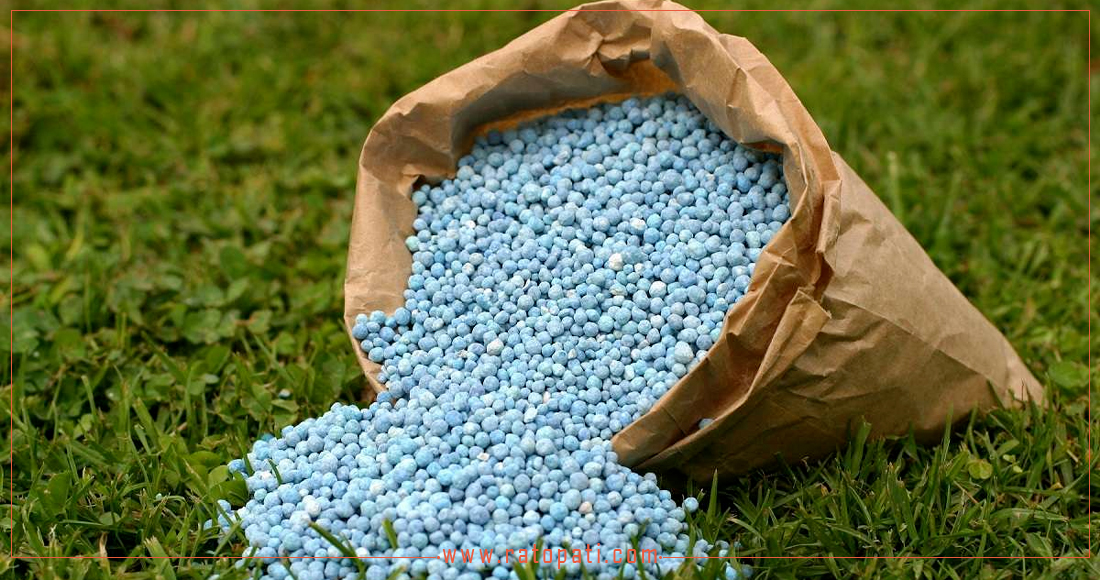
Nepal currently imports chemical fertilizers. Due to long import times and price increases during procurement, farmers cannot be supplied with fertilizer when needed. Due to internal and external obstacles in fertilizer procurement, the government has been trying to establish chemical fertilizer industries in Nepal. Looking at the data for 2024 and 2025, Nepal has spent 200 million US dollars on the purchase of chemical fertilizers. News has also been published that ministry officials have informed the new agriculture minister that about 50 billion rupees will be required for fertilizer.
Although it is said that the amount of budget requested this time can be used to establish an industry in Nepal, it is not as easy as it seems. 'Nitrogen' or 'Urea' is the most important among chemical fertilizers. It provides the main nutrients required by plants. According to basic scientific principles, ammonia is required for urea production. Hydrogen gas is required for ammonia production. Hydrogen can be produced in various ways. Hydrogen can be obtained through biogas combustion, electrolysis of water, and coal combustion. In today's situation, it is almost impossible to think about alternatives to gas and coal in Nepal.
Producing hydrogen by electrolyzing water seems like a suitable process for Nepal. However, 55 kilowatts of hydropower are required per hour to produce one kilogram of hydrogen. Scientific fact states that 10 kg of urea can be produced from 1 kg of hydrogen. In this sense, 50,000 tons of hydrogen are required to produce the 500,000 tons of urea currently needed in Nepal. This requires 2.5 million kilowatts of electricity per hour. This option is also not feasible for Nepal in the immediate future. In all these circumstances, the question arises: Is it ever possible to produce fertilizer in Nepal?
Certainly, it is possible. There is also an easy solution.
That solution is to extract hydrogen from domestic waste and produce urea from it. Waste found in cities contains organic residue and plastic. Scientific facts state that it can be converted into 'syngas' by heating it to 1000 to 1500 degrees Celsius with limited access to oxygen. Hydrogen can be produced from syngas. This process is called 'gasification'. However, this process is not simple.
Numerous research articles have been published on this topic worldwide. The latest research article was published in the March issue of the Science Direct journal (2026). According to research by professors in China, hydrogen production using this technology has started in Hubei Province, China. They estimate that more than 350,000 tons of hydrogen will be produced from this project by 2035.
Similarly, Hyundai Motor Company in South Korea is working with a target of producing 30,000 tons of hydrogen per year.
According to the US Environmental Protection Agency (EPA), 117 gasification plants are currently in operation worldwide. Of these, 36 percent produce fuel, 19 percent produce electricity, and 43 percent produce other chemicals, according to EPA data. Similarly, pilot projects have also been initiated in Europe. According to researchers, 35 to 50 kg of waste is required to produce 1 kg of hydrogen.
- Kathmandu's Waste
Statistics show that more than 1200 tons of waste are generated daily in 18 local bodies of the Kathmandu Valley. At least 20 tons of hydrogen can be produced daily from this waste. 200 tons of urea can be produced daily from this amount of hydrogen.
Some Western companies are also interested in investing through Foreign Direct Investment (FDI) to produce hydrogen from waste. They are willing to invest 90 percent of the total budget. They want the remaining 10 percent to be invested by local partners. They want to work in third-world countries. They believe this will help clean the environment and generate income. Comparatively, the problem of waste is more acute in third-world countries. High-tech professionals of Nepali origin living in America are trying to bring such companies into Nepal.
According to Nepalis in America, investors want the Nepal government to ensure the security of the industry. They are more concerned after the riots that broke out in Nepal last year. If the government ensures the security of the industry and creates an environment conducive to investment, investors are willing to provide 10 percent of the profits to the Nepal government. It is estimated that at least 50 tons of waste are required daily to operate such an industry. Establishing an industry to process a thousand tons of waste requires about 65 million US dollars. Investors say that if 10 percent, or 6.5 million dollars, is invested by local partners, they will invest the rest. In other words, about 1 billion Nepali rupees of investment is required from the people of Nepal.
There is also a simple solution to raise the source of 1 billion. According to the National Census 2078, there are more than 437,000 houses in the Kathmandu Valley. Currently, about 400 rupees per household are collected monthly for waste collection. In simple calculation, about 175 million is collected monthly. Collecting one year's payment in advance yields more than 2 billion.
This is how the industry will run. For the operation of such an industry, one hectare of land is sufficient. The government does not need to look at the land of the disadvantaged people in another district to find one hectare of land. Nepalis in America say that waste collection and transportation will be managed systematically.
This will permanently solve the problem of waste and also the problem of chemical fertilizers. The general public who produce waste, schools, markets like Kalimati, hospitals, and other public organizations will also become owners of the industry. They can be given share ownership in the 10 percent investment required from local partners. If that happens, the government will not have to invest a single rupee.
If other local bodies in the country can learn from Kathmandu's experience, the days of relying on the federal government for chemical fertilizers will end. In the current political situation and the atmosphere of public expectation, if the government shows willingness, a fertilizer factory can be established immediately.
(The author is a Postdoctoral Researcher on 'Farmer's Learning Capacity'. He can be contacted at [email protected].)
This specific news has been automatically translated by AI. As a result, there may be some inaccuracies or language errors.