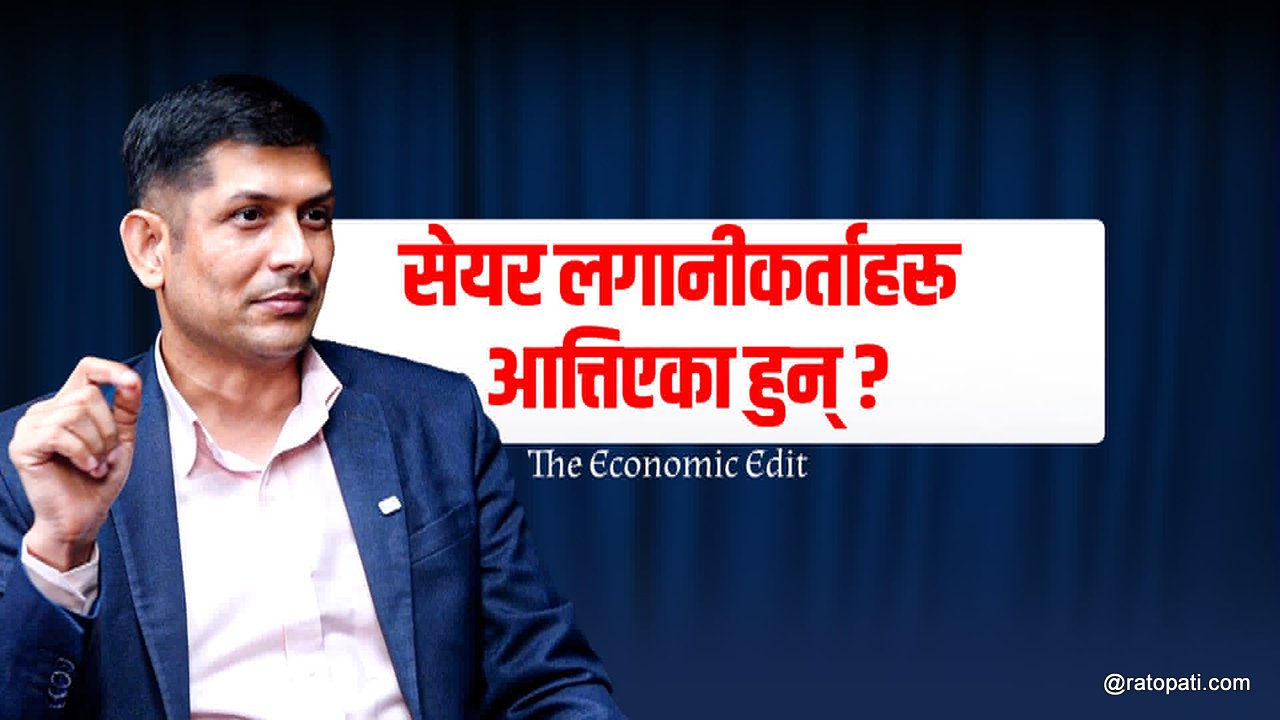
Share Market Expert Dev Guragain Discusses Nepal's Stock Market in 'Economic Edit'
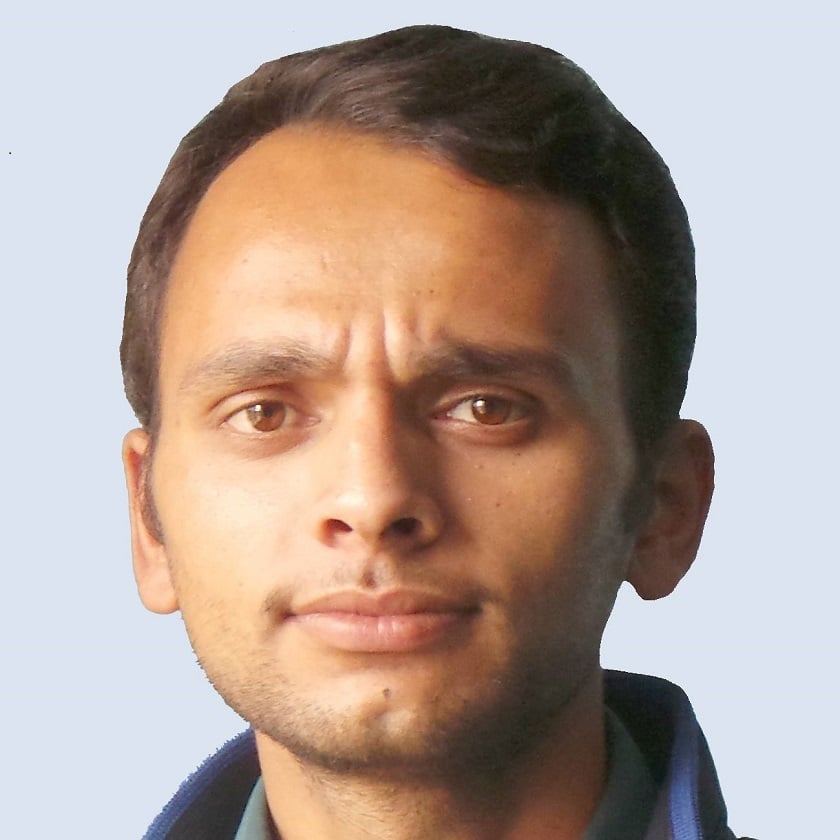
Kathmandu. Nepal's share market is currently in a 'wait and see' state. Contrary to investors' expectations of market enthusiasm following the formation of a new government and budget speech, the market has already fallen by about 350 points.
Why did the stock market not rise despite sufficient liquidity and very low bank interest rates? What direction will the market take with the new policies introduced by the government, the fear of money laundering, and the upcoming monetary policy? Here is an edited excerpt of a conversation with share market expert Dev Guragain for RatoPati's 'Economic Edit' on these contemporary issues (detailed video and audio available):
The stock market fell by about 300 points after the formation of the new government. The rate of decline seems to have increased further after the budget. You have been analyzing and investing in the stock market for a long time. How do you view the current state of the market?
In the past, when governments changed frequently, we used to analyze – the market couldn't grow due to the lack of a stable government and policy risks. Recently, as a new coalition including Rastriya Swatantra Party went to elections, the market index was around 2649 points. After the elections, with new parties coming into power, the market saw an increase of 300-400 points, and now the market has fallen again.
Yesterday, it was said that the government was not stable, but today the government is stable. Yet, everyone is curious why the market has not improved?
In my analysis, the steps the government is taking have created fear in the market. We always say – there should be no distorted transactions in the market, but there have been many distorted activities in the past, which the current government has exposed in the name of money laundering.
The stock market runs on two things – fear and greed. Greed increases the market, while fear decreases it. Major capital players in the market are currently scared. Therefore, the market is in a 'wait and see' state. However, the policies related to the capital market in the budget are not bad. The government has not even completed a hundred days in office, so its implementation remains to be seen.
You mentioned that the policies in the budget are good. What good policies that could encourage investors did you see?
A matter I have been raising for a long time has been addressed in the budget this time. Our stock market has always been one-way; other products have not been introduced. However, this time, the budget includes provisions for allowing intraday trading and short selling. This is something investors like us have been demanding for years.
Second, the matter of restructuring the stock exchange. I have been hearing about this for decades. It used to be mentioned in past budgets but was not implemented. The current government has continued this, so perhaps it will be implemented now.
Similarly, bringing non-resident Nepalis into the capital market has been prominently addressed in the budget. Bringing in institutional foreign investors was not heard of in the past; now the government is talking about bringing in a diaspora fund. All these policies are aimed at making the market very dynamic and increasing demand.
The appointment of the Chairman of the Securities Board, which had been vacant for a long time, has just happened. However, even after the chairman's appointment, the market did not seem to welcome it positively?
The appointment of the Securities Board Chairman was indeed delayed. Investors had a suspicion that 'this government also couldn't appoint a board chairman,' which has now been dispelled. However, in terms of the index alone, the appointment of the board chairman is only a minor factor.
The main reason for the market not rising is the 'fear' I mentioned earlier. Another factor might be the psychological impact on investors that the IPOs of 89-90 companies, which were stalled due to the absence of a board chairman, will now open one after another, and the supply of shares in the market will increase sharply.
You talked about policies that increase demand in the market. But don't the financial condition of companies, their returns, and the supply of shares in the market also play a significant role along with demand?
Certainly. This is not just a problem of today; our economy has been in a sluggish state for about three and a half years. Due to the economic recession, our listed companies have not been able to perform well. Consumption has decreased, which has prevented the returns of trading or service-providing companies from increasing. In the case of the banking sector, loans are not being recovered, leading to an increase in NPL and NBA.
The supply of shares in the market is increasing through IPOs, rights shares, or FPOs of new companies. To support this supply, demand must also increase proportionally. Therefore, the policy of bringing in NRIs and FIIs must be implemented simultaneously. Only then will the market become dynamic.
What is the impact of the government's actions regarding money laundering on the stock market?
The issue of money laundering is one of the main reasons for the current 300-point decline. The government is also compelled to take this step because Nepal has been placed on the grey list. It was recently reviewed, and an additional six months have been given.
Being on the grey list has already resulted in negative impacts such as a lack of foreign aid and investment and a negative perception from the international community. Getting out of this is the government's primary responsibility.
However, its impact on the stock market is that the individuals who were initially targeted or apprehended by the government were major players directly connected to the capital market. Those who engaged in distorted transactions by taking advantage of weak regulatory bodies or loopholes in the past are now scared. This has created fear in the market.
In a country like Nepal, where the informal economy is large, can the government impose money laundering charges on anyone it wishes? What will be the future of the stock market if this situation persists?
In a country like ours, where digitalization is not fully complete and the majority of transactions were informal in the past, that fear is natural. I will give an example.
In 2008 (2065 BS), the market was bullish, and the index reached 1100. When the Maoists came into the peace process, formed a government, and Dr. Baburam Bhattarai became the Finance Minister, a single statement from him caused the market to fall sharply to 293 points.
At that time, people were disappointed and said, 'The stock market has collapsed, there's no point here.' I entered the market around 2010 (2067 BS) at that lowest (bottom) point. I used to think – this despair won't last forever; everything has a saturation phase.
The same is happening now. Look at how far the market has gone in India after the Harshad Mehta scam. We may have a handful of major players here who have been disciplined by the government. This action also has a 'saturation phase.' I am fully optimistic that after this issue subsides, the market will form a 'bottom' and reach new heights again.
How are investors affected by the government's economic policies, from VAT on vegetables to capital gains tax on the stock market?
The budget has increased the capital gains tax for short-term investors from 7.5 percent to 10 percent and for long-term investors from 5 to 7.5 percent. However, I do not see this as a major negative impact.
In our country, a 10 percent capital gains tax is not that expensive compared to other countries. The most pleasing thing is that the budget has declared it as the 'final tax.' In the past, tax officials used to intimidate investors by showing a double-edged sword, saying, 'This is not the final tax; you have to pay tax by adding it to other income.' Now that confusion is gone. Although this has not yet been codified into law, the Finance Minister has clarified it.
Instead, the government should now focus on broker commissions and DP fees. These charges are quite high compared to other countries. Brokers should be given the authority to offer discounts. Investors cannot make a profit by paying such high fees on frequent intraday transactions.
In the past, when deposit interest rates rose, the stock market fell, and when interest rates fell, the market rose. But now, banks have ample liquidity, and interest rates are in the single digits, yet the market has not been able to rise. Why is this inverse relationship seen?
This seems a bit unusual. For the past year and a half, we have had ample liquidity and very low interest rates. In such a situation, the market should have risen. The main reason behind this is the economic recession. The informal economy has a very large share in our economy, which was primarily run by cooperatives.
When the cooperatives became distressed, it made the economy so sluggish that it directly impacted the capital market. Even though money is accumulating in the formal banking system, it is not circulating in the market. Therefore, the market has not been able to rise despite falling interest rates.
The Nepal Rastra Bank is soon going to bring out the monetary policy. What should a stock market-friendly monetary policy be like?
I don't think there is much relaxation left for the stock market to be provided by the upcoming monetary policy. Some people say that banks and insurance companies should be allowed to trade shares more freely, but the secondary market is a very risky area. The central bank cannot and should not fully open up the trading of public deposits in the stock market.
There might be some adjustments or minor relaxations in the currently set institutional investment limits, but I don't expect any new measures from the monetary policy that will revolutionize the market. The main thing is for the state to create hope among investors.
The market rose by a thousand points in one month and then fell again. Is it always good for the market to rise? What do you think is the reality of the market?
The market always rising, or rising unnaturally, is an even greater risk. In the past, when the market rose by a thousand points in a month, I said in an interview – this market is a blown-up balloon, it will burst. And so it happened. In 2021 (2078 BS) too, the market rose from 1100 to 3200 in 11 months, which was excessive, and it was forced to fall to 1800 later.
The market should rise healthily. It should rise based on company returns and fundamentals. But in our market, sometimes mass psychology overrides fundamentals.
Speaking of the ground reality, if we exclude the capitalization of new IPOs added in the last year and calculate the index, our market is still around 2000 or 2100. Therefore, it can be said that the market is currently at its bottom.
What is your advice to investors who are currently panicked by the market decline or those who are thinking of making new investments?
My clear advice is – now is not the time to panic. The market is at its bottom. At such times, many people become disappointed and try to sell shares and flee, saying the market didn't rise even with a stable government. But only a few optimistic people inject money at such times and make profits later.
Therefore, those who have money should invest now. Those who have already invested and are at a loss should average their investments. This is the time to average. After the saturation phase of actions and fear ends, the market will surely take a new turn.
Another hopeful aspect is that the heads of all four economic bodies of the government are experts. The Finance Minister, the Governor of the central bank, the Vice-Chairman of the Planning Commission, and the recently appointed Chairman of the Securities Board are all experts who understand this sector. They will surely take appropriate steps to resolve this economic stagnation. Therefore, my suggestion for today is to increase investment by looking at fundamentals without getting discouraged.
Video/Photo: Ayush Dhami/RatoPati
This specific news has been automatically translated by AI. As a result, there may be some inaccuracies or language errors.

_uwZqw7sHpf.jpg)