Courts Overstepping Jurisdiction, Threatening Press Freedom: Media Bodies
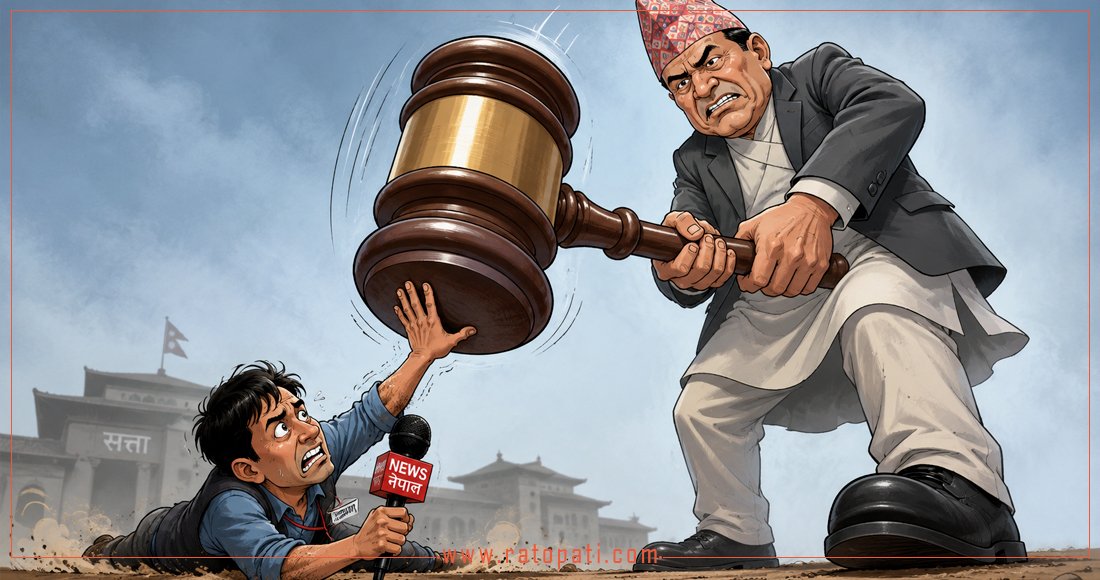
Kathmandu. The primary jurisdiction to verify the accuracy of content published in the media and monitor the code of conduct lies with the 'Press Council Nepal', but in recent times, district courts are increasingly bypassing the role of the Press Council and issuing interim orders to directly remove news.< /p>
The Nepal Journalists Association has termed the recent order issued by the Kathmandu District Court in the dispute between Simex Inc, the official distributor of electric vehicle BYD, and Business News Dot Com as 'an attack on press freedom in the name of judicial activism' and 'violation of jurisdiction'.< /p>
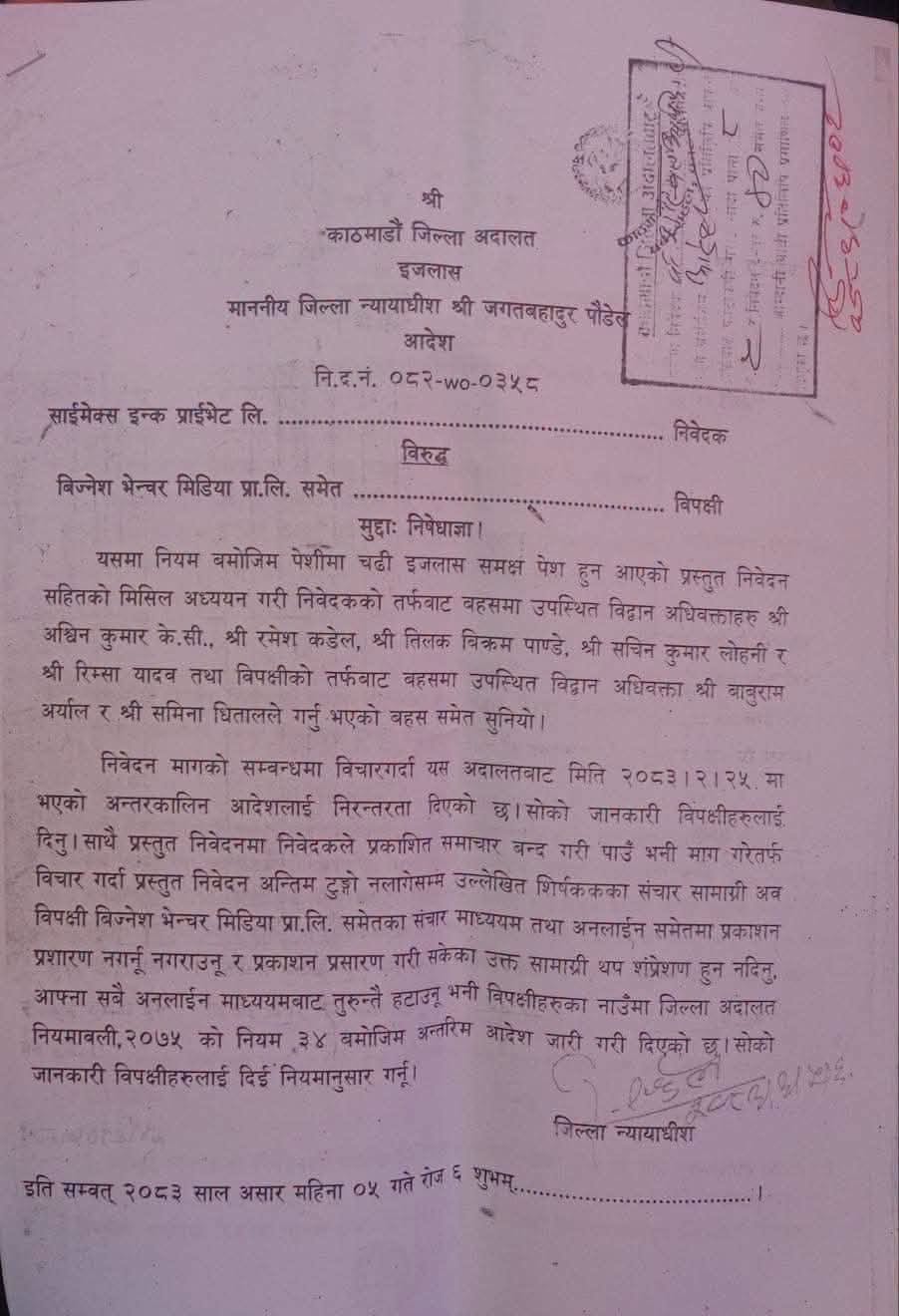
The bench of District Court Judge Jagat Bahadur Poudel had ordered the removal of 66 news items. Article 19 of the Constitution of Nepal, under the right to communication, states that 'no news, article or any other text material printed or published shall be banned, confiscated or its registration cancelled for the reason of being printed or published'.< /p>
According to Ram Prasad Dahal, General Secretary of the Federation of Journalists, ordering the removal of news without concluding whether the news is true or false is 'contrary to the fundamental spirit of independent journalism'. Dahal states that the Press Council not considering matters within its jurisdiction is causing the current problem. 'The time has come for the Press Council, the body that supervises the media, to review the issues that have recently gone to court,' said General Secretary Dahal, 'We cannot say that more serious situations will not arise in the future.'< /p>
Dahal stated that ordering the removal of news without concluding whether the facts included in the news are true or false attacks the fundamental spirit of independent journalism and creates a risk of evidence destruction. He said, 'Considering the precedent where interim orders issued by the court to remove news published in online media have been quashed in the end, the Federation is confident that the interim orders will be amended by the court and press freedom will be protected.'< /p>
Ramkrishna Adhikari, Treasurer of the Federation of Journalists, says that the recent court orders to remove news indirectly encourage 'censorship'. 'If there is an issue with the content, one should go to the Press Council, but the court has also ordered not to write news even before it is written. Another thing is that journalistic ethics states that news cannot be removed after it is written,' said Federation Treasurer Adhikari, 'The Press Council cannot remain silent on this issue when it should speak about its jurisdiction.'< /p>
He cited the case of Diyopost Online, where the police were active in removing news, and asserted that the Press Council has not been seen to be proactive in matters within its jurisdiction.< /p>
Ananta Raj Luintel, legal advisor to the Press Council, says that while the Council has expressed its views on some issues, it is not appropriate to proactively express its views on cases pending in court. 'Issuing a press note regarding the order is not something the Press Council speaks about,' he said, 'There is a matter of speaking when the constitutional provisions, legal provisions, or any decision weakens or questions the existence of the media.'< /p>
He stated that if there is an interpretation regarding freedom of expression, regulatory bodies, and jurisdiction, they informally provide their opinions in a coordinated manner.< /p>
If any news is misleading or damages someone's reputation, the aggrieved party should first go to the Press Council, and the Council will arrange for a rebuttal to be published or blacklist the source. In the case of BYD, Simex Inc had also filed a complaint with the Press Council. The court's order for 'content removal' while the Council's process is ongoing or while the Council is exercising its jurisdiction raises questions about the relevance of the specialized body.< /p>
Recently, the police increased their efforts to remove news published by 'Diyopost.com' about a gang threatening to kill the Chief Commissioner of the Commission for Investigation of Abuse of Authority, Prem Kumar Rai.
Previously, a similar order was issued against Nepal Khabar and Bizmandu on the application of Santosh Narayan Shrestha, Chairman of the Securities Board, which was later quashed by the court itself. In a situation where the court has corrected such orders in the past, the issuance of a similar order again raises questions about judicial uniformity.< /p>
It appears that business houses are using 'interim orders' as a 'shield' to hide their weaknesses, and when the court issues orders without considering the gravity of the content, there is a risk that the environment for writing news about corruption and irregularities will be destroyed in the future.< /p>
While the judiciary has the responsibility to maintain a balance between press freedom and individual reputation, orders to completely eliminate news not only curtail the right to information but also increase the risk that powerful parties can use the court as a tool for 'censorship'. Stakeholders say that instead of activating regulatory bodies like the Press Council, the court itself appearing in the role of an 'editor' has become a challenge to democratic values and norms.< /p>
Recently, the police increased their efforts to remove news published by 'Diyopost.com' about a gang threatening to kill the Chief Commissioner of the Commission for Investigation of Abuse of Authority, Prem Kumar Rai.< /p>
Diyopost's Chief Editor Sudip Bik says that Police Superintendent Mohan Thapa working at the CIAA, former Kathmandu Police Chief Ramesh Thapa, Police Superintendent Pawan Bhattarai, and Kathmandu Police's Case Section Chief Raju Adhikari, at the initiative of Prem Kumar Rai, Chief Commissioner of the Commission for Investigation of Abuse of Authority, corresponded with various bodies to remove the news published on Diyopost.< /p>

'At first, we thought Facebook itself might have removed it,' he said, 'Later, after examining the charge sheet submitted to the court by the government attorney's office, we found out that Diyopost's news was deleted.'< /p>
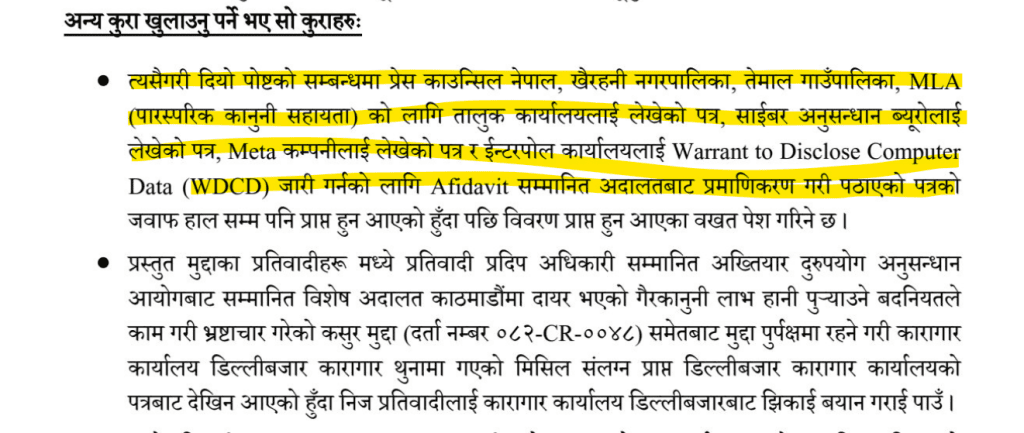
Chief Editor Sudip says that although the Press Council is responsible for monitoring media, the case file clearly shows that the police were active in removing the news content. He stated that if this problem is ignored as being an issue with just one media outlet at first, it could lead to attacks on other media outlets in the future.< /p>
SP Pawan Bhattarai of the Kathmandu Police Range, on the other hand, claims that they did not correspond to remove Diyopost's content. He stated that after the online portal posted videos and news that could disrupt peace and security on Facebook content, the relevant body, the Press Council, was alerted. 'We have not corresponded with Meta to remove any online news,' said SP Bhattarai, 'Removing news is also not within the jurisdiction of the police.'< /p>
This specific news has been automatically translated by AI. As a result, there may be some inaccuracies or language errors.
_cvUCBlwFTZ.jpg)
_sucFhOEREN.png)