Nepal Faces Drought and Fertilizer Shortage Amidst Paddy Planting Season

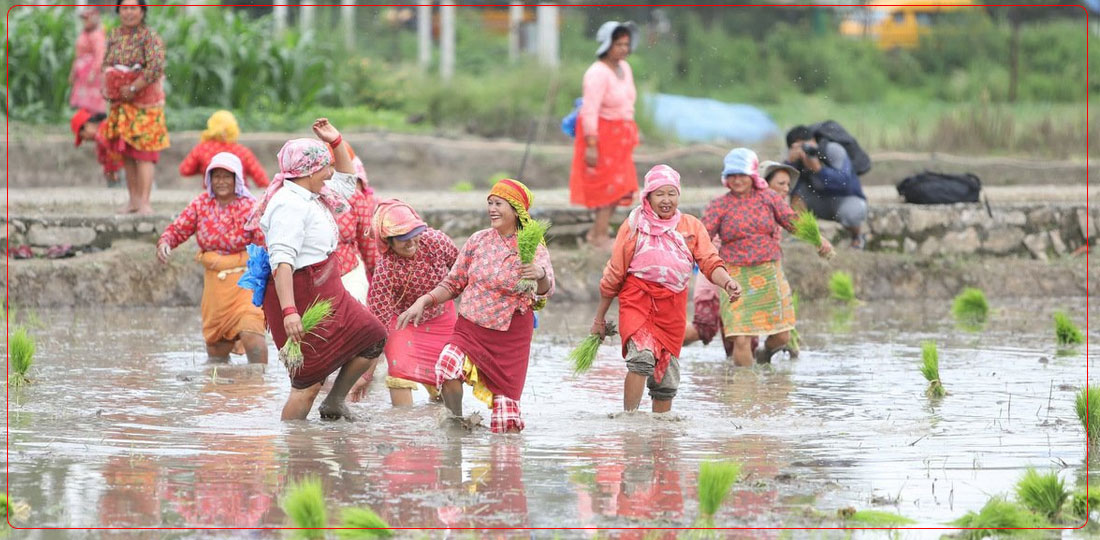
Kathmandu. The government celebrates National Paddy Day every year on Asar 15. The purpose of celebrating this day is to promote paddy, Nepal's main food crop. Farmers, water, and fertilizer come together on this occasion. While the government and various organizations are preparing to celebrate Paddy Day with enthusiasm, farmers' faces are not reflecting happiness.
It is currently the paddy planting season. However, even in mid-Asar, paddy planting has not gained expected momentum. On one hand, due to the monsoon not being sufficiently active, drought conditions have been created in most parts of the country, and on the other hand, there is an extreme shortage of chemical fertilizers during the main planting season. Despite being called an agricultural country, these two major problems that farmers face every year during the paddy planting season have recurred this year as well. Farmers are disappointed due to the lack of timely and adequate rainfall. The problem of chemical fertilizers is also as perennial as ever.
This year, the South Asian Climate Forum had already issued a warning of below-average rainfall in most parts of this region, including Nepal. According to meteorologists, the monsoon has weakened due to a climate cycle developed in the Pacific Ocean. The monsoon, which entered Nepal late from the eastern part, has become almost inactive by the time it reached the central and western parts of the country. Especially in many districts of the Terai region, considered the granary of Nepal, the temperature has reached around 40 degrees Celsius, making the drought situation dire. The flow of water in rivers has decreased, and canals are dry. This has severely affected small farmers who depend on rainwater for cultivation.
Paddy Seedlings Drying Up in the Nursery
Ramlal Chaudhary, a farmer from Bardiya, who is directly facing the drought, is in a great crisis. In his four bighas of land, paddy seedlings would have been ready by the end of Jestha in previous years, and planting would have been completed within the first week of Asar. But this year, due to insufficient rainfall, the paddy seeds in his nursery have turned yellow and started to dry up.
Fearing the loss of his year-round livelihood, he is trying to draw water through boring by buying expensive diesel. Due to the excessively high fuel prices, he is finding it very difficult to cover the cost of cultivation. He mentions that with the daily operation of the boring, the groundwater level is also decreasing, and shallow tube wells in neighboring villages have stopped working. Some local levels have even started banning the operation of boring to prevent excessive exploitation of groundwater, leaving thousands of farmers like Ramlal in distress.
Another pain is the chemical fertilizer shortage. Ramadevi Acharya, a farmer from Morang, who is struggling with the fertilizer shortage, visits local agricultural cooperatives and depots daily. She has not been able to get the DAP fertilizer that needs to be applied to the fields before planting paddy. As soon as she hears that fertilizer has arrived at the cooperative, she starts queuing from 4 AM. However, many small farmers like her are always forced to return empty-handed. Unable to get subsidized fertilizer in the market, she is forced to buy expensive and low-quality fertilizer smuggled from Indian border markets.
Imbalanced Use of Fertilizers
Dr. Ramkrishna Shrestha, head of the Agricultural Inputs Company Limited, claims that despite external and technical difficulties, the government is trying to manage fertilizer supply through alternative measures and systemic reforms.
In recent times, geopolitical conflicts and transportation crises worldwide have directly affected Nepal's fertilizer import process. Due to the ongoing tension between Israel and Gaza, 95,000 tons of fertilizer, which was supposed to arrive in Nepal under a government agreement from Jordan, could not be received on time, and the security challenges in the Red Sea region also disrupted international shipping routes. Additionally, a temporary ban on chemical fertilizer exports by China, a major source of supply, caused delays in the procurement process. However, Shrestha states that because the government had secured approximately 170,000 tons of fertilizer in stock before the crisis, it was possible to continue distribution in the initial phase.
Currently, 2,500 to 3,000 tons of fertilizer are being distributed daily from depots across the country, and this quantity can reach up to 5,000 tons daily during peak planting season. The government has set a target to distribute approximately 600,000 tons of fertilizer by the end of Asar in the current fiscal year, which is a significant amount compared to previous years.
Meanwhile, it is expected that the supply situation will become even more convenient by the first week of Shrawan, as the fertilizer under the G2G agreement with India is expected to arrive by the last week of Asar, and approximately 245,000 tons of fertilizer on six ships that have arrived at the Kolkata port will also be gradually entering Nepal.
The demand and consumption of chemical fertilizers in Nepal appear to be quite imbalanced. According to technical recommendations, Nepal requires 1.737 million tons of chemical fertilizer annually, but Shrestha believes that if soil use is balanced, an annual consumption of 800,000 tons can meet the overall demand. Currently, 80 percent of the total available fertilizer is consumed only in the Terai region, and the eight districts of Madhesh Province alone account for about 29 percent of the country's total consumption.
Studies show that the trend of using three to five times more fertilizer than necessary in some areas without recommendations also increases the artificial shortage and demand for fertilizer in the market.
Strict Rules in Distribution System, Weak Implementation
For internal distribution, the government has integrated over 14,000 dealers and cooperatives across the country into a digital software system to make fertilizer sales systematic and transparent. Although a rule has been made requiring cooperatives to enter details in the software about which farmer they sold how much fertilizer to after taking possession of it, the entry of details is delayed due to the lack of internet, electricity, and technological access in rural areas.
Due to the technical arrangement that prevents the system from issuing new fertilizer until the previous phase's details are entered into the software, some cooperatives have complained that they cannot collect fertilizer even though it is available at the depot. In response, the government has currently adopted flexibility in this rule. To address the slowness of the system, the software's capacity has been expanded and CPUs have been upgraded, but the mandatory condition for entering details has been somewhat relaxed to prevent fertilizer shortages for farmers.
Increasing Paddy Imports
According to the Department of Agriculture, paddy contributes about 7 percent to Nepal's Gross Domestic Product. Economists say that a decrease in paddy production will lead to a contraction in the country's overall economic growth rate and a decrease in the purchasing power of rural people. Paddy is a major crop linked to the social, economic, cultural, and religious aspects of Nepali life. According to the Agricultural Census 2078, out of 4.131 million farmer households in Nepal, 2.765 million households cultivate paddy, which is about 54 percent of the total cultivated land. Similarly, paddy contributes about 13 percent to the total GDP of the agricultural sector and about 50 percent to the total cereal crop production.
Although paddy productivity has shown gradual improvement in recent years, Nepal still faces a deficit of about 1 million metric tons of paddy to meet domestic demand. According to the Department of Agriculture, Nepal currently requires about 7 million metric tons of paddy annually, but the existing production is lower than that. In the last five years, paddy productivity has increased from 3.80 metric tons per hectare to 4.19 metric tons per hectare. In the fiscal year 2081/82, 5.954476 million metric tons of paddy were produced from an area of 1.420636 million hectares. Although the area for paddy cultivation is gradually decreasing, the department's analysis attributes the increase in productivity to improved seeds, chemical fertilizers, and agricultural technology. However, due to changes in consumer eating habits, the demand for fine and aromatic rice has increased significantly, and consequently, the import of paddy-rice has not decreased as expected, according to the department.
The department stated that the government prioritizes programs such as setting minimum support prices, producing improved seeds, and disseminating technology to increase paddy production, substitute imports, and achieve self-sufficiency.
Promoting Adaptation Technologies to Cope with Climate Crisis
To mitigate the negative impact of floods, droughts, and unseasonal rains caused by climate change on paddy crops, the government has focused on developing climate-adaptive technologies and varieties. In the context of paddy planting and production being affected by Koshi river floods, Terai inundation, and drought caused by last year's El Niño effect in previous years, adaptive technologies have been prioritized this year. The Nepal Agricultural Research Council (NARC) has developed and is promoting paddy varieties such as 'Sukha-1, 2, 3, 4, 5, 6' which are drought-tolerant, 'Swarna Sab-1' which is flood-tolerant, and 'Seharaad Sab-1', as well as 'Bahuguni-1 and 2' which are tolerant to both drought and flood, at the farmer level. Furthermore, the 'Climate Resilient Agriculture and Food System Climate Resilient Transformation Project' has been launched this year to minimize the negative impacts of climate change.
This project has been implemented in 8 local levels in Mahottari, Sarlahi, Nuwakot, and Nawalparasi (Bardaghat Susta West) districts. Under this, technologies such as resilient variety development for paddy crops, seed broadcasting technology, alternate wetting and drying methods, and rainwater harvesting are being expanded.
Intensifying Conservation of Indigenous Paddy and Promotion of Spring Paddy
According to the Department of Agriculture, various promotional programs are being conducted at the government level for the conservation of Nepal's indigenous paddy biodiversity and the expansion of spring paddy cultivation areas. The Department of Agriculture states that over 2,500 genetic resources (indigenous varieties) of paddy found in Nepal have been secured at the National Gene Bank. Technical and financial facilitation is being provided to farmer groups and communities for the conservation and value chain development of popular and highly nutritious indigenous varieties like Black Paddy, Shuddhodhan Kalo Namak, Hariyo Kauchhin, Kalo Patle, Rato Anadi, Jorayal Basmati, Jhinua, and Ekle at the local level. On the other hand, to increase paddy productivity, the promotion of spring paddy has been intensified. Currently, the spring paddy promotion program is being operated in 58 local levels in 18 districts through federal conditional financial transfer.
Under this program, subsidies are provided for the production of source seeds and the use of improved seeds to increase farmers' access to quality seeds. Additionally, emphasis has been placed on the promotion of spring varieties developed in Nepal such as 'Hardinath-1 and 3' and 'Varshik' for productivity enhancement and on the mechanization of paddy cultivation, the department said.
Experts Suggest 'Drought-Tolerant Paddy' as a Suitable Option in Climate Crisis
As paddy crops are being affected by imbalances in the monsoon and drought due to climate change and the impact of El Niño, paddy crop expert Mathura Yadav has advised farmers to plant drought-tolerant paddy varieties. He pointed out that farmers should choose climate-adapted paddy varieties as the impact of weather is varying according to geographical regions.
Informing that paddy production, which previously reached up to 5.9 million metric tons, decreased to 5.7 million metric tons last year due to drought in the Madhesh region, he stated that due to climate change, some areas face floods while others face drought. He mentioned that the Nepal Agricultural Research Council (NARC) and the National Paddy Research Program have developed special paddy varieties tolerant to both drought and flood to provide relief to farmers in such adverse situations. He stated that varieties from 'Sukha Dhan 1' to 'Sukha Dhan 6' have been developed for farmers in drought-affected areas.
Expert Yadav said that 'Sukha Dhan-3' has proven very effective for areas in the Terai of Nepal and hilly valleys up to 700 to 800 meters altitude and river basins. He informed that this variety of paddy gives good yield even with less water and in drought conditions, making it very popular among farmers, and its field results are also encouraging. He believes that climate-adapted varieties, rather than traditional ones, are the main means to overcome the current crisis as weather uncertainty increases. He advised that in areas with a high risk of drought, farmers should choose certified drought-tolerant varieties when selecting seeds and cultivate according to the advice of agricultural technicians.
What is the Planting Situation in Each Province?
According to the latest data released by the Crop Development and Agricultural Biodiversity Conservation Center, the pace of paddy planting has been very slow in Koshi Province this year. As of Asar 12, only 8.25 percent of the total area in Koshi Province has been planted. Out of the total 276,386.73 hectares of land for paddy planting in this province, only 22,814.98 hectares have been planted so far.
Due to the lack of timely rainfall this year, the planting rate is significantly lower compared to the same period last year. Last year, by this time, 14.25 percent, or 39,389.93 hectares, had already been planted in Koshi Province. The late arrival of the monsoon and the prolonged drought in areas without reliable irrigation systems are considered the main reasons for this.
Paddy Planting Limited to 5 Percent in Madhesh Province
In Madhesh Province, known as the main granary of the country, only 5.01 percent of the land has been planted with paddy as of Asar 12 this year. According to the Crop Development and Agricultural Biodiversity Conservation Center, out of the total 382,433 hectares of land for paddy planting in Madhesh Province, only 19,157.5 hectares have been planted so far. However, compared to last year, the planting rate has shown a slight improvement this year. During the same period last year, in Madhesh, out of a total of 380,283 hectares of paddy-growing land, only 3.89 percent, or 14,785 hectares, had been planted. Despite the dry weather and lack of adequate monsoon rainfall, farmers have advanced planting in limited areas with irrigation facilities.
Planting Decreased in Bagmati Province
The pace of paddy planting has slowed down in Bagmati Province this year. According to data prepared by the Crop Development and Agricultural Biodiversity Conservation Center as of Asar 12, only 12.59 percent of the area in Bagmati Province has been planted. Out of the total 144,254.4 hectares of land for paddy cultivation in this province, only 14,384.52 hectares have been planted so far.
Compared to last year, the planting rate has significantly declined this year. Last year, during the same period, out of a total of 120,545 hectares in Bagmati Province, 20.53 percent, or 24,742.78 hectares, had been planted. The delay in rainfall and the compulsion to rely on rainwater in hilly areas have affected planting this time.
Gandaki 24 Percent
In Gandaki Province, the paddy planting work appears to be relatively good this year. According to the data provided by the Crop Development and Agricultural Biodiversity Conservation Center as of Asar 12, 23.68 percent of the area in Gandaki has been planted with paddy. Out of the total 93,606 hectares of land for paddy planting in this province, 22,166.1 hectares have been planted. Last year, during the same period, only 13.79 percent, or 12,989.90 hectares, had been planted in Gandaki Province. This year, light monsoon has started in most districts of Gandaki, and irrigation has also increased, leading to more planting.
Lumbini 20.8 Percent Planting
In Lumbini Province, the rate of paddy planting this year has more than doubled compared to last year. According to the Crop Development and Agricultural Biodiversity Conservation Center, as of Asar 12, 20.8 percent of the area in Lumbini Province has been planted. Out of the total 301,372 hectares of land for paddy planting in this province, 62,670.87 hectares have been completed. Last year, during the same period, only 9.66 percent, or 29,251 hectares, could be planted in Lumbini.
Slow Pace of Paddy Planting in Karnali Province
In Karnali Province, which has a predominantly hilly terrain, the pace of paddy planting this year is weaker compared to the previous year. According to the latest data from the Crop Development and Agricultural Biodiversity Conservation Center, only 22.81 percent of the area in Karnali Province has been planted as of Asar 12. Out of the total 43,290 hectares of land for paddy planting in Karnali, 9,875 hectares have been planted so far.
This progress is significantly less compared to the previous year. Last year, during the same period, 39.14 percent, or 16,002.4 hectares, had already been planted in Karnali. The lack of timely and adequate rainfall in the hilly and mountainous districts of Karnali this year and the impact of dry drought have been the main reasons for the affected planting.
Sharp Decline in Planting in Sudurpashchim Province
The rate of paddy planting in Sudurpashchim Province has seen a sharp decline this year. According to the data released by the Crop Development and Agricultural Biodiversity Conservation Center as of Asar 12, only 9.26 percent of the area has been planted in Sudurpashchim. Out of the total 170,650 hectares of paddy cultivation land in this province, only 15,800 hectares have been planted so far.
Last year, paddy planting was at a much faster pace in Sudurpashchim Province during the same period. Last year, by this time, 45.49 percent, or 80,128 hectares, had been planted. The center stated that due to drought and the prolonged absence of monsoon rains this year, the rate of planting in Sudurpashchim has significantly decreased compared to last year.
This specific news has been automatically translated by AI. As a result, there may be some inaccuracies or language errors.