Cooperative Problem Resolution Efforts Stall Due to Conflicting Interpretations


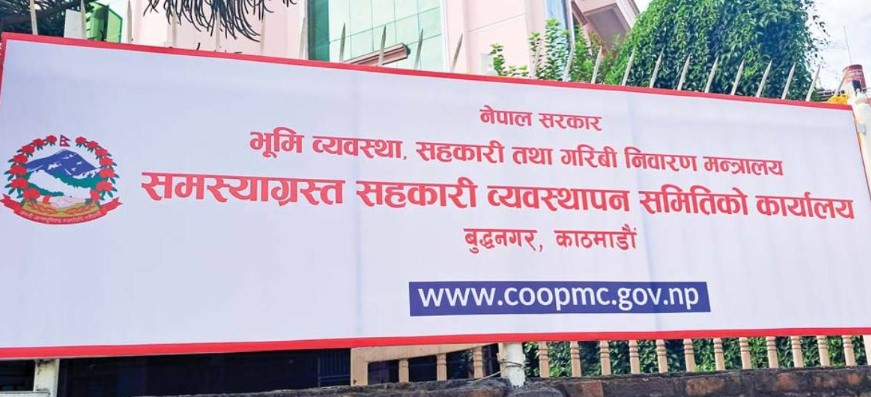
Kathmandu. Efforts to find a sustainable solution by returning problematic cooperatives to the ownership and management of their respective shareholders appear to be failing. The knot in the issue of returning the operation of cooperatives to the members is unlikely to be untangled due to the discrepancy between the new criteria introduced by the office managing problematic cooperatives and the office's interpretation of these criteria.
The office managing problematic cooperatives issued two separate working procedures in the last week of Jestha to address the issue of problematic cooperatives. The 'Savings Repayment, Loan Recovery, and Asset Management Working Procedure, 2083' was approved and implemented on Jestha 25, followed by the 'Restructuring and Management Working Procedure for Problematic Institutions or Unions, 2083' on Jestha 29.
With the release of these two working procedures, there was an expectation that the long-standing cooperative problem would be resolved and small savers would receive their money back quickly. The old management committee and other shareholders were excited, believing they could revive the institutions based on these working procedures. However, the possibility of implementation seems to be diminishing as the committee has provided a different interpretation of the matters written in the working procedures.
Two Different Working Procedures
The 'Savings Repayment, Loan Recovery, and Asset Management Working Procedure, 2083', issued by the committee on Jestha 26, was particularly aimed at providing relief to small savers and opening a path for shareholders to participate in the management of the institution's assets.
According to clause (d) of section 2 of the said working procedure, savers with savings up to five hundred thousand rupees have been defined as 'small savers'. Section 26 of the same working procedure contains special provisions regarding the management of assets of problematic cooperatives.
As per this provision, in order to collectively carry out the repayment of savings or recovery of loans of a problematic cooperative, an option was given to deposit the savings of all small savers, constituting at least fifty-one percent of the total savers with outstanding savings repayment claims, into the account of the respective problematic cooperative.
Similarly, for the remaining savers (up to 49 percent), it was clearly stipulated that a temporary committee formed by members of the respective problematic cooperative, willing to manage all the assets of the problematic cooperative, could submit a written action plan to the committee, provided that at least fifty-one percent of the outstanding savings claim amount was represented by these savers, with their agreement obtained through a meeting of savers.
This means that a path was opened for members to manage the institution themselves by ensuring the funds of small savers and gathering the agreement of members representing fifty-one percent of the savings of the larger savers.
Likewise, the 'Restructuring and Management Working Procedure for Problematic Institutions or Unions, 2083', issued on Jestha 29, introduced another amendment and provision. This working procedure further clarified the process of how problematic institutions could be brought back into operation.
Sub-sections 1 and 2 of section 3 of the said working procedure stipulated that if a problematic institution or union wishes to restructure and operate, it can request the committee, and if the committee finds reasonable grounds, it can ask the shareholders for an action plan.
The provision regarding savings repayment was the most attractive aspect of the working procedure for former directors. This sub-section states: In response to the request for an action plan, the shareholders of the problematic institution or union, if they wish, can convene a meeting and submit an action plan to the committee indicating their intention to repay the savings of at least sixty percent of the savers with outstanding savings repayment claims in their institution or union.
According to this, instead of fifty-one percent or savers with savings up to five hundred thousand rupees, it is interpreted as sixty percent of savers. That is, any member can submit a proposal with the intention of repaying the savings of those savers, and if the committee deems the proposal appropriate, the cooperative can be re-operated with the remaining savers being recognized after the committed amount is deposited.
After the release of both these working procedures, the suspended/former management committees intensified internal discussions. They concluded that it would not be difficult to repay the savings of sixty percent of small savers immediately, and even all savers with savings up to five hundred thousand rupees could be repaid.
Generally, small savers constitute 70 to 80 percent of the total savers in cooperatives. While these savers deposit small amounts, their total savings constitute only a small portion of the institution's total liabilities. Therefore, in the understanding of the directors, the amount required would only be a small portion of the total liabilities if the amount was deposited as per the working procedure.
Confusion Caused by the Committee's Interpretation
Following this working procedure, the directors held direct and indirect discussions with the committee officials. They also stated that it would not be difficult to meet the criteria in both the first and second working procedures.
A director of a cooperative institution says, 'Even if we were to deposit money to repay 60 percent of the small savers among the currently claimed savers, our calculation was that only about 10 to 12 percent of the total claimed amount would be needed. We had also started discussions with the debtors to raise that money. By persuading the major debtors, we believed we could create a basis for immediate repayment to all savers up to five hundred thousand rupees and at least 60 percent of the savers according to the criteria.'
However, they have now backed down after the interpretation by the committee officials. The committee not only insisted on fulfilling the conditions of both criteria issued on Jestha 26 and 29 simultaneously but also interpreted that sixty percent of the total savings must be deposited for the cooperative to be returned.
Committee Chairman Dilliraj Acharya also states that this provision mentioned in the working procedure is sixty percent of the total savings. He says that this amount can be settled through accounting adjustments or any other method.
'If the directors of any cooperative reconcile accounts with debtors and savers, it is acceptable; if they create a basis for repaying 60 percent of the savings, we can let them operate it,' says Chairman Acharya. 'We have received information that they are currently making efforts.'
However, the directors say this is impossible.
'Even non-problematic cooperatives find it difficult to maintain 10 percent liquidity. How can 60 percent be managed? It's simply not possible,' says one director.
Currently, there are claims amounting to 39.93 billion rupees in the problematic cooperatives under the committee's control. They claim that to make all these cooperatives operational, approximately 24 billion rupees would need to be deposited, which is impossible.
Liabilities of Billions and an Unresolvable Path
The director claims that this interpretation of the criteria has created liabilities of billions, and under these conditions, not a single cooperative can be freed from being problematic.
According to this working procedure, approximately 24 billion rupees need to be deposited. However, the committee itself has only recovered 100 million rupees from debtors and repaid only 299.3 million rupees so far. The former director states that the demand to deposit 60 percent of the money before the cooperative is returned is not reasonable.
'The current interpretation means that cooperatives can never be freed from being problematic,' he says. 'It clearly shows that the state mechanism does not want to solve the cooperative problem and it will never be returned.'
This specific news has been automatically translated by AI. As a result, there may be some inaccuracies or language errors.
_jEGOtGcTjV.jpg)