
Kalamati-Basundhara Ring Road Expansion Delayed

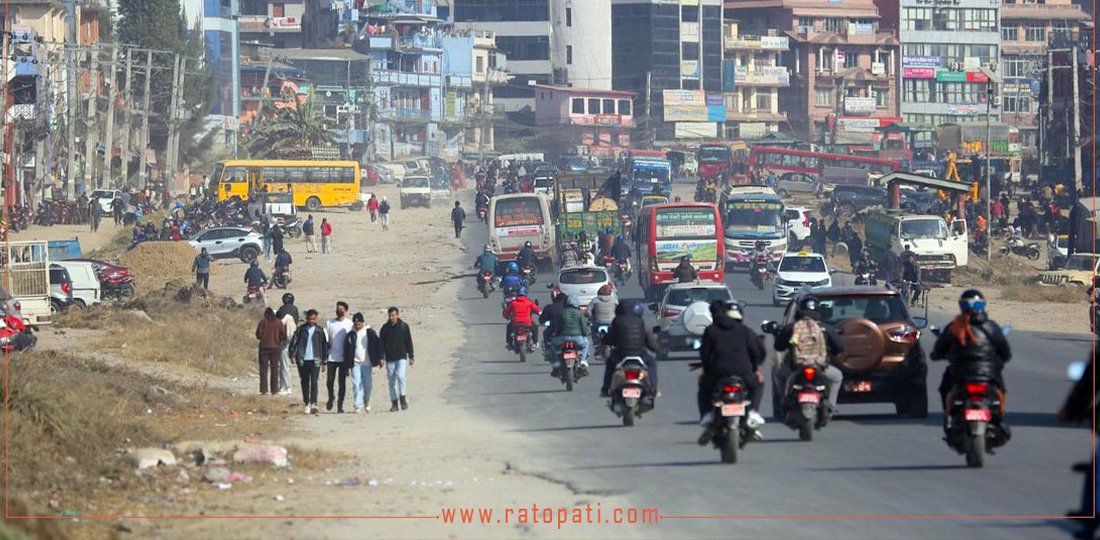
Kathmandu. The construction process of the second section (Kalamati-Basundhara) of the Kathmandu Ring Road expansion, which has been in uncertainty for a long time, has not yet physically started.
More than two months have passed since the formal agreement was signed between the Government of Nepal and the Chinese side on April 16 last year, but the road expansion work has not progressed. An agreement-letter regarding grant assistance was signed between the Minister of Infrastructure Development Sunil Lamsal and the Chinese Ambassador to Nepal Zhang Maoming on April 16, 2083 BS.
According to the agreement, the Chinese government will provide approximately 11 billion rupees in grant assistance for the construction of the 8.2 kilometer road and bridges from Kalamati to Basundhara. However, even though the agreement has been made and the preliminary design has been approved, the expansion will only happen after the monsoon season.
Delay due to China's procedural reasons, can't pressure?
With the objective of facilitating the Chinese side in the Ring Road upgrading work, the government established a project office in Babarmahal on Poush 18, 2069 BS. Under the same project, China expanded the first section of Koteshwor-Kalamati (10.39 km) to eight lanes with a grant of approximately 5 billion rupees and handed it over to Nepal on January 8, 2019 (2075 BS).
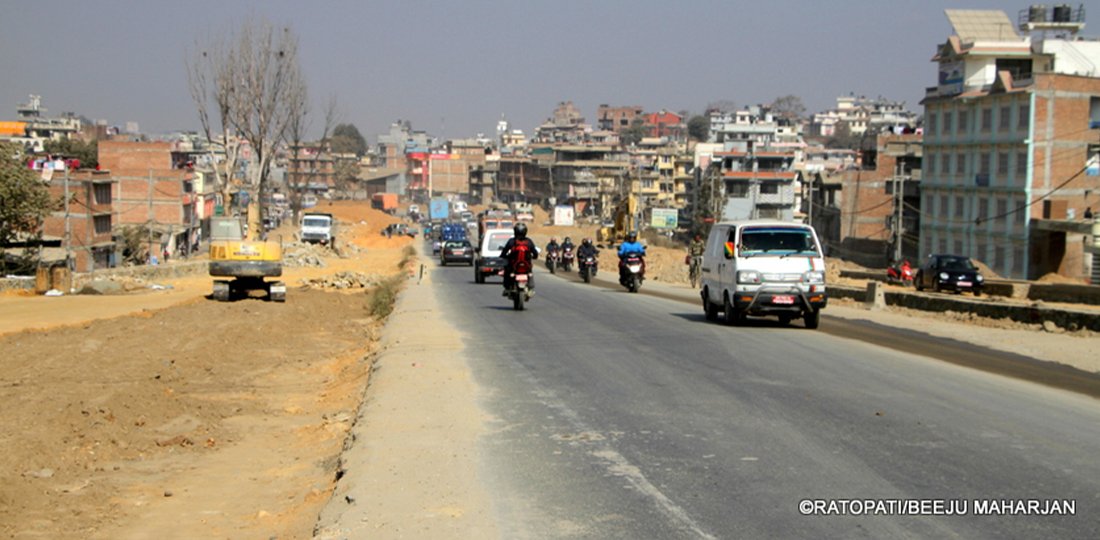
Although it was said that the second phase would start immediately after the completion of the first phase, the process for the Kalamati-Basundhara section has only moved forward after about 7 years. The Government of Nepal has fully completed its part of the work, such as clearing the right of way, relocating electricity, drinking water, and telephone poles and wires, and cutting trees for this section.
Similarly, under the budget of the Government of Nepal itself, the service tracks on both sides from Kalamati to Swayambhu have been constructed, and the service tracks from Swayambhu to Basundhara have been completed in four packages. Although Nepal has completed the site clearance and service track work, since the main road is to be built with the grant from the Chinese government, it is necessary to rely on the Chinese side's contracting system as per the Letter of Exchange agreement.
According to Arjun Prasad Aryal, Deputy Director General of the Department of Roads' Development Cooperation Implementation Division, technical work has progressed along with the agreement. The Chinese company has prepared the preliminary design and got it approved by the Department of Roads.
“We and the design company have signed the preliminary design. Now the detailed survey and the design company will submit it to their country's ministry,” said Deputy Director General Aryal. “Only after approving it according to their own system will they enter the stage of contract management.”
Since the construction is to be fully funded by Chinese grants, the entire responsibility of selecting the contractor lies with the Chinese side. Aryal says, “If it were loan money, we could have complained or pressured a little, but since it is grant money and a matter between two countries, they will do the contracting. We have only requested them to start the work after the monsoon, saying it is too late.”
Why the 7-year delay?
The main reasons cited for the 7-year delay in starting the second section, even though the first section was completed in 2019, are COVID-19, administrative hurdles, and political instability. According to officials from the Department of Roads, the delay in the Ring Road expansion is due to regular administrative processes and internal reasons within Nepal, rather than any specific political or geopolitical reasons.
However, Nepal's political instability has also had some impact. When proposals related to tax exemptions were sent to the Council of Ministers, files became inactive and had to be resubmitted due to reasons like government changes or dissolution of parliament. Finally, after the Council of Ministers decided to grant customs and tax exemptions on construction materials on February 12, 2082 BS, the path to an agreement with the Chinese side opened up.
Overpasses to disability-friendly bridges are being built
The design for the 8.2 kilometer Kalamati-Basundhara section was done by Chinese government companies 'CCCC First Highway Consultants' and 'Xian Fangzhou Engineering Consulting Limited'. This road is designed to be expanded into a state-of-the-art eight-lane road according to China's urban road standards.
The structure of the road, which will be 38.5 meters wide, will be very attractive. There will be a 2.75-meter footpath on both sides, a four-lane main road in the middle, and a 3-meter median (green belt) in the middle of the road for planting trees and managing electricity and internet wires.
Two main bridges will be constructed in this section; a 16-meter long bridge in Kalamati-Syuachatar and a 64-meter long bridge over the Bishnumati River. In addition, there will be 13 culverts along the road and 4 disability-friendly overpasses will be constructed to facilitate pedestrian crossing. These bridges will be built between Sitapaila-Swayambhu, Dhungedhara-Balaju, Balaju-Machhapokhari, and Samakhushi-Basundhara Chowk.
The most important structure will be a 560-meter long 'overpass' to facilitate traffic management from Machhapokhari to Baspark. The design includes the construction of 11 intersections (junctions) and 22 organized bus stops on the road for vehicle and passenger diversions.
When will the work start?
Due to the long period without the second section being built after the completion of the first section of the Ring Road, there is severe traffic congestion and dust pollution from Kalamati to Basundhara. Although the agreement in April has given hope to the valley residents of getting a comfortable road, they will still have to wait a few more months for physical construction.
According to Deputy Director General Aryal, there is no possibility of starting work with machines by June. Since the Chinese side will take time to complete the contractor selection process, physical work on the Ring Road will only begin after the monsoon of the upcoming fiscal year (around October), he informed.
Earlier, China had expanded the first section of the Ring Road, Koteshwor-Kalamati. The section, which started in 2069 BS, was completed in about 6 years in 2075 BS. The 10.39 kilometer stretch from Koteshwor to Kalamati was expanded to 8 lanes at a cost of approximately 5 billion rupees, borne by the Chinese government. Traffic congestion at Kalamati has decreased with the expansion of this road section. Similarly, the road division Kathmandu has already expanded the road from Maharajgunj to Koteshwor under the third section Maharajgunj-Koteshwor. Preparations are underway to advance the expansion work in the remaining sections.
_bzh4m9hamu_yDxwSptHw2.jpg)

This specific news has been automatically translated by AI. As a result, there may be some inaccuracies or language errors.




_CJUItIXTM0.jpg)