Surkhet. The main challenge for the Karnali Province government is budget implementation. Every time, the primary agenda of the Ministry of Finance and the leadership of the government is to improve budget implementation. Previously, the current Chief Minister Yamlal Kandel used to say from the opposition bench during the first term of the Provincial Assembly, 'Can't even implement the budget given as grants by the central government?' Now that Kandel himself is leading the government, one of his agendas was to improve budget implementation. He also made efforts. From administrative bodies to ministers, he made them express commitment and also made them sign performance agreements. However, the pace of budget implementation in Karnali has not improved. Instead, the results of budget implementation are weaker than in previous years. Now, a strong question has been raised against those in the government: 'They cannot even implement the budget given as grants by the central government, yet they do not refrain from criticizing the center for not providing enough budget.' More than 95 percent of the annual budget brought by the Karnali government depends on federal grants and revenue sharing. For the upcoming fiscal year (2083/084), the province's share is only 2.40 percent. Looking at the budget implementation data of the past nine fiscal years, the budget implementation has not reached 70 percent in any fiscal year. So far, the Karnali government has brought a budget of 2 kharba 64 arba 34 crore with the support of federal grants. Out of this, the government has only been able to spend 58.92 percent of the total budget. The implementation status of the development budget is even more dire. According to the data, the progress of development budget implementation is only 55.39 percent. See the budget and expenditure status brought by the Karnali Province government since its establishment: 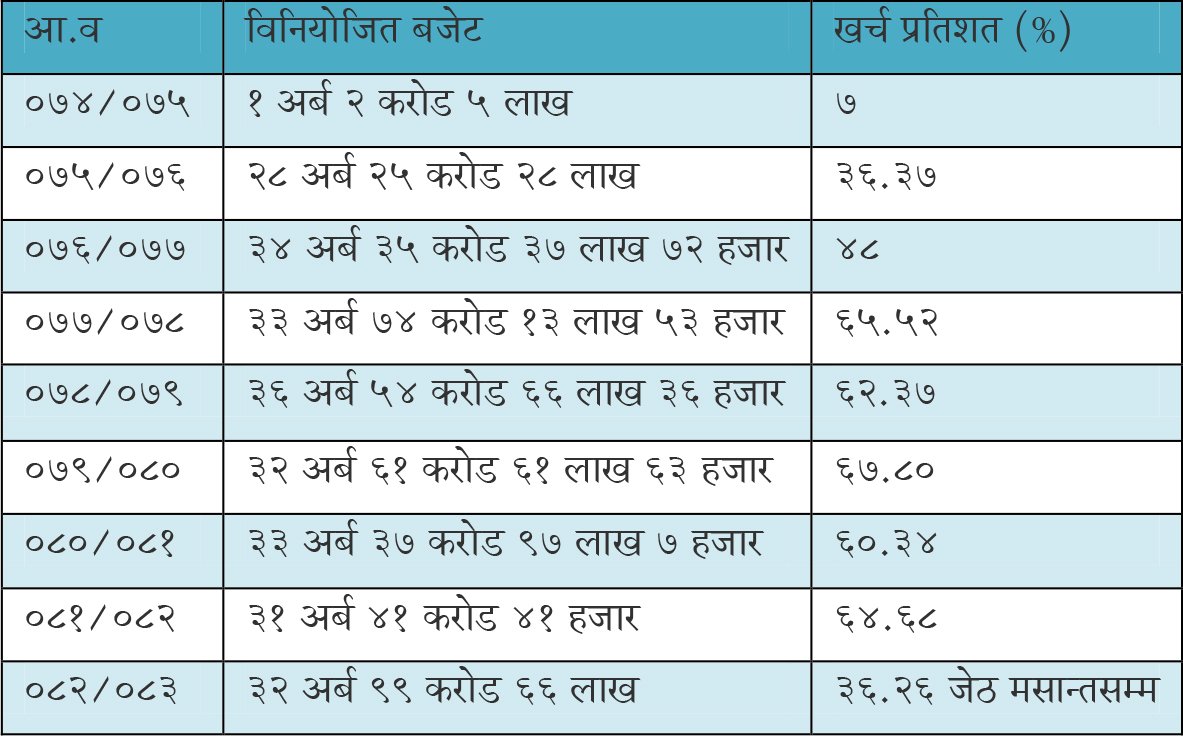
- No Improvement in Budget Implementation
The Karnali Province government brings plans in its annual policy and program and budget statements every year to improve budget implementation, but these plans are not practically implemented, so budget implementation has not improved. For the upcoming fiscal year, the government has put forward the same old policies, claiming to improve budget implementation. Minister for Economic Affairs and Planning, Rajeev Vikram Shah, has put forward six policies and programs under the title 'Effectiveness in Budget Implementation and Improvement in Capital Expenditure'. Shah has mentioned that budget allocation efficiency will be maintained and accountability for implementation will be ensured. For this, he claims that the tendency to allocate lump sums to thematic ministries without confirming the spending body or activities will be discouraged. 'If the lump-sum allocated amount needs to be distributed, I have made arrangements for it to be distributed by the thematic ministry within the stipulated time,' he said. He also said that for infrastructure development projects included in the budget, procurement process can be started after June 1st within the limit of the approved budget. Such a policy was also put forward by the government before. 'I have continued the arrangement that if a separate directive, procedure, or standard needs to be formulated for the implementation of a program for which funds have been allocated in the approved annual program, it must be drafted by the end of Kartik and published in the Provincial Gazette and on the website of the concerned ministry,' Shah said. Previously, new projects had to be taken to the implementation stage by the end of Asoj, but some programs only entered the implementation stage in Jestha. The government is repeating the same policies every year. The new budget statement has set a limit for revising any project or program included in the budget information system. 'If a revision is requested with appropriate basis and reason, and without changing the budget amount and source, arrangements have been made for it to be revised by the end of Chaitra,' said Finance Minister Shah. 'Arrangements have been made for thematic ministries to make decisions on budget reallocation, program revision, activity revision, and quarterly revisions to expedite the decision-making process.' Shah said that the project bank management system will be further simplified, automated, and systematized. This will further systematize the identification and selection process of projects to be operated by the provincial government. However, the parliamentarians are questioning the effectiveness of the project bank.
- Parliamentarians Say – No Plan to Improve Budget Implementation
Since the policies and programs put forward by the Finance Minister to improve budget expenditure are old, the province's parliamentarians say that there are no new concrete plans. RPP MP Santoshi Shahi said that the implementation aspect will be very challenging in the new budget. She said, 'The non-implementation of the budget raises questions about the credibility of the new budget. The fact that only 27 percent of the development budget has been implemented by the end of Jestha is itself a sad aspect.' She said that the new budget does not have a clear plan to improve budget implementation and reduce dependency. Chief Whip of the Congress Parliamentary Party, Hikmat Bisht, said that the Finance Minister is confused about the selection of the province's problems. According to him, there are three main problems in Karnali: the revenue target is not being met. Second, a large amount of allocated budget is not implemented, and third, irregularities and manipulation during budget allocation are major problems. He questioned the spending capacity, stating that only 27 percent of the development budget has been implemented now, compared to 41 percent by the end of Jestha last year. The leader of the Nepali Communist Party's parliamentary party, Mangal Bahadur Shahi, says that although budget implementation is a major problem, the government is not paying attention to it. 'Now the government is becoming capable in all aspects, including employees,' he said, 'but the implementation status is weaker than before. The government's clear plan on this issue is not visible.'