Nepal's Fiscal Federalism Weak, Province Budgets Lag Behind Federal Budget


Kathmandu. All three tiers of government in the country are currently in the budget process. Federal and provincial governments are in the process of passing budgets. Among the local levels, some have already presented their budgets, while others are in the process of doing so.
According to the constitutional provision, the federal government must present the budget for the upcoming fiscal year to a joint meeting of both houses of the federal parliament on Jestha 15. Similarly, provincial governments must present their budgets for the upcoming fiscal year by Asar 1, and local governments by Asar 10.
This time, the federal government presented a budget of Rs 21 kharba 24 arab 34 crore. This budget, presented by Finance Minister Swarnim Wagle, is 8.16 percent higher than the budget for the current fiscal year (2082/083), which was Rs 19 kharba 64 arab 11 crore.
Likewise, all seven provincial governments have presented budgets totaling Rs 2 kharba 92 arab 46 lakh. Among these, Bagmati presented a budget of Rs 66 arab 93 crore, Madhesh Rs 41 arab 13 crore, Koshi Rs 40 arab 44 crore, Sudurpashchim Rs 37 arab 70 crore, Lumbini Rs 37 arab 38 crore, Karnali Rs 35 arab 39 crore, and Gandaki Rs 32 arab 99 crore to their respective provincial assemblies. Last year, the total budget for all seven provinces was Rs 2 kharba 87 arab 30 crore.
A significant aspect of strengthening federalism is fiscal federalism. The comparative size of the budget reflects the state of fiscal federalism, but these figures for the federal budget and the total provincial budget highlight two situations. First, the weak share of provincial budgets compared to the federal budget. Second, the shrinking proportion of provincial budgets.
India's central government budget for 2025/026 is 50.56 lakh crore, while the total for its provinces is approximately 75 lakh crore, meaning provincial budgets are about 150 percent of the federal budget this year.
The federal budget and the overall provincial budget share of only 13.70 percent is itself a weak situation. In the United States, considered the birthplace of federalism, the total budget for state governments in 2025 is $4.5 trillion, while the federal government's budget is $7 trillion. This is about 66 percent.
The US is a developed country, so it does not have to undertake much development work. Similarly, since federal responsibilities include military spending and foreign aid, it is natural for the provincial budget share to be weaker. In this context, the provincial budget being close to two-thirds is considered good.
In neighboring India, where federalism is effectively implemented, this share is above 100 percent. That is, the size of the federal government's budget is less than the total budget of all Indian states.
India's central government budget for 2025/026 is 50.56 lakh crore, while the total for its provinces is approximately 75 lakh crore, meaning provincial budgets are about 150 percent of the federal budget this year.
The second thing our budget statistics show is the shrinking budget percentage. While the federal government's budget increased by 8.16 percent compared to last year, the provincial budget's increase of 1.80 percent indicates that the share of provincial budgets is shrinking compared to the federal budget. Data from the past five years also shows this.
(See total budget of federal and provincial governments and their share in the last 9 years)
However, Nepal's federalism is somewhat different from that of the US and India. While both countries have two tiers of federalism, Nepal has three tiers. That is, all 753 local governments here also prepare separate budgets. Therefore, it is not unusual for this share to be less compared to them.
Looking at international practices, resource allocation to provinces appears quite generous.
However, even with this, Nepal's fiscal federalism is not strong. For this, we can take South Africa, which has a three-tier structure like Nepal, as an example. Although South Africa does not consider itself a federal state, in South Africa, the federal budget for 2025/026 is 2.2 trillion Rand, while the total budget for the 9 provinces is 0.8 trillion Rand. This share of provincial government budgets is about 36 percent, which is about three times that of Nepal.
- Why is Nepal's Fiscal Federalism Weak?
This basis for the allocation of resources to provincial governments clearly shows the weak state of Nepal's fiscal federalism. However, there are differing opinions among stakeholders and experts regarding its causes.
1. Stinginess in Revenue Sharing
Another significant obstacle to the implementation of fiscal federalism is considered to be stinginess in revenue sharing. In Nepal, 70 percent of the value-added tax and excise duty collected from domestic production is kept by the center. Only 15 percent each is shared with provinces and local levels. Similarly, provinces and local levels have no share in the revenue collected at customs points.
Of the royalty from natural resources, 50 percent is kept by the center, and provinces and local levels are given a 25 percent share each. This results in provinces receiving a limited amount of revenue share.
Looking at international practices, resource allocation to provinces appears quite generous. In India, 50 percent of the Goods and Services Tax (GST) goes to the provinces. This applies to both domestic and imported goods.
In the US, state governments collect sales tax and excise duty themselves. The federal government has no share in this. Only tariffs (customs) on imported goods and income tax are considered revenue collection areas for the federal government. In South Africa, which has a three-tier structure like Nepal, generally 50 percent of resources are sent to the center, 40 percent to provinces, and only 10 percent to local levels.
One of the main sources of income for provinces in Nepal's federalism is also domestic revenue collection.
Former acting chairman of the National Natural Resources and Fiscal Commission, Juddha Bahadur Gurung, argues that this unitary mindset of the center is causing problems for federalism. 'Policy makers in the center still have the old mindset that money sent down will be misused. Even though laws are made, the center is reluctant to create the structures and regulations for their implementation,' he said. 'Although there is a heading for revenue sharing in the federal budget, it seems motivated by the intention to make provinces mere implementers of the center's orders rather than strengthening them.'
2. Limited Authority for Revenue Collection and Narrow Scope of Resources
One of the main sources of income for provinces in Nepal's federalism is also domestic revenue collection. However, its scope is also very narrow. The constitution has not provided any other strong internal revenue base for provinces except for annual vehicle tax and land registration.
This situation provides some relief to provinces with large cities and vehicles like Bagmati, but in geographically remote provinces like Karnali and Sudurpashchim, the revenue generated from these sources is barely enough to cover the administrative costs of collecting that revenue. Karnali, with a budget of Rs 33 billion, has set a target of less than Rs 1 billion in domestic revenue.
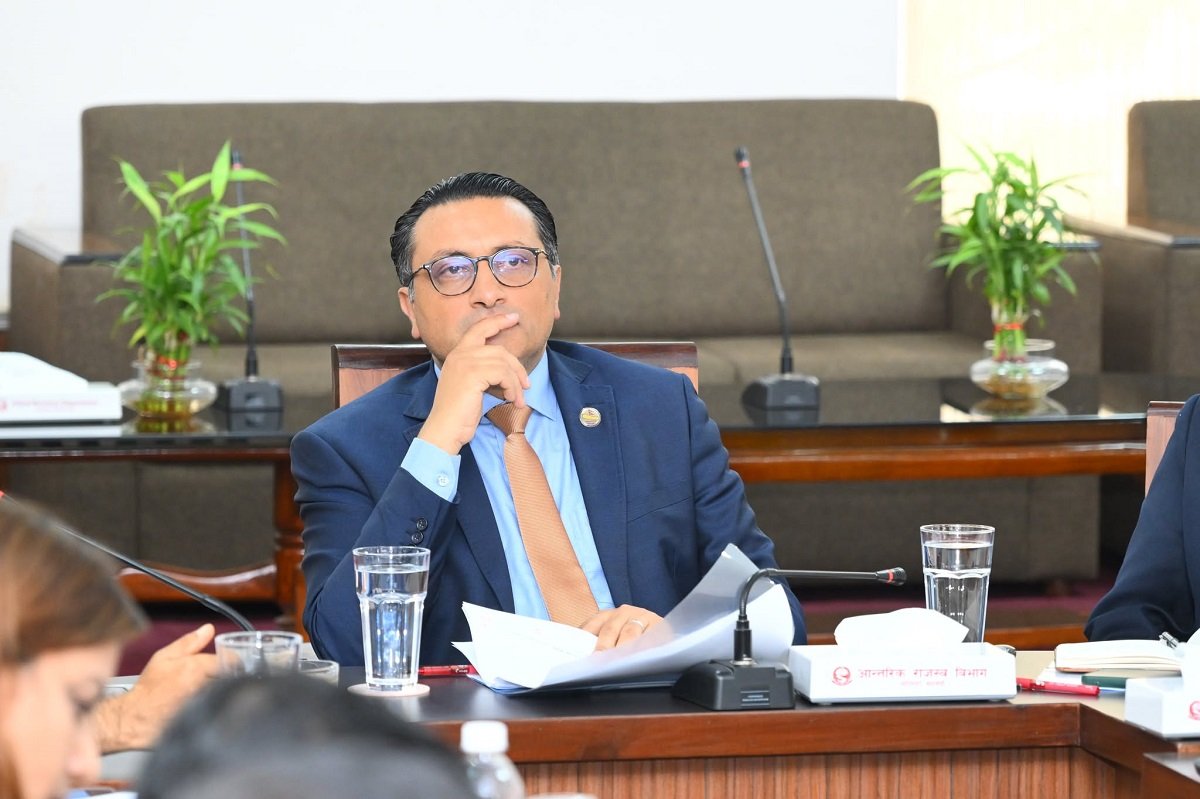
Prabhat Lama, Minister of Economic Affairs and Planning for Bagmati Province, states that there is no scope for expanding provincial resources based on the country's economic activities and gross domestic product.
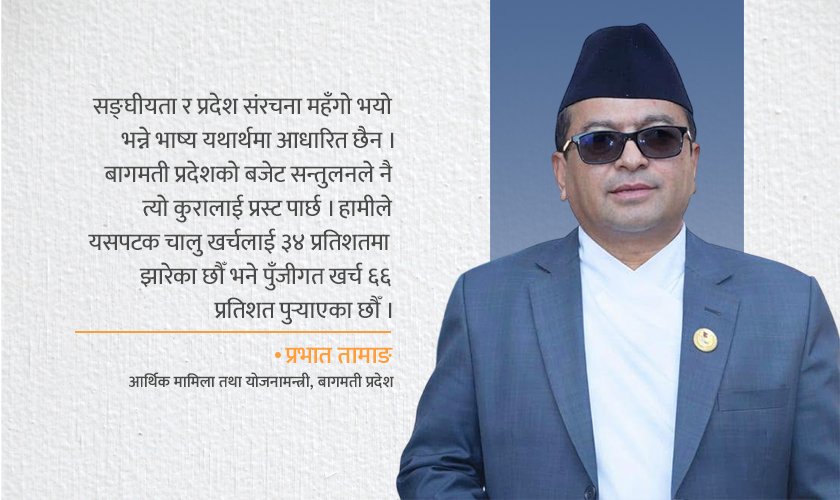
'Although the constitution has granted rights, the key to the financial resources needed to implement those rights is still held by the center,' he said. 'We have set goals to increase domestic production and create employment through agriculture and small industries, but with major and attractive revenue sources concentrated in the center, provinces cannot make the expected strides.'
3. Three-Fold Federalism and the Crisis of Provincial Identity
Stakeholders believe that another reason for the inadequacy of provincial budgets in Nepal is the country's federalism model. Nepal's federalism is more complex than that of the US or India because it has three tiers of government. The constitution has given local governments the primary responsibility for service delivery, while the center handles large projects and security.
Basic services such as education, health, drinking water, and land revenue are primarily provided by local governments. Security and large projects are still under the control of the center. Therefore, the areas where provinces are required to create mandatory obligations are narrow. This is why they do not have large budgets like in countries like India.
Raju Nepal, a former member of the Bagmati Province Planning Commission, states that provinces have failed to establish their distinct identities. He comments that provincial governments have become mere replicas of the center.
'It seems that provinces have only copied the budgets made by the center. They have neither been able to identify new revenue sources nor spend the allocated budget effectively,' he said. 'In such a situation, instead of positioning themselves as engines of development, they are stuck in the work of supporting cadres and scattering budgets on small, fragmented projects, which has led to a decline in provincial effectiveness.'
4. Lack of Laws and Contraction of Authority
Even though a decade has passed since the promulgation of the constitution, the absence of federal police, federal civil service, and federal transport acts has tied the hands of the provinces. Without their own employee administration and security mechanisms, provinces are unable to exercise even the limited rights they have been granted.
- Effectiveness of Resource Mobilization Also Questioned
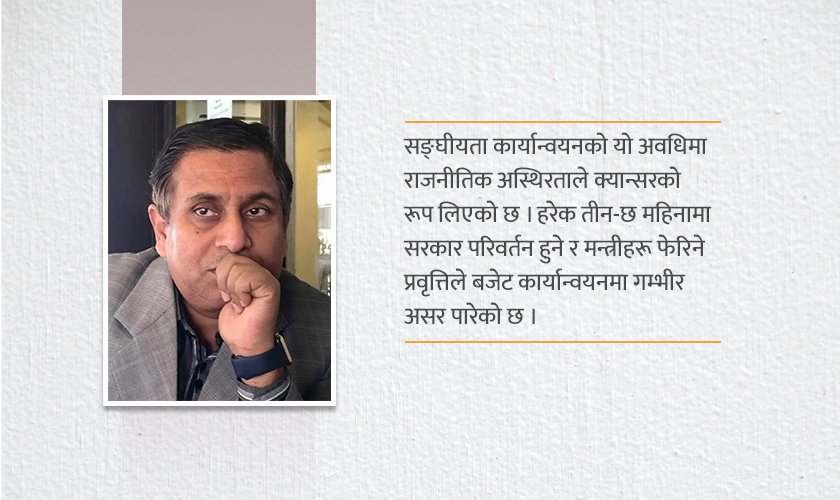
While blaming the center for not providing resources, serious questions have also been raised about the capacity of the provincial governments themselves. The average budget expenditure of only 35 percent for the first eleven months of the current fiscal year highlights the financial discipline and implementation capacity of the provinces.
Taking Bagmati Province as an example, a large portion of the total budget is going towards administrative expenses and unproductive sectors. Former acting chairman of the commission, Gurung, said, 'Provinces have introduced a culture of pocket budgeting. Budgets are allocated based on political influence rather than feasibility studies and priorities of projects. Although it is said that provinces should not look at projects smaller than 5 million rupees, if you look at the red book, you will find thousands of fragmented projects worth 1-1.5 million rupees. How can such a working style justify the existence of provinces?'
Raju Nepal's analysis also suggests that provinces are not focusing on increasing capital expenditure and creating new revenue bases. He said, 'Provinces are losing the moral authority to demand more rights from the center. The tendency to not be able to spend the money received but always blame the center is discrediting federalism itself. Fiscal federalism cannot be strengthened without provinces improving their efficiency.'
However, Prabhat Lama, minister of the Bagmati government, claims that the situation is not entirely negative. He said, 'We have tried to present a realistic budget this time. The budget is focused on completing incomplete projects and creating employment. However, the center should not see provinces merely as units but should accept them as governments and be generous with resources and authority.'
Minister Lama believes that provinces have been proving themselves in recent times. He stated that provinces are implementing socialist-oriented programs such as free services in health and technology-friendly investments in education.
He said, 'There were some problems in the past due to various reasons. But the provincial government has now become organized. The fact that two-thirds of our budget is capital expenditure is proof of this. Recently, we have streamlined various bodies transferred from the ministry and above by adjusting and abolishing them. This is why capital expenditure can increase even when employee salaries are raised by 21 percent.'
He also urges for development work to be handed over to provincial governments. He said, 'The federal government should look after policy making, security, and foreign affairs. Local levels should handle basic services. Development work is the responsibility of the provinces.'
According to Minister Lama, this is the main essence of federalism. He stated that there is no alternative to implementing it.
This specific news has been automatically translated by AI. As a result, there may be some inaccuracies or language errors.