Communist Leader Pun States Nepal is Geopolitical Center Amidst Global Power Tussle


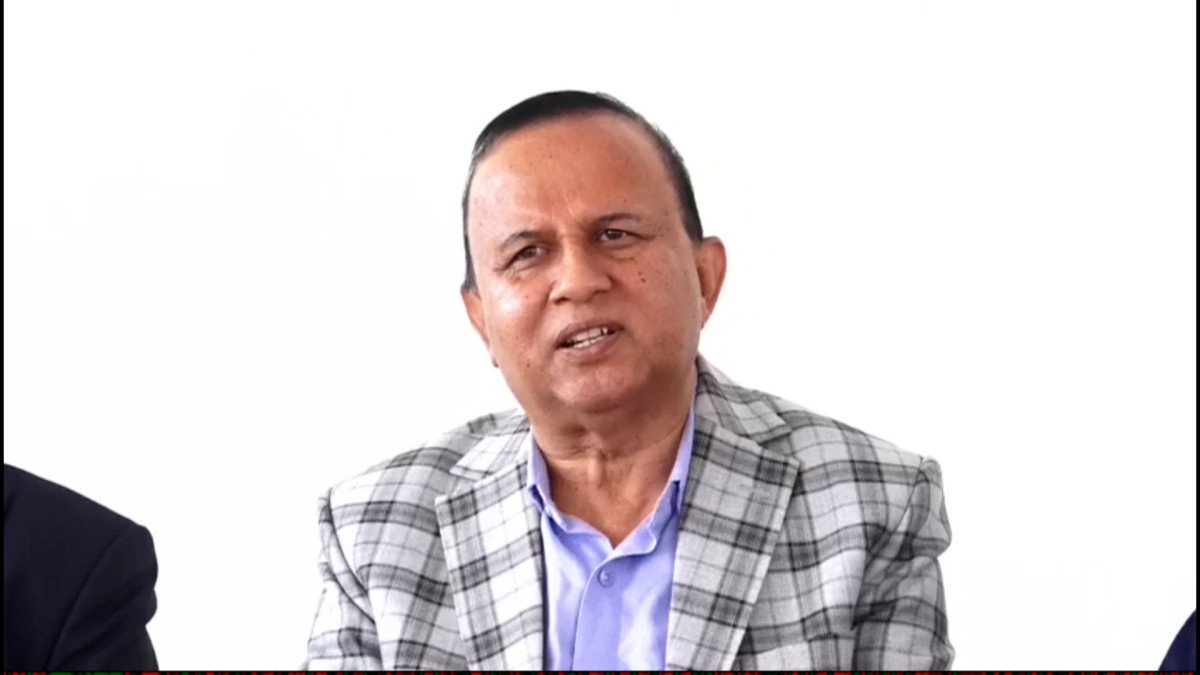
Kathmandu. Nepali Communist Party (NCP) leader Varshaman Pun Ananta has stated that Nepal is at the center of geopolitics. Pun said this while addressing the National Unity Gathering of the party-affiliated intellectual organization in the capital on Saturday.
He claimed that Nepal is caught between the rivalry of new and old world powers. He stated that the changing global political balance is affecting Nepal.
Pun pointed out the need for a national perspective on how Nepal can remain separate from such rivalries. Pun claimed that the center of global politics is shifting towards Asia, with world powers moving towards China and India.
“The center of world power is shifting towards Asian land, this is a reality. World powers are coming around China-India. Due to this, there is naturally a tussle between the old power and the new power,” Pun said, “Nepal is one of the centers of that. We cannot stay out of it even if we want to. Geopolitics is not solely in our hands.”
He clarified that Nepal's internal mistakes or faults are not solely responsible for the potential geopolitical changes and the resulting rivalries or interventions. However, Pun stated that Nepal must be vigilant about how to deal with geopolitical 'interests'.
He discussed that the main reason for the communist parties losing public mandate in the last election was the inability to preserve the unity of the NCP formed in 2074 BS. Pun mentioned that the path forward cannot be determined without self-reflection on how public trust in communist parties weakened.
“The public became disappointed when the nearly two-thirds mandate received by the Communist Party in 2074 BS was not utilized as expected. There is a question of why the Communist Party, which received two-thirds majority, became defensive,” Pun said, “We must resolve that question, we must self-reflect. We must self-reflect on where we became disconnected from the people in terms of ideology, leadership, working style, and organization.”
He appealed not to be discouraged by recent events, stating that the future of the socialist movement in Nepal is alive and that they have the possibility to advance it. He argued that the return of a communist-background party to government in Sri Lanka after a long time, a young person with socialist ideology winning the mayoral election in a center of capitalism like New York, USA, and people carrying the communist flag in protests in America and European countries indicate that the future of the socialist movement is not over.
“Communists are running the government in Sri Lanka. While everyone is saying there is no future for socialism globally, a socialist candidate won the mayoral election in New York, the center of capitalism, with the slogan that laborers should at least get a place to live. Socialism has already won in New York, and it seems strange that we are afraid to talk about socialism in Nepal, but this is not the case. Today, people in America and European countries have started walking around carrying the communist flag.”
He argued that the Communist Party, which played a decisive role in bringing about the republic, inclusivity, secularism, and establishing social justice, had to become defensive because it could not establish the importance of those achievements.
He discussed that there is a single reason why the public gave their mandate to Congress in the first general election held in 2015 BS after the end of the Rana regime in 2007 BS, to Congress in the 2047 BS parliamentary election and the then left front, to the then Maoist after the 2062/063 revolution, and to the Rastriya Swatantra Party (RSP) in the elections after the 23rd and 24th youth movements.
“In every election, whoever has fought against power and irregularities has received the public mandate,” Pun said, “The public felt that the RSP took ownership of the youth movement. The public voted for it, believing it fought for good governance. Whoever fights becomes the alternative. The public gives them a majority.”
Pun stated that they will now fight against discrimination, arbitrariness, threats to nationality and constitutional rights, and the current ruling tendency to disregard the parliament. He questioned why the NCP, with 17 seats, could not secure a two-thirds majority, while the RSP, with 20 seats, achieved nearly two-thirds by fighting.
“We must be able to fight, and we will fight, on issues such as ruling by ordinance despite having a majority, curbing people's rights, disrespecting parliament, abolishing trade unions opened using constitutional rights, and baseless statements about India encroaching on our borders,” Pun said, “We will fight for democracy. We can fight for socialist revolution by making ourselves relevant. If we fight, the public will trust us.”
He expressed doubt about the sustainability of popularity gained through virtual means, recalling the history where the public, who celebrated the 'coup' by former King Gyanendra Shah, later ousted him from power.
This specific news has been automatically translated by AI. As a result, there may be some inaccuracies or language errors.