
South Asian Nations Discuss Geopolitics and Strategic Autonomy Amidst Great Power Competition

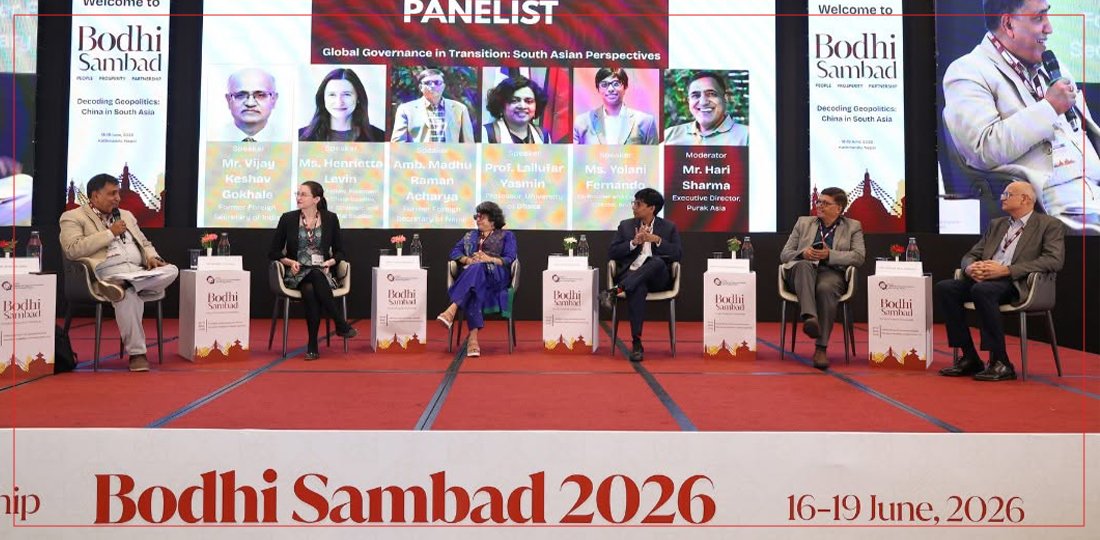
Kathmandu. The 'Center for Social Innovation and Foreign Policy' has been organizing Bodhi Dialogue for the past three days. On the third day of the dialogue on Thursday, discussions were held on the regional geopolitical landscape and the strategic autonomy of small nations.
Vijay Keshav Gokhle, former Foreign Secretary of India, who was the chief speaker at the event, discussed China's BRI and its strategic impact, stating that China is deeply involved beyond trade and commerce, extending to security and cultural spheres.
Gokhle claimed that South Asian countries are not only benefiting economically from China, but the Chinese side is also involved in the politics and national security of those countries. He highlighted the change in China's 'forward security perimeter', claiming that China is increasingly entering South Asian security and politics.
At the same event, Henrietta Levin of CSIS claimed that China is trying to build a world order favorable to itself and is actively working to displace India's influence in the region. She said, 'China's recently released Global Governance Strategy (China-centric) is an attempt to establish a world order.'
According to Levin, Beijing is actively working to displace India's regional influence and build an international system conducive to authoritarianism, while showing full commitment to its core interests regardless of the governance system of partner countries.
Former Foreign Secretary Madhuraman Acharya stated that China has now become a permanent reality in South Asia and that small countries may fall under bilateral pressure in the absence of a regional security mechanism. He argued that the lack of a collective security structure in the region is the reason why various countries are under bilateral pressure.
Former Foreign Secretary Shanker Das Bairagi said that the era of unilateral diplomacy is over. He expressed the view that small countries should build strong internal consensus in international forums and speak with one voice.
Bairagi stated that regional countries must secure their leadership before advancing India as a global ambition.
Professor Lailufar Yasmin of Bangladesh clarified that Bangladesh is not anyone's playground, claiming diversification in development diplomacy. Rejecting the notion that Bangladesh is China's playground, she claimed that a strategy of development diplomacy has been adopted with global partner countries.
Sri Lankan economic expert Yolani Fernando said that Sri Lanka's economic crisis was not caused by the 'Chinese debt trap' but by its own weak public sector capacity and declining tax revenue.
Emphasizing that Chinese state-owned enterprises are highly profit-oriented, she clarified that South Asian countries will not be able to effectively regulate incoming foreign capital or protect their national interests unless they prioritize domestic governance and legal reforms.
Former Indian Ambassador Pankaj Saran stated that South Asia has entered a 'post-infrastructure era' and that infrastructure alone cannot prevent economic crises.
He claimed that Chinese state-affiliated companies control Nepal Telecom's main mobile network and urged small countries to avoid the monopoly of Western and Chinese technology.
Hasan Mehdi, CEO of CLN, Bangladesh, said that due to the administrative delays of Western lenders, countries like Bangladesh are attracted to Chinese commercial loans with weaker environmental standards.
Former Finance Minister of Nepal, Rameswor Khanal, said that government officials are afraid to make project decisions due to fear of the authority or anti-corruption bodies. He stated that ending administrative bottlenecks is more important than amending the Public Procurement Act.
Talal Rafi, a fellow at the World Economic Forum, and Dr. Pradeep Taneja from the University of Melbourne, said that small states are caught between great powers through political unity and constructive diplomacy.
Advocate Baburam Aryal, co-founder of the Internet Governance Institute, accused Nepal of using foreign equipment to digitize the cabinet's 'war room' by circumventing procurement laws. He also stated that the state's sensitive data is insecure due to the absence of a separate data protection law.
Former US Assistant Secretary of State Tom Malinowski said that Western powers should respect South Asia's desire for strategic ambiguity and offer the best development models unconditionally instead of applying diplomatic pressure.
Vijaykant Karna, Executive Chairman of CESIF and former Ambassador, said that South Asian countries should not only be arenas for great power competition but should also play their own active role.
This specific news has been automatically translated by AI. As a result, there may be some inaccuracies or language errors.

-(2)_QJLjKxR87n.jpg)