Discussions on Dengue Vaccine in Nepal Remain Inconclusive

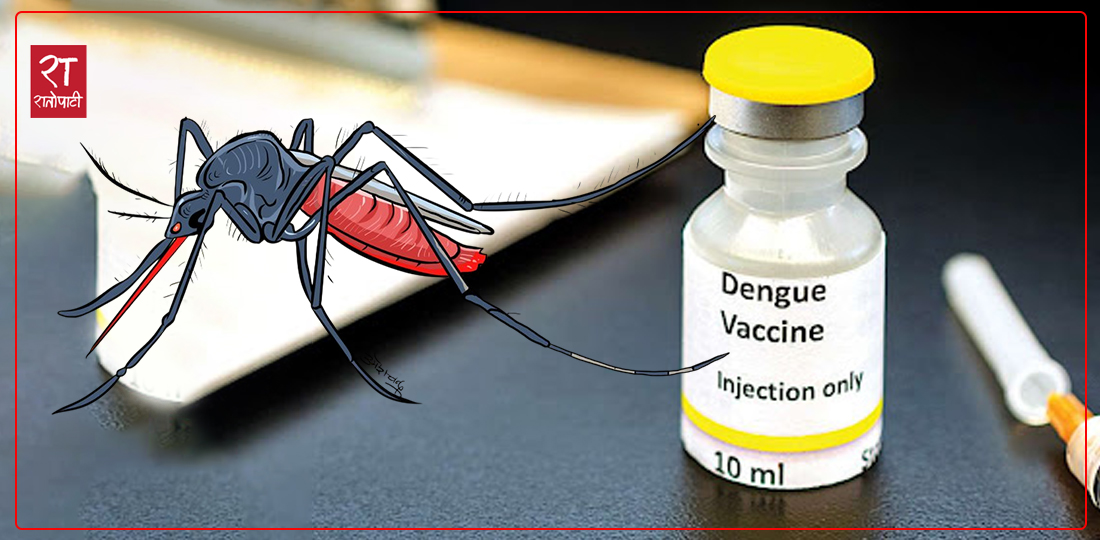
Kathmandu. Despite repeated discussions with stakeholders regarding the introduction of a dengue vaccine in Nepal, it has not yet been implemented. Dengue vaccine has not been easily available even though dengue is seen every year. The Ministry of Health and Food Hygiene has not reached a concrete conclusion despite discussions with the World Health Organization and technical experts. Dr. Anuj Bhattachan, acting Director-General of the Department of Health Services, stated that further understanding of the vaccine's development stage and its compatibility with Nepal's public health programs and strategies would lead to further processes. Dengue infection is confirmed every year in Nepal. The number of deaths due to dengue is increasing. Dr. Bhattachan said, 'Vector-borne diseases are managed at their source for eradication and control. Vaccination is also a tool for management after the disease occurs or before it occurs.' He mentioned that he was aware of various research works and vaccine development happening internationally, including in countries that have faced dengue problems. However, he stated that the stage of vaccine development needs to be considered, and whether it aligns with our public health programs and strategies. The Epidemiology and Disease Control Division under the Department of Health Services has admitted that discussions with the World Health Organization and technical experts regarding the introduction of dengue vaccine in Nepal have taken place but have not reached a conclusion. An official from the Division said, 'The World Health Organization had given a worldwide suggestion to administer two vaccines not in mass vaccination groups but to targeted groups for individual vaccination.' He mentioned that one of these vaccines, 'Dengvaxia,' is produced by a company that has now closed down, and another vaccine is made by a group called Takeda. According to that official, there are mainly four serotypes of dengue. He informed that the vaccine's efficacy has been observed in two of these serotypes. Further studies on the effectiveness in the remaining two serotypes are ongoing. He said, 'Because of this, all four serotypes are seen in Nepal. Also, the vaccine is said to be more effective when administered only to the age group up to 16 years. It has been said that its effectiveness is less in the age group above 16 years.' He added, 'Looking at the context of Nepal, most of those affected by dengue are above 15 years of age. When all four serotypes are circulating, it is not enough for us to bring a vaccine that works only for two serotypes.' Dengue viruses are of different types, called serotypes. According to doctors, infections of four serotypes – Dengue 1, 2, 3, and 4 – have been observed in Nepal. Dengvaxia (CYD-TDV), developed in 2015, is the world's first proven vaccine against dengue. That official said that the department had discussions in the presence of experts and the vaccine manufacturing team. He said, 'Many discussions have taken place on this subject. Discussions were held two years ago as well. We discussed whether a dengue vaccine could be introduced and used.' However, he stated that those discussions have not reached any conclusion. According to the Epidemiology and Disease Control Center, dengue is a type of vector-borne disease transmitted by mosquito bites. It is transmitted by the bite of infected Aedes aegypti/albopictus mosquitoes. Dengue infection was first detected in Nepal in 2004.
This specific news has been automatically translated by AI. As a result, there may be some inaccuracies or language errors.