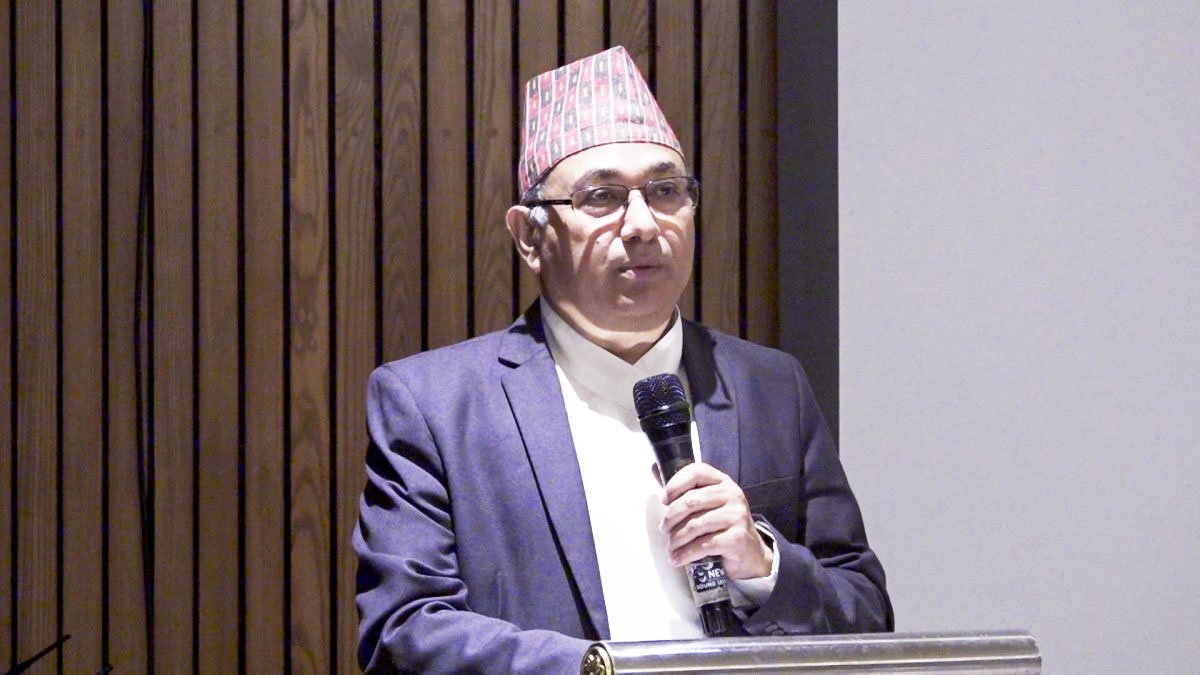
Janardan Sharma: Nepali Communist Movement on Brink of Collapse Due to Ideological Contradictions

_fwfFaTGV0L.jpg)
Kathmandu. Progressive Democratic Party leader Janardan Sharma has stated that the Nepali communist movement has reached the brink of collapse due to a serious contradiction between its core philosophy and practice. Speaking at a discussion program for the book 'History of Philosophy' on Wednesday, he expressed the view that the Nepali communist movement is in crisis because it has not been able to properly embrace Marxist philosophy. Sharma clarified that the essence of Marxist philosophy is not just to interpret society and the world but to change it. He commented that the movement has been weakened by the distance between bookish philosophy and life practices, excessive inclination towards parliamentarianism, and the tendency to rigidly confine Marxism. Sharma accused leaders who strongly advocate for materialist philosophy of becoming idealists in their practical lives. He honestly admitted that he himself has such weaknesses and limitations, stating that the communist movement has reached this stage due to the dual character of leadership that is materialistic in speech and idealistic in life. He said, 'Philosophers have interpreted what Marx said in various ways, but the main point is to change, which is the essence of Marxist philosophy. Due to the inability to embrace this essence and the contradiction between bookish philosophy and life practices, the Nepali communist movement has reached the final brink of collapse today. On one hand, there are responsible forces or individuals adopting the path of parliamentarianism and its idealism, while on the other hand, there are those who rigidly confine Marxism. Due to both these problems, the Nepali communist movement, instead of applying the philosophy, especially historical dialectical materialism, to life practices and advancing based on that understanding to change society and the world, has reached a point where materialistic leaders talk about a fusion of materialism and idealism. Since then, we have more visibly felt the difference between bookish philosophy and life practices. Similarly, due to communist leaders who are materialistic in speech and idealistic in life, shaped by such schooling, training, and practices, this situation has arisen. These problems seen in me, others, and top leaders have brought the communist movement to the brink of collapse today.' During his address, leader Sharma also stated that it is time for a serious debate on whether a genuine communist party currently exists in Nepal. Questioning on what principles a communist party should be recognized, he accused Nepal's communist parties of being unable to connect with the real lives of the people and even unwilling to do so. He commented that it is as clear as daylight that even those claiming to be connected with the people are progressing in an idealistic manner. He claimed that the communist movement has failed to provide true leadership to the oppressed classes, castes, regions, languages, and gender communities of the country and to bring about changes in their living standards. Sharma stated that the displacement of the landless, the deprivation of the lower class from state services, resources, and opportunities, and the persistence of linguistic, cultural, class, and ethnic discrimination are proof of the communist movement's significant weaknesses. He pointed out that the communist parties are the main reason for the current disappointing political situation in the country. He explained that the communist parties' popular support is declining day by day due to their inability to firmly stand by the people's problems and their involvement in anti-people activities such as various forms of corruption. Referring to the current state of the parties, he said, 'Who should be called a communist party today? On what principles should a communist party be recognized? It is evident that communist parties have not connected with the lives of the people, with the people. It is also apparent that they do not want to connect. It is as clear as daylight that those who claim to be connected are progressing in an idealistic manner. Therefore, does a true communist party exist in Nepal today? This debate is necessary. This discussion and debate are a need of the hour from a philosophical perspective, a political perspective, a class struggle perspective, and a societal transformation perspective.' Sharma expressed the view that true transformation of society is possible only through a revolutionary Marxist direction and thinking. He also lamented that when he raised this revolutionary idea and belief within the then-Maoist party, he had to be expelled from the party.
This specific news has been automatically translated by AI. As a result, there may be some inaccuracies or language errors.

_Op5LNdEvfb.jpg)