
Supreme Court Orders Government to Remove Encroachments on Sidewalks

_cvUCBlwFTZ.jpg)
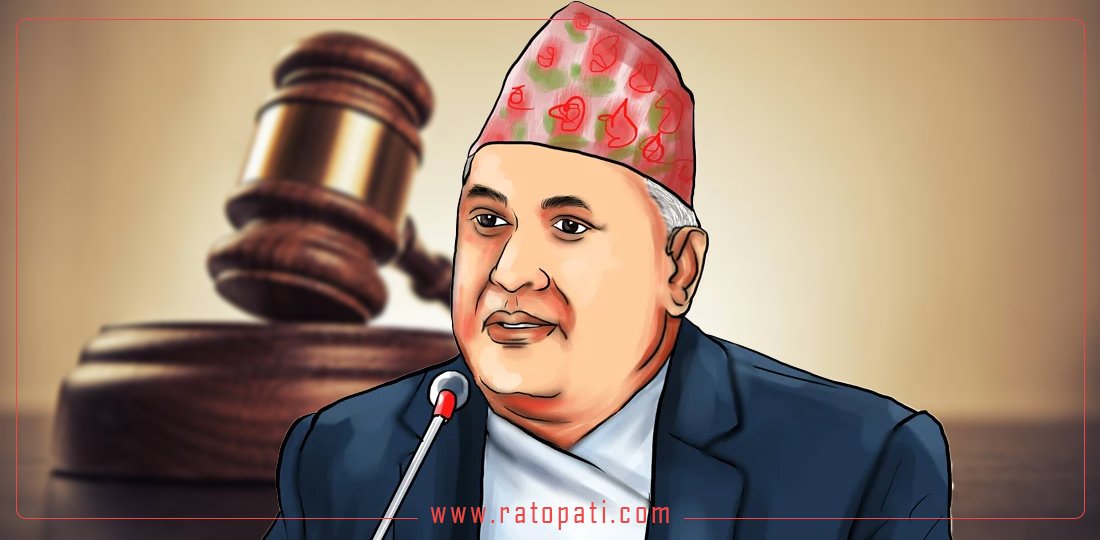
Kathmandu. The Supreme Court has issued a mandamus order in the name of the government to immediately remove encroachments on sidewalks. In the writ filed by advocate Sudhigya Pant, a joint bench of Justices Hariprasad Phuyal and Nripadhwaj Niraula issued a mandamus order in the name of the government to immediately remove encroachments on sidewalks. The full text of the verdict, delivered on Mangsir 17, 2081, was made public, issuing a mandamus order regarding the right of pedestrians to use sidewalks.
The Supreme Court has issued a mandamus order in the name of the government to issue necessary directives from the Ministry of Home Affairs, which is the respondent in the case of police posts being set up on sidewalks, and from its subordinate bodies, to remove any other encroachments on sidewalks, and to remove such encroachments. The order states that the government, the Ministry of Home Affairs, the Ministry of Physical Infrastructure and Transport, the Ministry of Urban Development, and the Kathmandu Metropolitan City are the respondents.
Similarly, in places where sidewalks are encroached upon by private individuals, companies, and non-governmental organizations by placing construction materials, platforms, verandas, or any other type of materials or structures, the respondents Kathmandu Metropolitan City and the respondent ministries have been ordered to coordinate and issue a public notice to remove the encroachments on the sidewalks, specifying an appropriate time and issuing directives. The Supreme Court's mandamus also states that if the encroachments on the sidewalks are not removed as per the notice, necessary and appropriate steps should be taken to coordinate and take action to remove such encroachments.
It has also been stated that all concerned federal units and subordinate respondent bodies should issue necessary directives and take all actions to inspect and maintain sidewalks of roads under their jurisdiction that are damaged, destroyed, or have open drains, to minimize and prevent situations where anyone loses their life or property by falling into drains.
Furthermore, the Supreme Court has stated that if there is any ambiguity in the jurisdiction between the respondents regarding the removal of encroachments on sidewalks and sidewalk management, coordination should be done on the basis of cooperation, coexistence, and mutual assistance.
The Supreme Court has also presented three examples while issuing the mandamus order in the name of the government. These include the incident on Kartik 12, 2075, where a cyclist lost his life after falling into an open drain; the incident on Magh 9, 2078, where a rare wild animal, a rhinoceros, lost its life after falling into a pit dug during road construction; and the incident on Asoj 8, 2078, where a child lost his life after falling into an open drain during the rainy season. In other words, the verdict states that the right of pedestrians to walk freely and easily on well-managed sidewalks falls within the scope of the right to live with dignity guaranteed by Article 16 of the Constitution of Nepal.
The petitioner had demanded that in cases where any person loses their life or property as a result of disorganized sidewalks, open drains, obstructions or man-made structures on roads or sidewalks, compensation should be paid according to tort law, and when determining compensation, Medical Expense, Punitive Damage, Future Economic Loss, and Damages with respect to pain and anguish should be considered as a basis, and if such acts fall under criminal standards beyond the standards of tort, criminal legal proceedings should be initiated.
In relation to these demands, the Supreme Court has mentioned in its verdict that according to the concept of public tort and the Civil Code, 2074, Sections 2(c), 42, 44, 672, and 675, if any public official or employee fails to perform their public duty, the government body in which they are employed shall bear the indirect liability for the tortious act.
The verdict also states that the conditions and requirements for the victim to prove such liability have already been discussed above and are not being repeated here.
Furthermore, the court has stated that since it is desirable to decide on compensation to be paid by the state and concerned government bodies to the victim for damages suffered due to public tort, as per Section 682 of the Civil Code, 2074, the court should decide on reasonable compensation when the case is being heard, and therefore, there is no need for further discussion.
This specific news has been automatically translated by AI. As a result, there may be some inaccuracies or language errors.
-(2)_QJLjKxR87n.jpg)