Nepal Announces Ambitious 'Quad Project' for Economic Growth

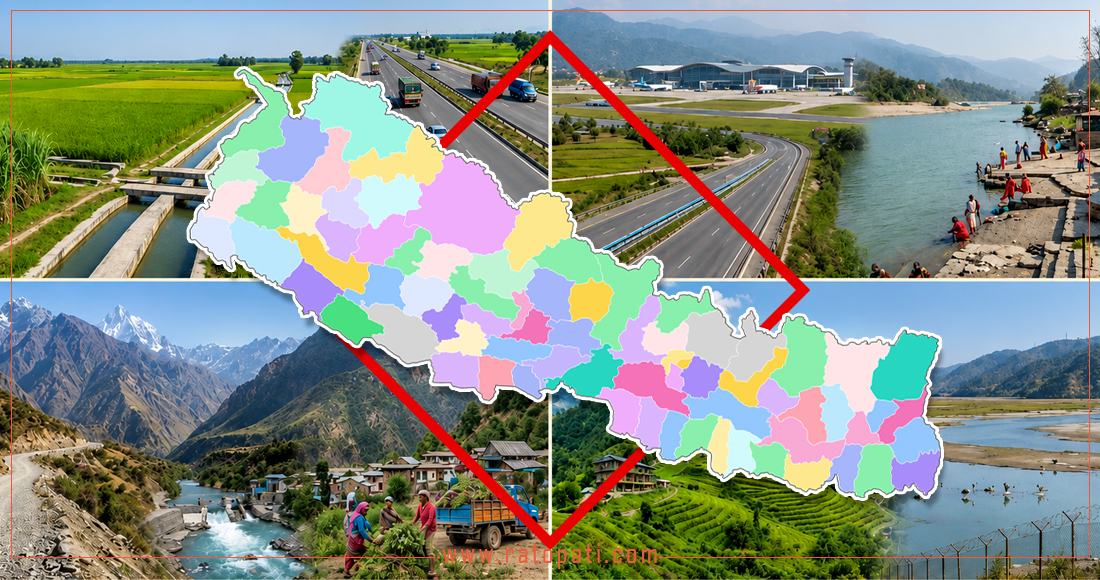
Kathmandu. The government has announced a highly ambitious 'Quad Project' (Chaturbhuj Project) through the budget for the upcoming fiscal year (2083/084) with the objective of accelerating economic prosperity by breaking the economic slowdown. Finance Minister Dr. Swarnim Wagle presented the concept in the budget speech on Jestha 15, proposing an integrated approach to infrastructure, tourism, agriculture, and hydropower sectors to develop various geographical regions of the country as 'growth poles'.
Although this project is considered a 'game-changer' for Nepal's development model at the policy level, its practical implementation appears to be extremely challenging. Despite the announcement of the plan, the lack of budget allocation, local levels hindering development construction, and weak inter-ministerial coordination have led experts to express concerns that the plan might remain a mere attractive slogan confined to paper.

- What is the outline of the 'Quad Project' in the budget?
Point number 21 of the budget speech clearly states the intention to increase investment in the all-round regional development of rural and semi-urban areas with high potential for economic growth. Finance Minister Dr. Wagle announced that an integrated plan for policy and physical infrastructure will be implemented to develop such areas as 'growth poles and quads'.
The government has envisioned three quadrilaterals and one corridor (path) primarily based on the country's geography and potential.
First, Mid-Madhesh Quadrilateral: Under this, the command area of 122,000 hectares irrigated by the Sun Koshi-Marin Diversion will be the base, completing the remaining work of the Hulaki and East-West Highway expansion to connect agriculture and industry.
Second, Karnali Quadrilateral: By connecting the Mid-Hills (Pushpalal) Highway, Karnali Highway, Bheri Corridor, and the area from Rara to Jumla and Mustang, the development of herbs, hydropower, tourism, and mining activities will be undertaken.
Third, Gandaki Quadrilateral and Shaligram Path: The goal is to expedite the completion of the Butwal-Narayangadh section of the East-West Highway and the Mugling-Damouli-Pokhara section, and transform the Siddhartha Highway into an international standard. The origin area of the Kaligandaki civilization will be focused on pilgrimage and clean enterprise-business, while integrating Triveni Dham, Devghat, Ruru Kshetra (Ridi), Kagbeni, Muktinath, and Damodar Kund to develop the 'Shaligram Path'.
Nirvana Path and Northern Border Network: The 'Nirvana Path' will be promoted based on the Lumbini-Muktinath religious-cultural route. It will integrate meditation, spiritual practice, yoga, Buddhist-Vedic philosophy, and the Himalayan cultural experiences of Manang, Mustang, and Myagdi. Additionally, northern eco-trade destinations such as Olangchunggola, Kimathanka, Tatopani, Rasuwagadhi, Korala, and Hilsa will be connected with the Mid-Hills Highway.
Koshi Corridor: The Koshi Corridor plan will be advanced, focusing on biodiversity conservation and clean energy development, encompassing the area from Koshi Tappu to Kanchenjunga.
Far-West 'Tourist Quadrilateral': A unique 'tourist quadrilateral' will be developed in the Sudurpaschim Province, covering the areas of Ramaroshan, Khaptad, Badimalika, Shaileshwori, Ugratara, and Mallikarjun.
Previously, in the budget for fiscal year 2081/082, former Finance Minister Barshaman Pun had proposed a 'Triangle Project' connecting Bhairahawa, Bharatpur, and Pokhara. However, this project did not come into implementation.
- What is the Quad Project?
The Quad Project, put forward by the government through the budget speech for the upcoming fiscal year, is a multi-dimensional development model that integrates infrastructure, tourism, agriculture, and hydropower sectors, according to Arjun Jung Thapa, a member of the National Planning Commission and infrastructure expert.
According to Thapa, this project is not limited to a single sector but is a strategic program that interlinks various economic and infrastructural dimensions. For example, its goal is to connect the religious tourism of Janakpur with the hydropower (Tamakoshi) and tourism of the hilly regions, and to link tourist areas like Lumbini, Pokhara, and Muktinath through integrated infrastructure. He clarified that its main objective, like the 'Triangle Project' included in the current budget, is the economic progress of the country.
- How will it be implemented and what are the challenges?
Although currently included in the budget speech, the implementation is in the preliminary stage, and the plan is to proceed with implementation only after study, according to National Planning Commission member Thapa. He said, 'This project is currently in its preliminary stage. Its concrete and refined form will be made public after a detailed study.'
Due to the lack of inter-ministerial coordination (e.g., the Ministry of Forest not allowing trees to be cut, the Ministry of Energy not relocating poles), such large projects often get stuck. Acknowledging that national projects are affected by weak inter-ministerial coordination, member Thapa informed that efforts are underway to make the National Planning Commission more empowered.
He stated that the current government has shown special interest in strengthening the National Planning Commission, whose role has been shrinking in recent years, functioning merely as a small appendage assisting the Ministry of Finance. He added, 'The budget announcement includes merging separate bodies like the Policy Research Institute into the National Planning Commission to make it a one-stop policy center.' 'It may take an additional 6 to 8 months to legally empower the commission, for which a new law will have to be passed. After that, the commission will present itself in a new and stronger form from next year.'
- Local levels themselves are obstacles to development
While this project looks beautiful at the policy level, its implementation on the ground is dire. Arjun Jung Thapa, a member of the National Planning Commission and infrastructure expert, makes serious accusations that the non-cooperation of local levels and economic exploitation are the main reasons for development projects being stalled.
Thapa presented the dire example of the four-lane expansion project of the Butwal-Gorusinghe section (50 km) of the Mahendra Highway. He claimed that local levels, including the Butwal Sub-Metropolitan City, instead of facilitating this national pride project funded by the World Bank, burdened the contractor with additional financial costs, causing them to flee.
'When the contract was awarded, the rate for gravel (sand and aggregate) per cubic meter determined by the District Administration Office was Rs 1,000. But when the contractor went to the field to work, the local municipalities increased the royalty for construction materials extracted from the Tinau and Danu rivers to Rs 1,600,' Thapa said. 'With the royalty alone set at Rs 1,600, the cost of materials per cubic meter, including transportation and other collection expenses, exceeds Rs 2,500. The construction entrepreneur stated they could not work with such expensive materials and abandoned the work.'
He indicated that national importance projects like the 'Quad Project' are likely to be stalled due to this 'loot' in the use of local resources.
- 'Only integrated development yields results'
The core essence of the 'Quad Project' is to solve problems like digging roads in the name of development without vehicles plying on them, and building irrigation canals while fields remain barren. Ashish Gajurel, chairman of the Infrastructure Committee, stated that development projects do not yield expected results when operated in isolation.
'Roads are built, but if we don't connect them with production, the roads do not yield results,' Gajurel said. 'We need to integrate transportation required for agriculture and tourism, water for irrigation, and the electricity generated from it.'
He claimed that multi-purpose projects like the Sun Koshi-Marin Diversion project, in which he is involved, which produce both irrigation and electricity, can change the face of the country. He mentioned that similar 'combination'-based models have been successful abroad.
- Benefit: An effective remedy for increasing migration and disorganized urbanization
This concept is considered highly relevant in the context of the increasing trend of small and fragmented projects not being completed on time and merely draining state resources. Economist and former Vice-Chairman of the National Planning Commission, Dr. Govinda Pokharel, considers this project an excellent management tool for the changing demographic situation.
In recent times, the hilly and rural settlements of Nepal are rapidly emptying, while cities and the Terai region are becoming overcrowded. 'This project can do a great job of managing the current increasing migration and urbanization,' said Dr. Pokharel. 'Scattered settlements in villages are gradually decreasing. People are moving towards cities, towards densely populated areas. In such a situation, the strategy of building infrastructure in economic growth centers like Bhairahawa, Pokhara, and Chautaura and bringing their surrounding produce to the market is scientific.'
The problem of migration highlighted by Dr. Pokharel is also confirmed by the data from the National Census 2078. According to the census, about 31.5 percent (more than 9.3 million) of the country's total population is living outside their birthplace. As people increasingly move from the hills and mountains to the Terai and cities, the population growth rate in 34 hilly and mountainous districts has become negative. Only the Terai region hosts 53.61 percent of the country's population.
In the 2068 census, the Terai population was 50.27 percent, which increased to 53.61 percent in 2078. Conversely, the hill population decreased from 43.01 percent to 40.31 percent, and the mountain population decreased from 6.73 percent to 6.08 percent. This confirms the one-way migration from the hills and mountains to the Terai.
According to expert Pokharel, concepts like the 'Quad Project', which create economic opportunities in the Karnali and Gandaki regions, are a correct step, albeit late, to prevent this alarming demographic imbalance of emptying villages and increasing pressure on urban areas.
Pokharel stated that the 'Triangle' concept previously proposed by former Finance Minister Barshaman Pun has been modified to connect development from four angles. He recalled that the plan to develop ten new cities along the Mid-Hills Highway in the past was also brought with a similar goal of creating 'growth centers'.
- Empty Pockets, Big Dreams: How will the Quad be built?
The biggest irony of this project is that although the Finance Minister announced it loudly in parliament, no separate budget has been allocated for it in the budget book. Economist Dr. Pokharel is concerned that this tradition of presenting a plan without allocating a budget might turn it into another 'populist' slogan.
'The government has announced it, but has not allocated a budget,' said Dr. Pokharel. However, he also suggested an alternative. According to him, the budget allocated for roads and bridges can be redirected towards this.
'In the future, when fiscal policy or monetary policy is introduced, incentives can be given to those investing in that sector. To promote organic farming, hotel businesses, and adventure tourism in such areas, private sector should be provided with tax exemptions, concessional loans, and grants,' he said.
Meanwhile, Ashish Gajurel, chairman of the Infrastructure Development Committee of the House of Representatives, argues that a budget is not needed in the initial phase. 'Once the project title (budget heading) is decided, the budget can be brought at any time as needed. Initially, there will be study and tender processes, so a large budget is not immediately required,' he clarified.
- If good governance is guaranteed, the private sector is ready to invest
It is impossible to achieve the ambitious goal of 7 percent economic growth through the government's efforts alone. Private sector investment is essential for this. Kamlesh Kumar Agarwal, President of the Nepal Chamber of Commerce, states that the private sector is ready to invest heavily in this project if the government guarantees good governance.
'It is difficult to achieve the growth rate target without expanding activities in every sector. There is encouraging investment in the energy sector, and five-star hotels are being built in tourism,' said President Agarwal. 'However, the government must facilitate the implementation of the policies committed in the budget.'
He is optimistic that with the government having a nearly two-thirds majority in parliament, laws and regulations can be amended on a 'fast track'. However, he has serious concerns about administrative good governance and the functioning of the bureaucracy. 'Currently, the government is merging ministries to cut expenditure, which has disrupted administrative work. We expect the mechanism to become capable after this management is completed,' he added.
- 'There is no separate budget heading; funds will be mobilized in an integrated manner'
The Ministry of Finance has stated that there will be no separate specific budget heading for the implementation of the 'Quad Project' announced through the budget for the upcoming fiscal year (2083/084). Although there is no separate budget heading, the ministry has stated that the government's various ministries will prioritize these quadrilateral regions when formulating their annual development programs and plans.
Clarifying the context of some ambiguity in the implementation framework due to the absence of direct budget allocation for the ambitious 'Quad' development concept encompassing Karnali, Mid-Madhesh, and Gandaki regions, Ministry of Finance spokesperson and Joint Secretary Amrit Lamsal informed that this is not a single or separate project but an integrated model of regional development.
According to spokesperson Lamsal, instead of allocating funds under a separate budget heading for the Quad Project, the regular budgets of the concerned ministries will be coordinated and mobilized under this concept.
He clarified that while it cannot be said that a specific amount has been allocated for this, the budgets allocated to the Ministry of Tourism, the Ministry of Physical Infrastructure and Transport, and other relevant ministries will be mobilized to support the quadrilateral approach (quadrangle approach).
Under this framework, the Ministry of Tourism will focus on tourism promotion activities, and the Ministry of Physical Infrastructure will focus on road improvement and other infrastructure development plans within those regions, with the budgets of all ministries being directed towards the same goal in a policy sense, according to spokesperson Lamsal.
This specific news has been automatically translated by AI. As a result, there may be some inaccuracies or language errors.