Nepal Considers Open Book Exams Amidst Mobile Destruction Controversy

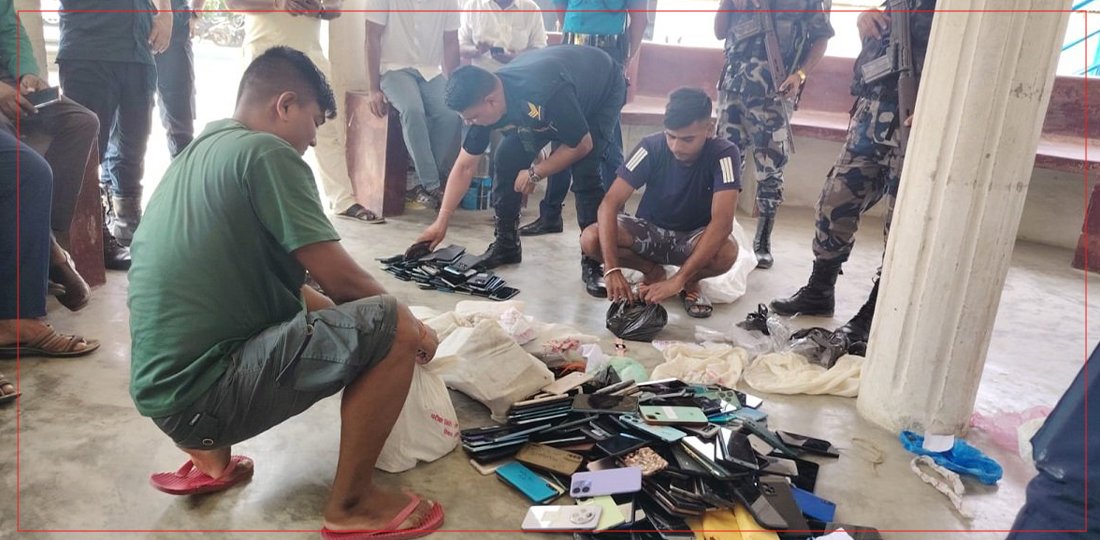
The incident in Siraha where the administration destroyed four hundred ninety-six mobile phones and five smartwatches worth more than crores, confiscated during the Secondary Education Examination (SEE) and Grade 12 examinations, has sparked an uncomfortable but necessary debate across the country.
The question is not why students took mobile phones to the examination center. The question is why our examination system forced students to choose such a path? Why is our education system making students memorize instead of encouraging them to think and experiment?
Therefore, the incident in Siraha is not just a matter of discipline; it is a question of our entire evaluation system. Hence, the Siraha incident should be taken as a starting point for moving towards a new examination system.
The incident in Siraha is a symptom, not the disease. The disease is in our examination system. When question papers are still designed in a format of definitions, bullet points, textbook paragraphs, and 'write what you remember, otherwise you're done,' students' attention is focused not on the meaning of knowledge, but solely on the source of the answers.
Previously, there was cheating; now there are mobile phones; tomorrow, there might be AI-enabled devices. But the fundamental problem remains the same. If the examination design is weak, technology will always be a tool for copying, not for learning.
Drowning and destroying mobile phones is a display of administrative rigidity. Preventing phones from being used in the exam hall, confiscating them, and destroying them does not provide a solution. Destroying devices will not stop the challenges of the information age. Rather, it shows that even in the 21st century, we have not been able to move beyond the 20th-century examination mindset.
In such a situation, the memory-based examination system should not only be a subject of reconsideration but should become an immediate agenda for reform. Nepal must now take a step towards open book exams. To make education practical and scientific, and to make examinations disciplined, adopting open book exams seems necessary.
- What is an Open Book Exam?
An open book exam is an evaluation system where one can take the exam by looking at books. Students are allowed to use certain types of reference materials in the examination hall, such as textbooks, their own notes, formula books, legal codes, case materials, or other approved sources. In other words, it is an examination system where answers can be written using books and other reference materials, and in some cases, even digital devices.
This does not mean students are allowed to copy answers by opening books. Its core philosophy is related to the skill of understanding and applying knowledge, not memorizing it.
In the traditional closed-book examination system, it is seen 'what the student remembered.' In an open book exam, it is seen 'what the student understood, how they applied it, and why they reached that conclusion.' Even with books present, the examination time is fixed. The questions are complex, and direct copying is not possible. Students must find facts from the source and construct meaning from them.
For this reason, open book exams are considered not easy, but in many cases, even more challenging. This is because memory alone is not enough; conceptual clarity, analysis, reasoning ability, example selection, time management, and writing skills are also essential.
In an open book examination system, the questions are such that even with books, answers cannot be given without understanding the concepts. If students are asked to provide local context, comparisons, analysis, case studies, and reasoning, the justification for hiding mobile phones diminishes on its own. Where books are open, the value of cheating decreases; where thinking is open, the meaning of copying is reduced.
Therefore, considering the Siraha mobile incident merely as a violation of discipline will not be far-sighted. It should be made a starting point for reforming the examination system. The administration destroyed the confiscated materials; now the state should show the courage to destroy the old mindset.
A major problem in Nepal's school and university level education is rote learning. Students memorize answers to potential questions without understanding the essence of the lesson, and forget them within a few days. Such education can provide certificates, but cannot enhance capabilities.
The biggest contribution of open book exams is that they shift the focus of learning from memorization to understanding. Students should know where a concept is, why it is important, under what circumstances it is used, and how to justify their conclusions. This promotes long-term learning.
Second, it develops critical thinking in students. Questions are generally not of the 'define' type, but rather involve comparing two perspectives, proposing solutions for a given situation, critically reviewing based on examples, analyzing given data, etc. Such questions demand not only the textbook but also the student's intellectual engagement.
Third, it reduces the fear of exams. In Nepal, exams are still experienced more as punishment than a celebration of learning. The pressure to memorize everything increases anxiety, stress, and fear of failure in students. The open book examination system alleviates the mental burden of having to remember everything. This does not mean encouraging carelessness, but rather changing the pattern of preparation.
Fourth, it connects education with real life. In the workplace, no one asks a doctor, lawyer, engineer, administrator, journalist, or researcher to make decisions by 'memorizing everything.' They refer to contexts, read data, consult laws, analyze reports, and seek expert opinions. If the real world operates on open resources, why should exams remain confined to closed books? In fact, the High-Level Education Commission in Nepal has also suggested conducting open book exams.
Open book exams are not a new concept in many countries around the world. Especially in higher education, professional education, and fields like law, medicine, management, and engineering, it has been used for a long time.
Many universities in America use 'open book,' 'open note,' and 'take-home' assessments according to the nature of the curriculum. Their emphasis is increasingly on applying concepts, case analysis, and constructing arguments rather than memorizing facts. Similarly, universities in the UK have adopted open-source-based assessments, particularly in essay-based, legal, social science, and research-oriented subjects.
Many institutions in Australia and Canada have adopted open book or open resource assessments as effective tools, not alternatives, to test students' higher-order thinking.
In India, the National Education Policy 2020 emphasizes conceptual and skill-based education by reducing rote learning. Accordingly, the Central Board of Secondary Education has initiated pilot practices related to open book exams, adopting this system to test new types of questions, especially in some subjects for Grade 9 at the secondary level. This is in a phased implementation stage in India.
What Nepal can learn from this is the changing reality of education. However, for its successful implementation, caution and phased implementation are necessary, not haste.
The success or failure of open book exams fundamentally depends on the design of the question paper. If the same old questions are asked with open books, it will only encourage the habit of copying from books. Therefore, in this system, students are generally asked to analyze a real or hypothetical situation. They are asked for step-by-step solutions, alternatives, and justifications for a given problem.
Students are asked to compare two theories, policies, methods, or perspectives and draw conclusions. They are asked to apply learned concepts in new contexts. They have to analyze the strengths and weaknesses of an argument, policy, article, decision, or data. They are asked to interpret tables, maps, graphs, quotes, or documents. Answers should be based on reasoning, evidence, and structure, rather than a single correct answer.
For example, in Social Studies, instead of 'Define federalism,' a question like 'Evaluate the changes brought about by Nepal's federal structure in service delivery with an example from a local level' might be more appropriate.
Although open book exams are a good concept, significant effort is needed for their implementation in Nepal. The biggest challenge is the capacity to create question papers. Extensive training is required to make teachers proficient in question design.
The second challenge is that if the teaching style is not changed, changing only the exam will not yield the expected results. If classroom practice remains only 'write the answer in this number of words,' then open book exams will be only in name and will not deliver results.
The third challenge is equality. The resource situation of all schools in Nepal is not the same. The level of materials, libraries, digital access, and teacher support available in private and urban schools is generally weaker in rural and community schools. If the implementation of open book exams leads to inequality in access to materials, it can create new discrimination.
Fourth, there is the challenge of exam management and monitoring. Clear policies are needed on what materials to allow, the role of mobile phones or the internet, the limit of notes, how to regulate the examination hall, and how to standardize evaluation criteria.
Fifth, changing mindsets is difficult. Parents, teachers, administrators, and some policymakers still doubt, saying, 'Is an exam taken by looking at a book really an exam?' They might say, 'Just give a passing certificate.' While this doubt is natural, facts show that a poorly designed open book exam is weak; a well-designed open book exam can be very strong.
If Nepal is to move towards open book exams, it should not overturn the entire system in haste. However, remaining only in discussion is no longer sufficient. Some concrete steps can be taken immediately. First, a pilot program should be started. Testing should be done within a limited scope by selecting classes and subjects. Second, a national question paper framework should be developed, which can develop sample questions based on higher-order thinking, analysis, application, and reasoning.
Third, teacher training should be central. Teachers are the backbone of this reform. Fourth, the evaluation guidelines should be clarified. When checking answers, importance should be given to reasoning, structure, relevance, and evidence, not word count.
Fifth, there should be a separate digital policy. Open book does not automatically mean uncontrolled internet. In the initial phase, a 'restricted open book' model – textbooks, personal notes, approved materials – might be more practical. Sixth, public dialogue is necessary.
The four hundred ninety-six mobile phones and five smartwatches drowned in Siraha are not just devices; they are symbols of the contradictions in our examination system. By destroying them, we have acted upon the symptoms, not the cause. If Nepal is to learn a serious lesson from this incident, the debate must now move beyond discipline to the philosophy of evaluation.
Today's student cannot succeed by merely remembering knowledge; they must know how to find, understand, test, connect, and responsibly use knowledge. That skill is essential for a 21st-century citizen, worker, researcher, and leader. Therefore, open book exams are the demand of the time.
If Nepal wants to transform its education system from a certificate-producing factory to one that produces citizens who think, question, seek evidence, and propose solutions, the examination system must change. The Siraha incident is both a warning and an opportunity for that. The decision now lies with the policymakers: whether they are satisfied by drowning mobile phones or by drowning rote learning in history and opening the door to a new era.
This specific news has been automatically translated by AI. As a result, there may be some inaccuracies or language errors.



_6FSvCrCShE.jpg)