
Nepal Praja Parishad Merges with CPN (UML)
Kathmandu. Nepal Praja Parishad, which blew the bugle of revolution against the autocratic autocratic Rana rule, has become extinct in the pages of history.
Nepal Praja Parishad was established under the leadership of Tanka Prasad Acharya on Jestha 20, 1993 BS. The Rana rulers hatched many assassination conspiracies against Nepal's first political party and the organization was destroyed.
In 1997 BS, some of its key members; Dasharath Chand, Dharmabhakta Mathema, Gangalal Shrestha, etc. were murdered. After the success of the 2007 BS revolution, the Ranas were removed from power.
After the establishment of democracy, Acharya was released from jail. At that time, he was a senior member of the Nepali Congress. But the dispute between Matrika Prasad Koirala and BP Koirala intensified within the party. Due to disagreements with the party, Acharya and Bhadrakali Mishra separated from the party.
Acharya reactivated Praja Parishad in 2015 BS. In 2012 BS, King Mahendra made him the Prime Minister. However, in the general election of 2015 BS, Acharya and Mishra contested the elections separately.
In the election, Nepal Praja Parishad (Acharya) and Nepal Praja Parishad (Mishra) participated in their respective forms. In that election, the Acharya group won 2 seats with 53,380 votes. Mishra's group secured 49,820 votes and won 1 seat.
In 2017 BS, after King Mahendra overthrew the elected government and implemented the Panchayat system, the Mishra group merged with the Nepali Congress.
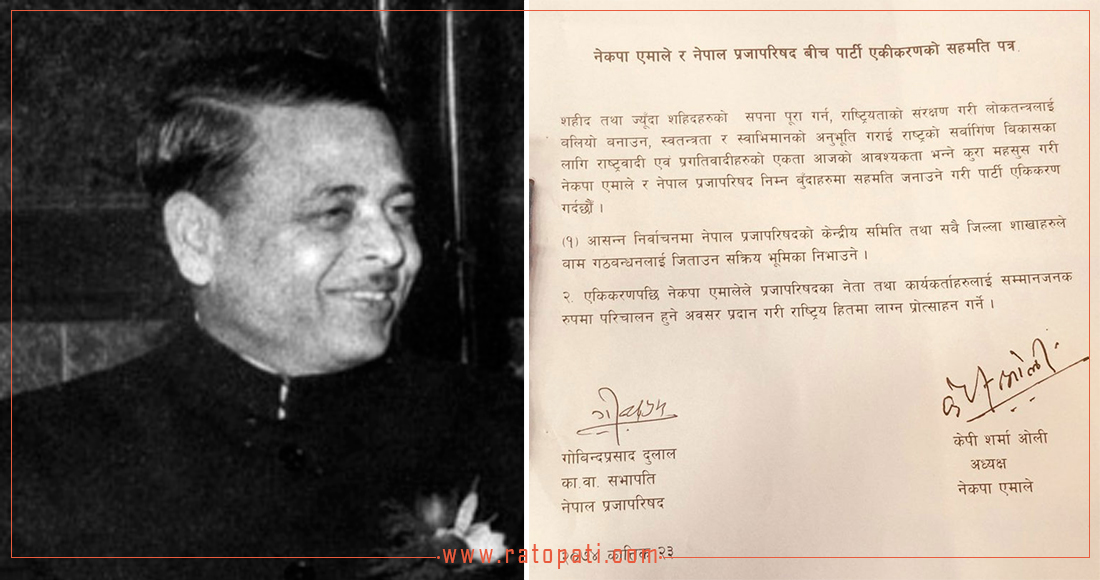
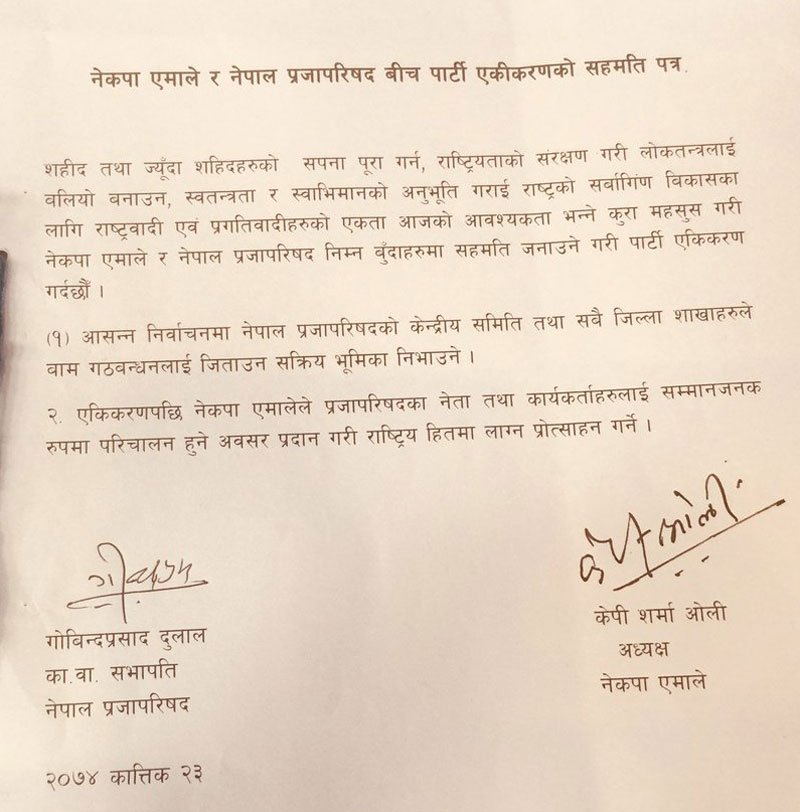
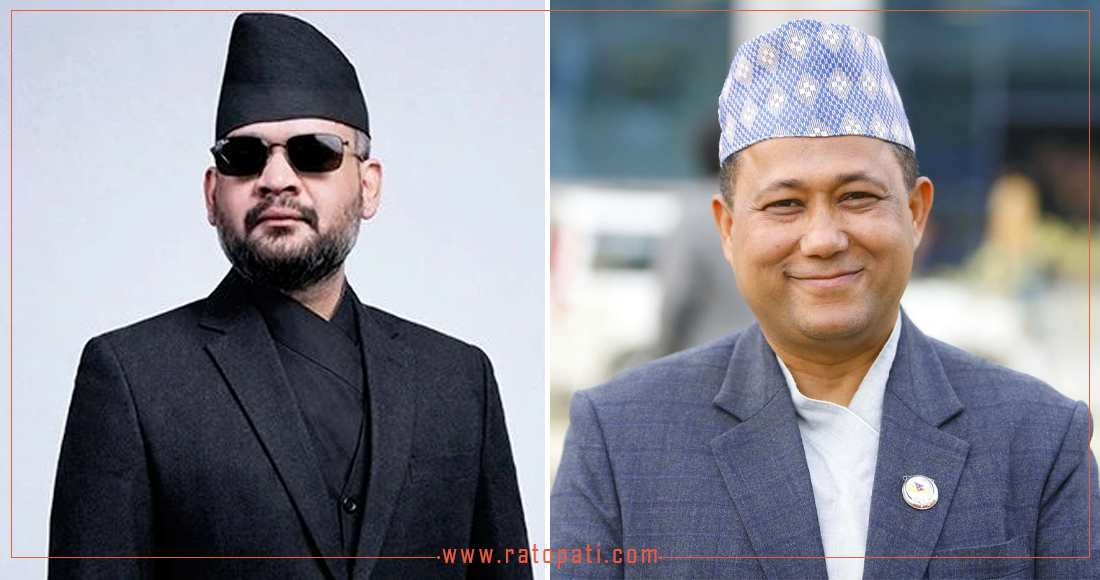
Nepal's first revolutionary political party Praja Parishad and the Communist Party of Nepal (Unified Marxist-Leninist) merged on Kartik 23, 2074 BS. With the end of Rana rule, the then chairman of this party, Govinda Prasad Dulal, and UML Chairman KP Sharma Oli signed the merger agreement.
- How was Praja Parishad opened?
At that time, no one dared to speak against the Rana rule, which had held power for over a century. But this party was opened through the initiative of conscious and aware youths like Tanka Prasad Acharya, Dasharath Chand, Ramhari Sharma, Dharmabhakta Mathema, Gangalal Shrestha.
At a time when the 'Quit India Movement' had started in neighboring India at the call of Mahatma Gandhi, these youths (named above) who were there for work and other purposes were influenced by the movement. With the activism of the youths who saw and experienced it there, Praja Parishad was established under the chairmanship of Acharya and Chand with the objective of ending the Rana rule in Nepal. However, before the establishment of that party, the 'Nepal Nagarik Adhikar Samiti' was formed under the chairmanship of Shukraraj Shastri, which was abolished by the then Rana government a year after its formation.
Tanka Prasad Acharya, Dasharath Chand, Ramhari Sharma, Dharmabhakta Mathema, and Jivaraj Sharma concluded that it was imperative to establish a party to agitate against the Rana rule. Acharya and Chand proposed the name Nepal Praja Parishad at a hotel in Bhimphedi, Makwanpur.
They announced an agitation to uproot the dictatorial Rana rule that had been entrenched for years. However, the intellectuals of the upper class at that time were not ready to support the uneducated, laborers, and farmers in that movement. But, this party was formed after Acharya and Chand's campaign received support from other classes.
Its central office was located at Dharmabhakta Mathema's house in Om Bahal, Kathmandu. He was also the gym instructor of the then King Tribhuvan. Other members of this organization included Chudaprasad Sharma, Govinda Prasad Upadhyay (Poudyal), Pushkar Nath Upreti, Mukunda Nath Rizal, Bal Bahadur Pandey, Dhruvprasad Dawade, Phanindranath Satyal, Hari Krishna Shrestha, Chakra Bahadur Khatri, Ganeshman Singh, Ramji Shrestha, Chandraman Shrestha, and King Jayaprithvi Bahadur Singh of Bajhang. King Tribhuvan indirectly supported that movement.
Initially, Praja Parishad distributed handwritten pamphlets. In Nepal, pamphlets against Rana rule were written by an Indian socialist newspaper 'Janata' and another newspaper 'Advance' published from Calcutta. Later, Tanka Prasad Acharya brought a printing machine from India. The party distributed pamphlets against the Rana rule to influence the general public. They started publishing articles in newspapers and putting up posters on walls. Later, upon receiving information about a plan to assassinate high-ranking Rana officials, the then Prime Minister Juddha Shamsher ordered the arrest of the main members of the group. In 1997 BS, Dharmabhakta Mathema, Dasharath Chand, Gangalal Shrestha, and Tanka Prasad Acharya were sentenced to death. Acharya was not given the death penalty because he was a Brahmin. At that time, Nepali law prohibited the killing of Brahmins.
After its execution (tameli), Acharya's sentence was commuted to life imprisonment. After the main leaders were executed, Praja Parishad was dissolved in the same year. Shukraraj Shastri (who was not involved in that movement), Mathema, Chand, and Shrestha, who were intellectuals against the Ranas, were executed. They are known as the four martyrs who sacrificed themselves against the autocratic Rana rule.
The Nepali National Congress was formed on Magh 12, 2002 BS, with Acharya, who was in jail, as its chairman. However, being in jail, he could not proceed with dialogue with the Nepali Congress. Later, BP Koirala was selected as the acting chairman of that party.
In 2017 BS, after King Mahendra overthrew the elected government and imposed the autocratic Panchayat system, Acharya appeared inactive in politics. The party's activities could not move forward. After the political change of 2046 BS, the party fielded candidates in some constituencies in the elections of 2048, 2051, and 2056 BS, informed Govinda Prasad Dulal.
According to Dulal, the fifth general convention of the party was held in Sarlahi in 2053 BS. After the death of Chairman Ramhari Sharma, known as the 'living martyr' of the anti-Rana movement, on Ashwin 24, 2069 BS, the party was almost on the verge of dissolution. After Sharma's death, Dulal took over the leadership.
- How did it merge with UML?
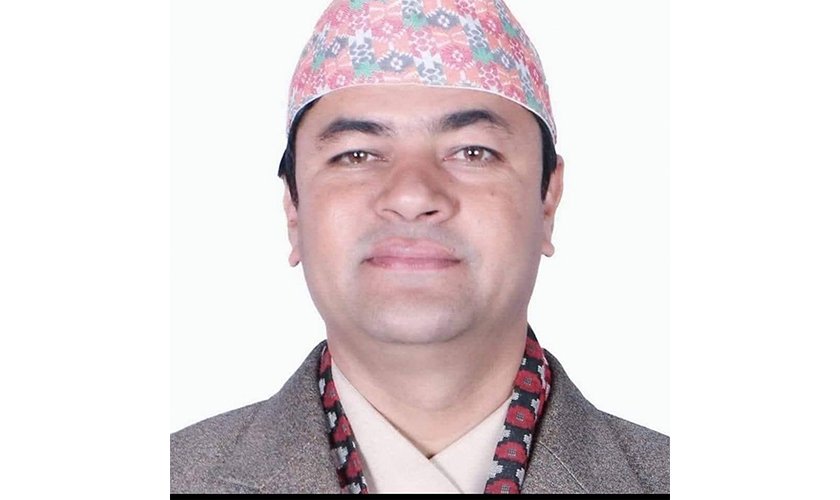
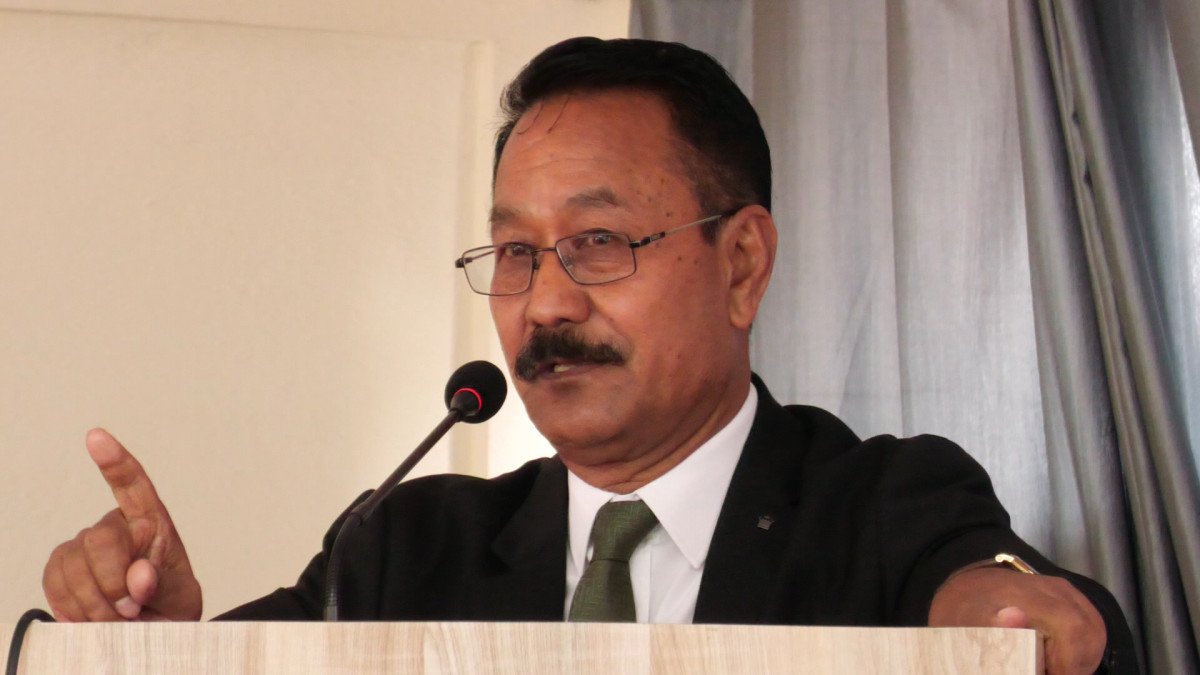
How did a revolutionary party with a proud history reach the stage of merger? The views of Govinda Prasad Dulal, the then chairman of Nepal Praja Parishad and currently a member of the UML Central Disciplinary Commission, are presented as they are:
The fifth general convention was held in 2053 BS at a place called Naya Road in Sarlahi. That convention formed a new working committee of 25 members under the chairmanship of Ramhari Sharma. After that convention, Praja Parishad's general convention could not be held formally. His (Ramhari's) activity also decreased due to old age. Due to the Maoist People's War, the organization could not be as active. After that, the party's activities gradually decreased. In the 2056 BS election, Praja Parishad fielded candidates in 21/22 places. Dr. Meena Acharya, daughter of the founding chairman Tanka Prasadji, contested from Kathmandu-2. After getting a small number of votes, on the eve of the 2062/63 movement, she realized that it was difficult for intellectuals to do politics and brought the younger generation forward. Meena ji stayed as an advisor.
In 2056 BS, I was the spokesperson of the party. I was in charge of the main publicity, having left the position of student organization president for the responsibility of party spokesperson. The Praja Parishad could not get the expected votes in the election. After that, we formed a front of small democratic parties. It was a front including Praja Parishad, Janata Parishad, Hariyali, Prajatantrik Lokdal, Rastriya Prajatantra Party (Nationalist), etc. As all the fronts started giving their own candidates in the election, that front also could not function. In this process, we could not advance the party's activities. Praja Parishad agitated for the achievement of the republic. It participated in the movement for the republic. During the movement for the republic, Keshav Sthapit became the acting chairman of the party. He did not go for the UML and Malé merger. He came to Praja Parishad and worked for some time. Under Keshav ji's leadership, we participated in the movement for the republic at that time. During the 2062/63 movement, I, Keshav, Bhim Kadayat, and others were arrested. We concluded that with the achievement of the republic and the subsequent new constitution, provisions like the 3 percent threshold and winning at least one direct seat would make it impossible to run the party. Meanwhile, our respected chairman Ram Hari Bua also passed away. As long as he was alive, we did not raise the issue of merging Praja Parishad or doing anything else. He had not accepted that. After his death, with the older generation all gone and the new generation unable to advance the organization and the party, the question of what to do arose. Discussions were also held at the Tanka Prasad Acharya Smriti Pratishthan about what to do with Praja Parishad. At that time, Daman Nath Dhungana was the chairman of the Pratishthan. During the discussions, the elders of the Pratishthan decided that the party's affairs would be handled by the party itself, and the Pratishthan would not say anything. After that, in terms of responsibility in the party, Bhim Kadayat ji was the vice-chairman. He also joined the Maoists after the end of the Maoist People's War. After Keshav Sthapit also became the chief of the Bagmati Improvement Project, the responsibility of the party came to my shoulders as the second vice-chairman. In 2064/65 BS, I held a youth gathering and discussed whether the party could be advanced.
At that time, I had not taken the leadership. Rahari Bua gave me a letter asking me to hold a youth gathering. He had given a letter to prepare for the youth gathering to form an organizing committee for the preparation of the general convention. I was the spokesperson at that time. Based on that letter, I held the gathering. But that gathering could not advance the party much. After that, we discussed what to do. Two years passed in discussions. Then, by 2074 BS, issues started coming from various angles. It was said that Praja Parishad was just a name, only issuing a statement, and then questions arose whether this party existed or not. At one point, having completed important work, the main objective of Praja Parishad's establishment was the end of Rana rule. That work was completed. Therefore, its responsibility is over, let's dissolve it, was a topic discussed in the Pratishthan and the party. And I proposed that dissolution is not good, but merging would preserve history. The youth friends agreed with my point. Then the issue of party merger came up. There was a long discussion about whom to merge with. We were engaged in discussions for about three to four months. In 2003 BS, the conference of the Nepali National Congress, established in Calcutta, India, also made Tanka Prasad the chairman and BP the acting chairman. In that context, some friends proposed merging with the Nepali Congress. When discussing with the elders, it was found that after Tanka Prasad was released from jail, a joint front held in the presence of Pushpalal made him chairman. We found that he had a history of working closely with the leftists. Similarly, when he became Prime Minister in 2013 BS, he lifted the ban on the Communist Party. The ban on the Nepal Communist Party in 2010 BS was lifted by Tanka Prasad's cabinet in 2013 BS. The leftists challenged the palace for the first time by pulling a chariot, stating that not only kings and emperors but also the sons of the people could ascend the chariot, and his 75th Diamond Jubilee was celebrated around 2045 BS at the initiative of the leftists.
Considering all these factors, Tanka Prasad was close to the leftists, so it was decided to merge with the leftists. We decided to merge with the CPN (UML) among the leftists. On Kartik 23, 2074 BS, UML and Nepal Praja Parishad merged.
This specific news has been automatically translated by AI. As a result, there may be some inaccuracies or language errors.
-(2)_QJLjKxR87n.jpg)