
Infrastructure Ministry Directs Termination of Stalled Construction Projects, Triggering Conflict with Contractors

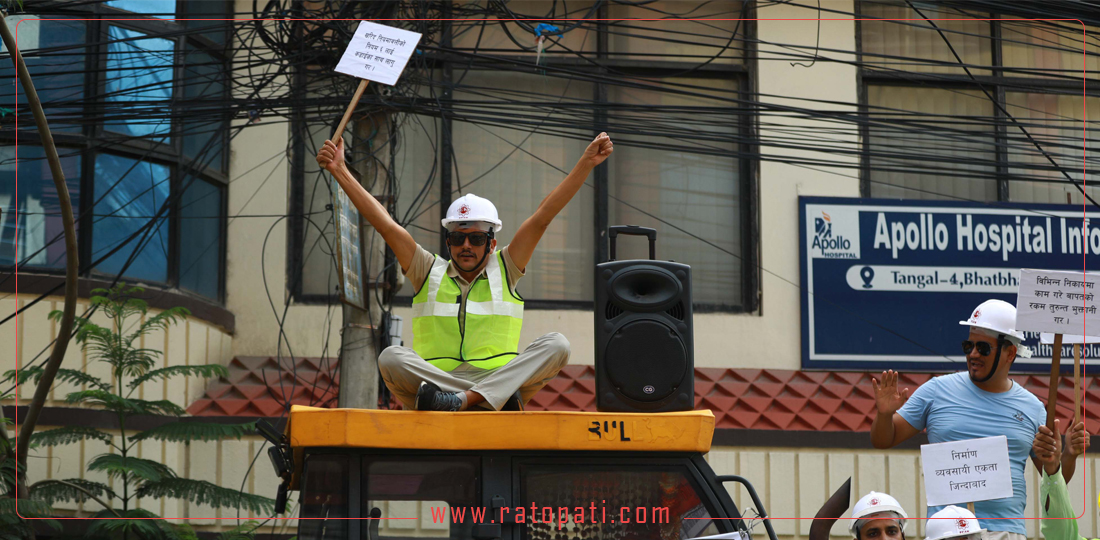
Kathmandu. The Ministry of Physical Infrastructure Development has directed to immediately terminate the contracts of stalled construction projects, creating intense conflict between the government and construction entrepreneurs. Entrepreneurs, who have halted work due to excessive price hikes in construction materials, have strongly protested the ministry's move, accusing the state of treating them like 'criminals'.
Entrepreneurs have warned of strong protests, stating that instead of price adjustment, the government is trying to take punitive action, which is likely to further complicate infrastructure projects across the country.
Entrepreneurs have been halting work for a long time, demanding price adjustments and contract extensions due to the increase in construction material prices. In this context, while the ministry has adopted a strict policy against non-performing contractors, the Federation of Contractors' Associations of Nepal has warned of strong protests, accusing the state of portraying them as criminals.
The government has announced that it will address the construction entrepreneurs' demand for price adjustment through the budget. Discussions on the budget are ongoing in the parliament. However, construction entrepreneurs have not resumed work, citing the government's delay in price adjustment.
- Ministry Warns of Cancelling Stalled Contracts
Secretary of the Ministry of Physical Infrastructure Development, Gopal Prasad Sigdel, has directed the Department of Roads to immediately take action against construction entrepreneurs who are delaying construction work and are absent from the work site. This directive from the ministry is particularly focused on projects where construction work has not progressed despite no obstacles from public entities.
The letter signed by Secretary Sigdel states that for projects where the physical progress is less than 90 percent even after more than 50 percent of the initial contract period has been extended, the procurement contract should be immediately terminated.
Similarly, it has been directed to initiate the process of action under Section 59 of the Public Procurement Act, 2063, for contracts where construction entrepreneurs have been absent from the work site for more than a month, deeming it pointless to continue them. The ministry has also warned that the decision-making authority responsible for the impact on project management and target achievement will be held accountable.
- Entrepreneurs' Outrage: Accusation of Government Treating Them Like 'Criminals'
The Federation of Contractors' Associations of Nepal has strongly objected to this directive from the ministry and announced a strong protest. The federation issued a statement calling the government's move inhumane and an act of mentally terrorizing entrepreneurs.
The statement issued by the federation's general secretary, Shivahari Ghimire, reads, 'Instead of the state playing the role of a guardian, threatening action by treating entrepreneurs like criminals is a mockery of basic human empathy. This has broken the trust of entrepreneurs in the state system.'
The federation believes that instead of playing the role of a guardian, the state treating entrepreneurs like 'criminals' and threatening action is a mockery of basic human empathy. According to entrepreneurs, on one hand, the construction sector is economically devastated due to price increases, and on the other hand, projects have become sick due to the government employees' failure to make timely decisions on technical issues such as design changes, variation orders, and contract extensions.
Federation General Secretary Shivahari Ghimire stated that there is a vast difference between government assurances and behavior, and the trust and hope of construction entrepreneurs in the state system have been shattered.
- The Dire Situation of Price Hikes
The federation claims that the recent abnormal price increase in construction materials has pushed the construction sector into further crisis. The direct impact in Nepal has been seen due to the rise in prices of petroleum-based products and raw materials in the international market, especially due to the Russia-Ukraine war and the US and Israeli attacks on Iran.
According to the federation's spokesperson, Mangal Bahadur Shahi, not only bitumen and petroleum products but also materials used in water supply and electricity projects have seen a price increase of 50 to 100 percent. According to data, the price of cover conductor wire has increased by about 100 percent, while seamless pipes have seen a 75 percent increase, HDPE pipes a 65 percent increase, and GI pipes a 55 percent increase. In such a situation, it is not just for the government to threaten to terminate contracts and blacklist entrepreneurs instead of providing relief through price adjustments, he argued.
State of Material Price Increases
- Cover Conductor Wire: Approximately 100 percent
- Seamless Pipe: 75 percent
- HDPE Pipe: 65 percent
- GI Pipe: 55 percent
- Fitting Materials: 50 to 60 percent
Entrepreneurs interpret the government's inability to make policy decisions regarding price adjustments for a long time after material prices increased as a weakness of the government.
- Impact of Growing Conflict on Development and Construction
The growing conflict between the government and entrepreneurs has plunged Nepal's infrastructure development into a serious state of uncertainty. The federation has warned of strengthening protest programs, including a 'construction holiday', by halting development projects operating across the country if its demands are not met. This poses a risk of not only failing to meet the government's capital expenditure targets but also creating liquidity shortages in the market and a crisis in loan recovery in the banking system.
On one hand, there is pressure from the ministry to complete projects on time and provide facilities to the public, while on the other hand, the stance of entrepreneurs unable to work due to high costs threatens to obstruct the country's development process. This conflict between the state and the construction sector increases the risk of further stalling sensitive projects like bridges, roads, and water supply across the country, which will inevitably have a direct impact on the general public.
This specific news has been automatically translated by AI. As a result, there may be some inaccuracies or language errors.

-(2)_QJLjKxR87n.jpg)