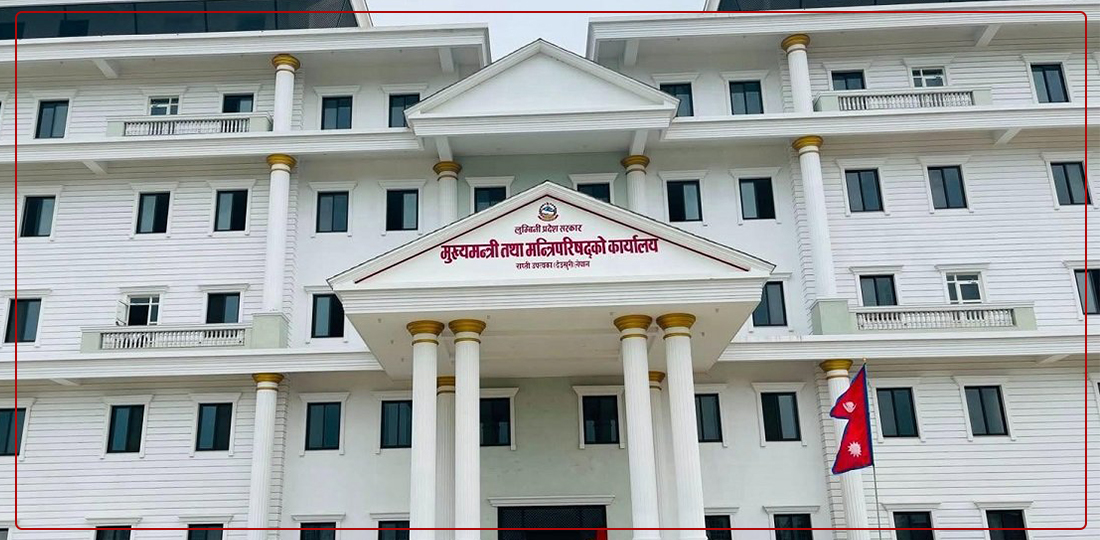
Koshi Province Government Faces Scrutiny Over 580 Million Rupees Irregularities


Biratnagar. The budget implementation and financial governance status of the ministries and subordinate bodies of the Koshi Province government appears challenging. With ministries responsible for formulating policies, rules, and laws failing to adhere to financial procedures and the Financial Accountability Act, the province government's irregular amount has exceeded 580 million rupees.
According to the 63rd annual report presented by the Office of the Auditor General to the Public Accounts Committee of the Koshi Province Assembly, the internal control system in the province's ministries and government offices is extremely weak, and a tendency to spend without legal basis has become rampant. However, when comparing the overall irregular situation of all seven provinces, the Koshi Province government's situation is the second best after Bagmati Province.
According to the Office of the Auditor General, audits were conducted for a total of 208 bodies, including ministries and subordinate offices of the Koshi Province government. Out of a total audited amount of 52 billion 384.979 million rupees in these bodies, an irregular amount of 586.683 million rupees was found. This accounts for 1.12 percent of the total audited amount. Among the seven provinces, Bagmati Province has the lowest irregularity at 0.83 percent, while Madhesh Province has the highest at 3.77 percent.
Although the Koshi Province's situation appears satisfactory in terms of percentage, the fact that more than 580 million rupees were spent without legal and procedural compliance raises questions about the province government's efficiency and financial governance.
During the meeting of the Province Public Accounts Committee, ministry secretaries defended themselves against the irregularities pointed out by Deputy Auditor General Shree Kumar Rai from the Office of the Auditor General. Secretaries from various ministries present at the meeting claimed that the province government's irregularities were not due to 'financial misappropriation' or 'corruption' but were merely procedural and theoretical irregularities.
They expressed dissatisfaction, stating that the Office of the Auditor General writes off irregularities by merely looking at the literal text of the law without considering the practical aspects and compulsions of the work. The secretaries stated that many irregularities arise because expenditures are made first and laws are made later, due to the pressure from political leadership to work immediately, while it takes time to create the necessary laws and procedures.
The secretaries raised serious questions about the technical aspects of irregularity settlement. They complained that the province ministries do not have access to NYAMS, the software used by the Office of the Auditor General to maintain updated details of irregularities and audits.
He clarified that without system access, ministries cannot see the exact data on how much irregularity each subordinate office has and how much has been settled. Furthermore, Damodar Khatri, chief of the Province Treasury Comptroller Office, stated that the figure of irregularities in the report appears to have increased because even after ministries and subordinate offices have sent vouchers and receipts to the Auditor General after recovering the irregular amounts to be recovered, the audit is not conducted for a long time. He pledged that from the next fiscal year, no budget will be disbursed without the creation of laws and procedures.
The practical complexities of the Ministry of Tourism, Forest and Environment and the Ministry of Health were presented at the meeting. Dr. Indra Prasad Sapkota, Secretary of the Forest Ministry, citing the example of timber auctions, said that the gap between market reality and technical valuation increases irregularities. He stated that the Office of the Auditor General directly writes off irregularities when the initial valuation of forest timber is high, but the revenue is not collected according to the initial valuation because contractors offer lower prices or the timber rots over a long period without being sold.
The Public Accounts Committee has reached a firm stance after hearing this back-and-forth between the Office of the Auditor General and the secretaries of the province ministries. The committee has concluded that collective and general discussions with all ministries in one place will not yield concrete results in settling irregularities and will only promote a tendency to shift blame.
Sapkota asserted that the market situation and legal hurdles, not the malice of the office chief, are the main reasons for this. Similarly, secretaries stated that technical irregularities have increased due to a lack of uniformity in the understanding between federal and provincial laws regarding Value Added Tax (VAT) and deposit accounts.
In the case of the Ministry of Health, policy ambiguity has been the main cause of irregularities, according to Secretary Dr. Yaduchandra Ghimire. He stated that double expenditure has occurred and irregularities have been created due to a lack of clear procedures when the treatment assistance for critical illnesses provided to citizens and the programs of the Health Insurance Board overlap.
Similarly, Ghimire said that the province government often sends large sums of money as grants to various hospitals for building construction or purchasing health equipment. However, the Office of the Auditor General has placed all such grant amounts in the category of irregularities due to the absence of clear agreements, criteria, and monitoring mechanisms when sending grants.
The overall financial discipline of the province has become a victim of the weakness of the political and administrative leadership, which allocates budgets but does not create clear bases for spending.
The Public Accounts Committee has reached a firm stance after hearing this back-and-forth between the Office of the Auditor General and the secretaries of the province ministries. The committee has concluded that collective and general discussions with all ministries in one place will not yield concrete results in settling irregularities and will only promote a tendency to shift blame.
To prevent the reduction of irregularities from becoming a mere ritualistic formality, the committee has decided to take action starting from June 2nd, at 8:30 AM, according to Committee Chairman Rajan Kirati. The committee has decided to summon the secretaries and concerned officials of each ministry to separate meetings on that date with their original irregularity files for detailed questioning.
This specific news has been automatically translated by AI. As a result, there may be some inaccuracies or language errors.


_cvUCBlwFTZ.jpg)