Government Vaccines Expire Due to Ineffective Management, Causing Financial Loss
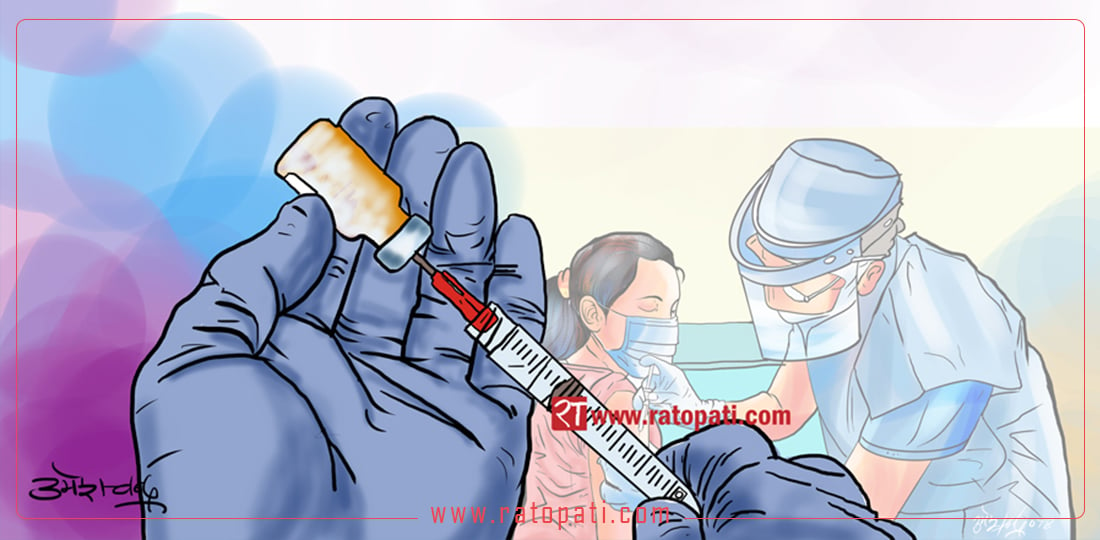
Kathmandu. Vaccines provided by the government under the National Immunization Program are found to be wasted every year. Vaccines have been wasted due to ineffective determination of vaccine needs and management of utilization. The government has wasted vaccines worth Rs 41 crore 4 lakh 82 thousand due to non-compliance with approved standards for storage and utilization in Nepal. According to the details provided by the Department of Health Services, while testing the wastage rate of 10 types of vaccines, government vaccines worth Rs 41 crore 4 lakh 82 thousand were wasted while vaccinating 54 lakh 68 thousand 295 people. Among them, BCG vaccine is seen to be wasted at 82 percent and other vaccines at an average of 36 percent. The 63rd report of the Auditor General has pointed out the need to reduce the wastage rate by utilizing vaccines according to approved standards.
The 62nd report of the Auditor General 2082 had pointed out serious negligence and legal errors in the government's vaccine management. As per the provisions of the Vaccine Act, 2072, there is a legal provision to immediately purchase vaccines during epidemics or natural disasters and to establish a separate vaccine fund for study and research, but the concerned department had deposited the amount in the operational fund without establishing a separate fund. While Rs 37 crore 57 lakh 87 thousand had been collected in the vaccine fund until last year, an additional allocated Rs 3 crore was frozen without being deposited in the fund. According to the 61st report of the Auditor General, 44 lakh 95 thousand 192 doses of vaccines were wasted.
_CS8prVbLhg.jpg)
The Auditor General had also directed the government to immediately establish a separate fund as per the law. On the other hand, the report expressed concern over the inability to properly dispose of millions of doses of vaccines that have expired in the country.
According to the Department of Health Services, Family Welfare Division, the number of target children in the hilly and mountainous regions of Nepal is low, immunization sessions are conducted up to the villages, and the number of doses in a vaccine vial does not exactly match the number of children coming to receive the vaccine, which also leads to vaccine wastage. There is a provision to give vaccines even for one child, but there is a technical aspect that the same vaccine cannot be given to other children who come after 6 hours.
Director of the Family Welfare Division under the Department, Dr. Madan Upadhyay, said that vaccine wastage is a global phenomenon. Director Upadhyay said, 'Vaccine wastage is global. Vaccines are also a priority for the Government of Nepal. Our belief is that no child should be deprived of vaccination. Some vaccines come in 5 doses. Some come in 20 doses. Some vaccines must be administered within one hour, some within two hours.'
Director Dr. Upadhyay stated that no vaccines were wasted in the routine immunization program.
Dr. Upadhyay said, 'BCG vaccine is given immediately after a child is born. The BCG vaccine comes in a vial of 10 doses. When a vial of 10 doses comes, even if only one child comes for vaccination, the vaccine must be given. It is not guaranteed that 10 children will come when a vial of 10 doses is opened. That is why vaccines are wasted. We have not misused vaccines intentionally.'
According to the Division, BCG is available only in 20 doses. While one dose of 0.05 ml is to be given to a child, a lot is wasted because a small amount needs to be used. The vaccine manufacturers have informed that they cannot reduce the quantity. The Division stated that one vaccine must be used within an hour of opening, while another type of vaccine must be used within 6 hours. Similarly, some vaccines cannot be used later if not used immediately after opening. That is why vaccines are wasted, say department officials.
A health official from the Department of Health Services said, 'Vaccine wastage is an internationally accepted technical aspect of the immunization program. There is a national and international standard for the wastage rate of every vaccine. Especially vaccines that need to be reconstituted, such as BCG, MR, and JE, must be used within 6 hours of reconstitution, so the remaining vaccines must be destroyed. Other vaccines like IPV must also be used within 6 hours of opening and destroyed if not used.'
Giving an example, he said, 'If only one child comes to a vaccination session, only one dose of BCG vaccine is used from 20 doses, and the remaining 19 doses are wasted due to compulsion. We are saying that micro-planning should be done to make systematic plans.'
The National Immunization Program conducts more than approximately 19,000 vaccination sessions every month. Department officials say that it is difficult to take full advantage of the multi-dose vial policy as more than half of these are external vaccination sessions. A department official said that it is natural for some vaccines to be wasted as the remaining vaccines must be destroyed after the specified time to ensure vaccine safety.
National Immunization Committee Nominal
There is a provision for a National Immunization Committee to provide recommendations to the Ministry for policy formulation related to the immunization program. The committee includes the Secretary of the Ministry as Chairman, the Director General of the Department, a Joint Secretary from the Ministry of Finance, a Joint Secretary from the Ministry of Federal Affairs and General Administration, a Joint Secretary from the Ministry of Education, a Joint Secretary from the Ministry of Women, Children and Senior Citizens, and two members nominated by the Ministry from among public health experts or health economists, including one woman. Although the committee plays a leading role in formulating policies related to the immunization program, the committee's meetings are held very rarely.
When is Which Vaccine Given?
According to the National Immunization Schedule, BCG vaccine is given immediately after birth. At 6 weeks of age, the first dose of Rota, Polio, PCV, DPT-HepB-Hib is given. Similarly, the national immunization schedule mentions that Rota (second dose), Polio (second dose), PCV (second dose) are given at 10 weeks of the infant's birth. At 14 weeks of the infant's birth, Polio (third dose), FIPV (first dose), and DPT-HepB-Hib (third dose) vaccines are administered. At 9 months, FIPV (second dose), Measles-Rubella (first dose), PCV (third dose) are vaccinated. At 12 months, Japanese Encephalitis, and at 15 months, Measles-Rubella (second dose) vaccine is given.
_IrXNGJG8Mt.jpg)
What is the Department Doing to Prevent Vaccine Wastage?
The Family Welfare Division has stated that to ascertain the number of children receiving vaccines at all levels, micro-plans are prepared by determining children with the supervision of the ward chairman and the cooperation of local female community volunteers every year, analyzing the average number of children vaccinated in the last 3 years, and requesting vaccines accordingly, and supplying them accordingly.
For vaccines following the multi-dose vial policy, arrangements have been made for them to be used for up to 28 days after opening, if technically feasible. The Division has stated that the vial size of MR vaccine has been changed from 10 doses to 5 doses from the fiscal year 2082/083, which is expected to reduce the vaccine wastage rate.
The usage period of JE vaccine has been extended from 1 hour to 6 hours. The department states that it has planned and monitored to further reduce the vaccine wastage rate through realistic estimation of vaccine needs, regular supply management, micro-planning of vaccination sessions, regular monitoring of vaccine wastage rates, and capacity building of health workers.
The Division has stated that preparations are underway to work by making micro-plans through systematic planning to prevent vaccine wastage.
Through the National Immunization Program, Nepal has eradicated smallpox since 1977, neonatal tetanus since 2005, polio has been at zero since 2010, and rubella is targeted for eradication by 2025. Currently, 11 types of vaccines are used under the National Immunization Program in Nepal, of which 9 vaccines are given to children, 1 to adolescents, and 1 to pregnant women. Of the 11 vaccines, 6 are supported by GAVI. Vaccines that children are supposed to receive are provided according to the immunization schedule.
According to the Vaccine Act 2072, Vaccine Regulations 2074, and the concept of full immunization, the Government of Nepal has been providing vaccination services to all children with the objective that no child is deprived of vaccination services, according to the Department of Health Services.
This specific news has been automatically translated by AI. As a result, there may be some inaccuracies or language errors.