China and North Korea Pledge Strategic Partnership

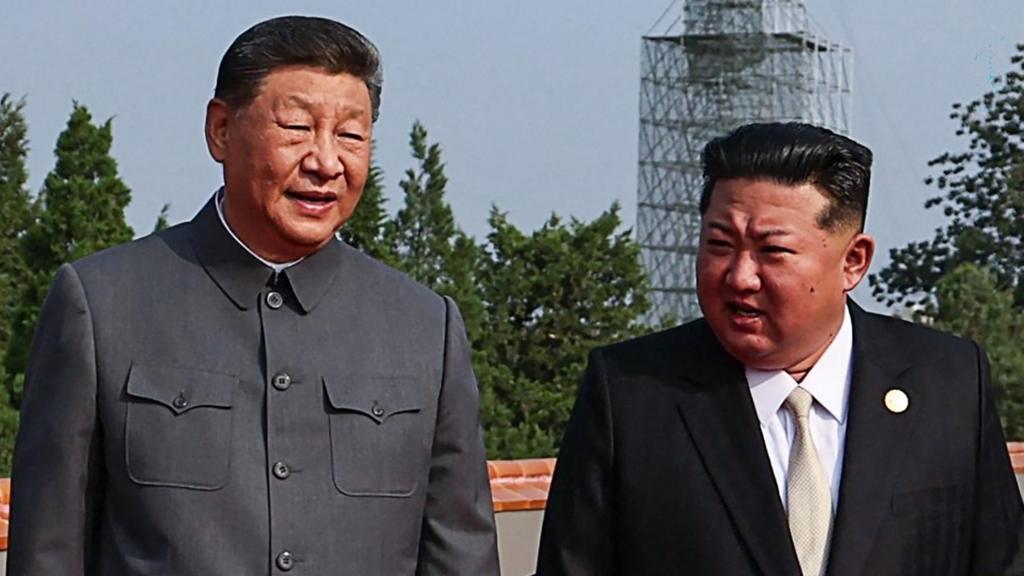
Kathmandu. Following Chinese President Xi Jinping's Pyongyang visit, North Korea and China have pledged to take bilateral relations to a more strategic and long-term level. According to North Korean state news agency KCNA, leaders of both countries agreed to further strengthen traditional friendship by preparing a 'far-reaching blueprint' for the future of relations.
Xi made a rare visit to North Korea on Monday, immediately after completing high-level meetings in Beijing with world leaders including US President Donald Trump and Russian President Vladimir Putin. This visit, amid the exceptionally close relations between North Korea and Russia in recent times, is being viewed in conjunction with regional power balance.
According to KCNA, Xi Jinping and Kim Jong Un expressed satisfaction with taking relations between the two countries to new heights. During the two-day visit, both sides reiterated their determination to further strengthen revolutionary friendship, political trust, and strategic cooperation.
During the visit, Xi and Kim jointly observed the Workers' Party's Central Cadre Training School. KCNA reported that they discussed party leadership development and political training there. Afterwards, both leaders planted trees at the Friendship Monument complex, built in honor of Chinese soldiers who lost their lives in the Korean War.
Xi was welcomed in Pyongyang with special honors. He arrived in North Korea with his wife and a senior government delegation. In a message sent to Kim after completing the visit, Xi mentioned that both sides exchanged in-depth views on issues of common interest and reached important understandings.
According to Xi, this agreement reflects the commitment of both countries to give new energy to traditional friendship, promote common development and prosperity, and protect regional and international peace and stability.
Chinese state news agency Xinhua also reported that Xi and Kim reached important agreements on developing China-North Korea relations according to the new era. According to Beijing's state media, Xi emphasized the need to expand cooperation in diplomacy, security, law enforcement, and military affairs.
According to analysts, prioritizing military cooperation may also be to directly assess the technical changes happening within the North Korean army and its growing military relationship with Russia. Hong Min, an analyst at the Korea Institute for National Unification in South Korea, said that China may be trying to gather more information about the pro-Russian and pro-Chinese influences within North Korea.
Another significant aspect of this visit was the public silence regarding North Korea's nuclear program. Last month, after talks with Trump, the White House stated that North Korea's nuclear disarmament was a common goal for both sides. However, the reports published by Chinese and North Korean state media regarding the Xi-Kim summit did not mention nuclear disarmament at all.
Analysts have interpreted this as a sign that Beijing is practically accepting North Korea's nuclear status. Kim Jong Un has repeatedly stated that North Korea will not abandon its nuclear weapons program. Before the visit, his sister Kim Yo Jong had also stated that the program was North Korea's 'non-negotiable border'.
Although North Korea has appeared to lean more towards Russia in recent years, China still remains its largest economic partner. Pyongyang has strengthened its relationship with Moscow by sending soldiers and weapons as aid in the Ukraine war. However, China remains the main economic base for the North Korean economy, which is under pressure due to international sanctions.
According to South Korea's Ministry of Economy and Finance, in 2024, about 98 percent of North Korea's total foreign trade, equivalent to 2.6 billion US dollars, was with China. This shows that China's economic influence over North Korea is still decisive.
This specific news has been automatically translated by AI. As a result, there may be some inaccuracies or language errors.