Drug Management Department Faces Ineffectiveness Due to Staff Shortage

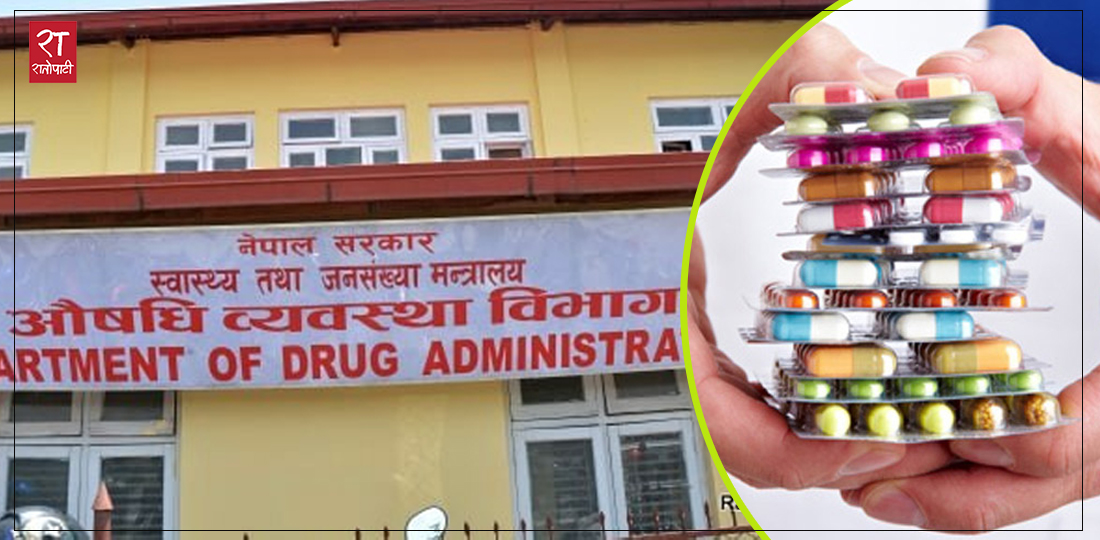
Kathmandu. The Drug Management Department has become ineffective in monitoring various complaints due to a shortage of staff. The number of drug stores and pharmacies across the country is around 26,000. The number of drug industries has reached 130. With only 115 employees in total, including the central and subordinate offices, the department's ability to take action on daily complaints and conduct market monitoring has become ineffective.
Taking advantage of this weakness, the sale of medicines without prescription, running stores without a pharmacist, doing business without registration, and advertising and selling illegal drugs through social media have all increased sharply, according to the department's officials themselves. The central office has 49 personnel. Among them, only 24 are for inspection.
There is not enough manpower to monitor drug stores. As a result, complaints are increasing about medicines being sold without a doctor's prescription, medicines being sold from pharmacies without a pharmacist or pharmacy assistant, drug stores operating without registration, and illegal drugs being advertised and sold through social media.
Senior Drug Administrator of the Department, Kiran Sundar Bajracharya, said that even when complaints are received, the department is not in a position to take action. Bajracharya said, 'I am still receiving complaints. When a complaint comes that medicines are being sold from unregistered drug stores, we are not in a position to take action. Kathmandu has to look after many districts. Just recently, the Pokhara case came up. In the Pokhara case, we have to go to Pokhara to file a case for selling medicines without a prescription. Due to the shortage of manpower, our work has become very weak.'
He claimed that complaints are received about the quality of medicines, and there is a lack of sufficient manpower and resources to follow up and investigate such complaints.
On May 18, the department directed the immediate recall of Marble brand calcium and vitamin D3 tablets from the market after samples collected during market monitoring were found to be of low quality by the National Drug Laboratory. Similarly, on April 7, during market monitoring, the drug Ondansetron-Four was found to be of low quality, and a directive was issued to recall the drug from the market. These are just representative incidents. The department admits that market monitoring is not effective due to the shortage of manpower.
According to the data of the Nepal Pharmacy Council, 8,355 pharmacists and 16,977 pharmacy assistants are registered. Whereas the number of drug stores itself is 26,000. According to regulations, it is mandatory to have a pharmacist or pharmacy assistant when operating a drug store or pharmacy. In the past, businesses used to sell medicines based on the orientation provided by the Drug Management Department, but this system has now been abolished.
Bajracharya said, 'It may be easier for many people once the department goes into a provincial structure. The workload of the central office will also decrease. Otherwise, 250 to 300 personnel are needed.'
- 16 Cases Registered in Court
As of Tuesday this fiscal year, 16 drug-related cases have been registered in the Kathmandu District Court by the Drug Management Department. The Department's Monitoring, Evaluation, and Implementation Division stated that complaints have been filed regarding the consumption, transportation, and sale/distribution of drugs without a license, and production without obtaining permission for drug manufacturing. Cases have also been registered for selling and distributing other wholesale substances as drugs, operating drug stores without renewal, and for the sale, distribution, and storage of drugs.
Om Jaiswal of the Division said that cases are registered in the district court where the offense occurred. He said, 'As per the Drug Act, the drug inspector registers the case in the district court where the offense occurred. In some cases, the police also bring the offenders to the department. Similarly, we register cases against those who commit illegal acts based on regular monitoring and verbal or written complaints.'
Jaiswal stated that it is not possible to ascertain how many cases have been settled as the court does not correspond with the department regarding case settlements. In 2081/082, 23 drug-related complaints were registered.
- Only One Ayurvedic Personnel
The department has a branch office in three places along with its central office. Although there are branch offices in Biratnagar, Birgunj, and Nepalgunj, there is only one Ayurvedic personnel. There are 52 Ayurvedic industries across the country. The monitoring of industries and drug stores has been affected due to the shortage of manpower. Rupendra Puri, head of the Ayurveda and Alternative Medicine Branch of the department, said that due to the shortage of manpower, there is a 'load' on work related to industry monitoring, registration, renewal, and establishment of industries.
Puri said, 'This branch should be developed into a division. If the manpower can be increased, there will be no additional burden on the work.'
- New Drug Act Being Introduced
Preparations are underway to introduce a new Drug Act, replacing the Drug Act, 2035. The Drug Management Department has stated that it is bringing a new act to replace the Drug Act, 2035. For this, the government is preparing the content to be included in the new act.
Senior Drug Administrator of the Drug Management Department, Kiran Bajracharya, said that discussions are ongoing about making the department's activities reach the provincial level after the country has moved to a federal system. He said, 'Work is being done on the Drug Act. A new Drug Act is coming. Our main problem is that even after the advent of federalism, the department's activities are concentrated only at the federal level. There is nothing about going to the provincial and local levels. Since the act is old, nothing has been said about it. Therefore, preparations are being made to bring a new act.'
The Drug Act was last amended on July 14, 2082.
This specific news has been automatically translated by AI. As a result, there may be some inaccuracies or language errors.