
Good Governance in Nepal: Challenges and Way Forward

Good governance is not an abstract ideal; it is a bridge of trust between the state and citizens. Transparency is its heart, while accountability and the effectiveness of service delivery are its lifeblood.
When former British Prime Minister John Major introduced the concept of 'Citizen's Charter,' he might not have imagined that one day it would be transformed into a digital form, fitting government into the citizen's pocket.
Today, Azerbaijan, through 'Government in Your Pocket,' and Sweden, through 'Street Bureaucracy,' are utilizing technology to its fullest to deliver services to citizens at home. Germany has gone a step further by implementing the 'People's Bonus System' to reward employees who satisfy citizens.
As the global landscape changes, slogans like digital citizen charter, Hello Sarkar, and faceless and paperless administration have also begun to resonate in Nepal. However, behind this theoretical facade of good governance, the reality of Nepal's development administration and capital expenditure is quite dismal.
- Adherence to Law or Legitimacy?
There is a serious ethical crisis in our administrative machinery. We easily identify bribery taken from service recipients for small favors as corruption, but policy-level corruption, achieved by exploiting loopholes in the law, has become the biggest termite of good governance.
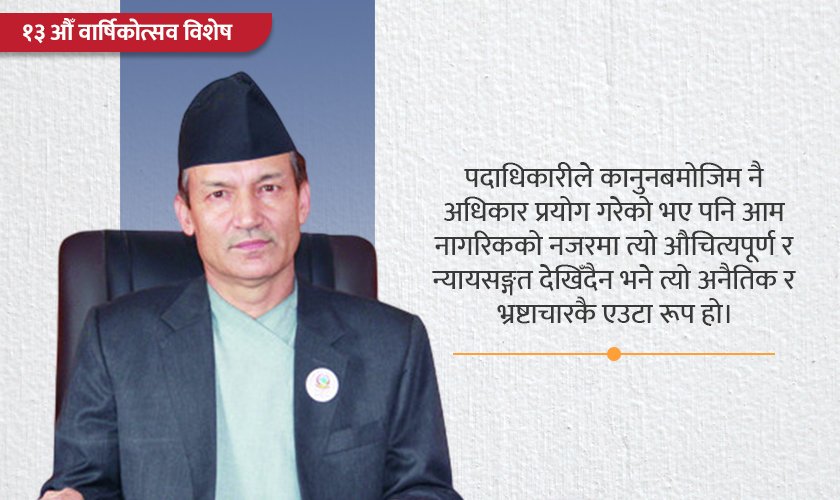
In good governance, mere adherence to law is not enough; it must also attain legitimacy. Even if officials exercise their authority according to the law, if it does not appear justifiable and fair in the eyes of the general public, it is unethical and another form of corruption. Our state machinery often tramples on this subtle line between being legal and being legitimate.
- The Issue of Policy and Intent in Development Obstruction
The biggest mirror of good governance is the country's budget and its implementation. The fate of Nepal's capital budget is always perplexing. At the beginning of the fiscal year, the budget is presented with great ambition, reduced during the mid-term review, and by the end of the year, less than 60-65% is spent, confining the pace of development to the old rhythm.
Why is the development budget not spent? There are certainly some policy and structural barriers behind this. Budgets are allocated haphazardly to projects that are not in the project bank, do not have detailed project reports (DPR), and have not undergone environmental impact assessments (EIA).
Moreover, land acquisition hassles, forest area obstructions, and the lack of easy availability of construction materials leave projects stranded for years. More than 3.5 million youth from villages are sweating it out in the Gulf, while here, there is a severe shortage of labor for development construction.
However, the biggest problem, more than these technical issues, is ownership. Leaders and ministers force projects into villages like guest bedrooms to fulfill their political ambitions. Locals do not take ownership of projects they haven't asked for and don't need, causing development construction to halt even over minor disputes.
- Impunity and the Farce of Performance
The most frightening aspect of Nepal's unspent capital expenditure is impunity. During budget formulation, ministers fight tooth and nail with the finance ministry to secure budgets for their ministries and regions. But when the budget is passed and reaches the implementation phase, these same ministers and employees fall into a deep slumber.
Every year, the ritual of performance agreements occurs in the country between the prime minister and ministers, ministers and secretaries, and secretaries and project chiefs. But, in anger over the inability to spend the development budget, which prime minister has removed which minister? Which minister has punished a secretary? The answer is zero. Until the fear that losing one's job or facing punishment for not working is established in the system, neither the budget will be spent, nor will good governance arrive.
- The Role of Investigative Bodies in Capital Expenditure
An oft-cited excuse by the bureaucracy for the lack of capital expenditure is the fear of the Commission for Investigation of Abuse of Authority (CIAA) or regulatory bodies. A narrative has been built that capital expenditure cannot happen due to the fear of the CIAA when carrying out procedural work. But this narrative is contradictory in itself.
The state's recurrent expenditure (administrative and salary expenses) is spent more than 90% every year. Does the CIAA not apply to recurrent expenditure? And does it only scrutinize capital expenditure? This is like giving a child who is playing chocolate and rice with dal; the child eats all the chocolate but leaves the rice and dal untouched, claiming a stomach ache or fever. If the child were truly sick, they wouldn't be able to eat the chocolate either.
The situation of the bureaucracy and political leadership is exactly like that child. Where interests align and hassle is less, there is no fear of any investigative body. But where hard work is required, procedures must be followed, and personal gain is minimal, the tendency to evade by invoking the bogeyman of investigative bodies and laws prevails.
- The Way Forward
In a participatory democracy, budget expenditure must be 'by the people, for the people.' Good governance will remain confined to paper until social audits and project public audits are conducted to assess the impact of the allocated budget on targeted groups such as the elderly, women, Dalits, and the impoverished.
The ambitious goals of economic growth and the daily agendas of digital transformation put forth by the government will only be fulfilled when development administration is freed from middlemen and impunity. If honesty is not shown in the entire cycle – before the budget, during budget implementation, and after budget expenditure – the destination of good governance and development is certain to be pushed much further away.
(Based on an interview with good governance expert Basnet)
This specific news has been automatically translated by AI. As a result, there may be some inaccuracies or language errors.

-(2)_QJLjKxR87n.jpg)