Federalism in Nepal Faces Challenges Despite Constitutional Framework

Kathmandu. Nearly a decade has passed since the implementation of the federal governance system, which is termed a revolutionary change in Nepal's political history. With the objective of bringing 'Singha Durbar to every village' and taking state power to the doorstep of citizens, a new constitution was promulgated in 2072 BS. On the foundation of the same constitution, elections for all three tiers were held for the first time in 074 BS, and the practical exercise of federalism began. However, a close observation of this nine-year journey of federalism reveals that while the division of powers was done on paper, the actual control still remains centralized in Singha Durbar, Kathmandu. The dream of good governance and prosperity seems to be struggling in the vortex of administrative ego, political arrogance, and legal ambiguity. On one hand, local governments, despite having authority, are unable to perform adequately due to a lack of resources and means. On the other hand, provincial governments are criticized as mere 'minister-producing factories' and 'white elephants' that drain the state treasury. The core pillars of federalism envisioned by the Constitution of Nepal are cooperation, coexistence, and coordination. Article 57 of the constitution clearly delineates the division of state powers among the federal, provincial, and local levels. There are long lists of exclusive and shared powers in the schedules. Theoretically, the federal government can exercise 35 exclusive powers, provinces 21, and local levels 22. However, in practice, when local and provincial levels attempt to exercise these powers, they always have to look to the center. The ungenerous character of the center in transferring powers and its 'centralized mentality' are attacking the very spirit of federalism. Especially, the narrowness shown by the center in the aspect of fiscal federalism has significantly weakened the autonomy of local levels. Local governments, considered witnesses to the direct joys and sorrows of the people, are increasingly becoming victims of the federal government's financial austerity, causing disappointment to resurface among citizens who had felt the government at their doorstep. 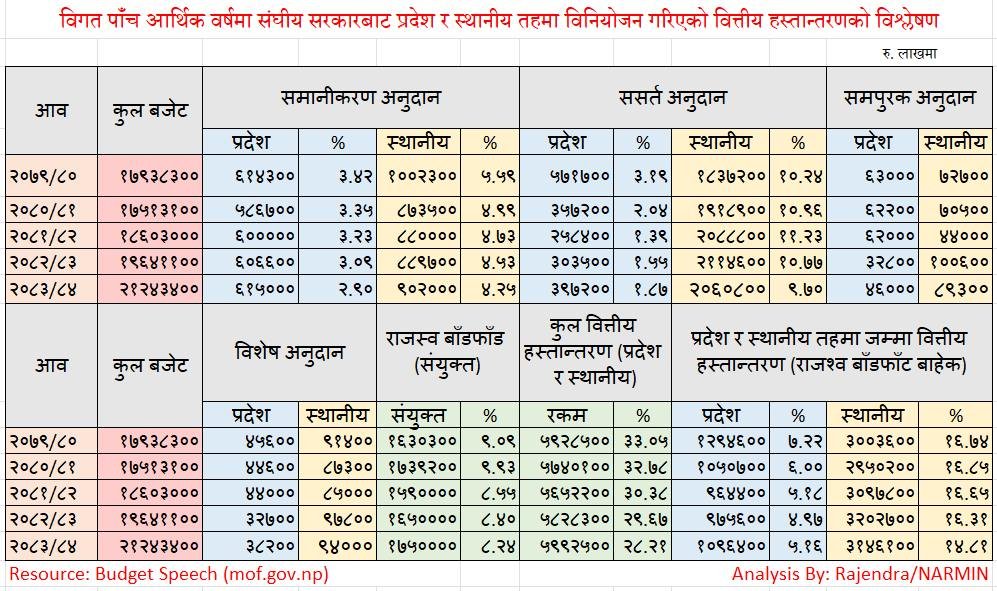 Federal government's encroachment on fiscal federalism Analysis of the budget trend over the past 9 years shows that the implementation of fiscal federalism in Nepal has not been encouraging. Based on the budget analysis from fiscal year 2075/076 to 2083/084, fiscal federalism has been continuously neglected. Looking at the data from the past five years, the size of the federal budget has increased significantly. The total budget, which was approximately 1793 billion rupees in fiscal year 2079/080, has reached 2124 billion rupees by the upcoming fiscal year 2083/084. However, in proportion to the increase in the budget size, the budget going to provincial and local levels has decreased. While 33.66 percent of the total budget was allocated for fiscal transfer in fiscal year 2075/076, it has been limited to only 28.21 percent for the upcoming fiscal year. This indicates the federal government's intention to retain resources and power at the center. The share of equalization grants, considered the backbone of fiscal federalism, has been continuously declining. Such grants received by local levels have decreased from 5.59 percent to 4.25 percent, while the share for provinces has dropped from 3.42 percent to 2.90 percent.
 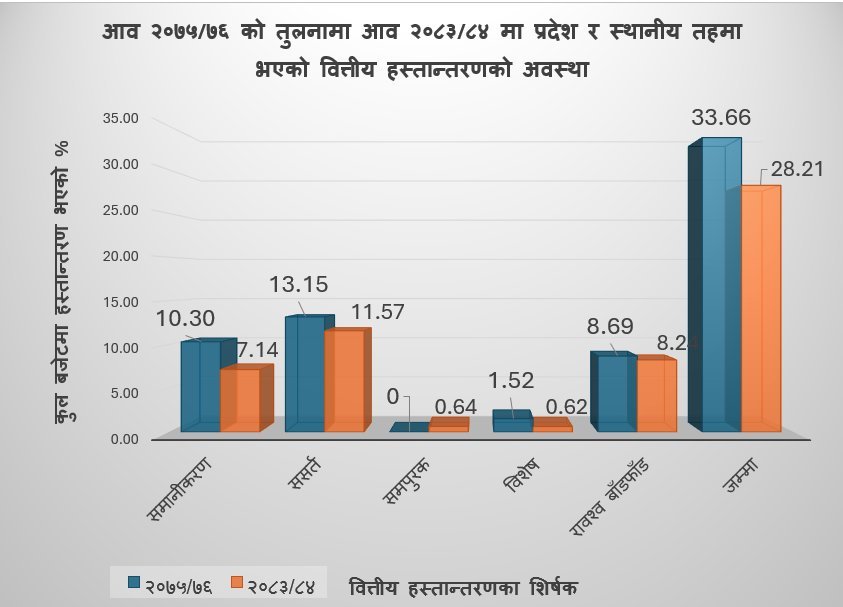 Overall, equalization grants, which were 10.35 percent in 2075/076, have shrunk to 7.14 percent by 2083/084. The reduction in unconditional grants has weakened the lower governments' ability to spend on their priorities. Statistics show that the largest share of fiscal transfer is 'conditional grants'. The increase in the share of such grants, which can only be spent on projects sent by the center, has limited the autonomous decision-making capacity of local governments. The situation of special and complementary grants is even more dire. The share of special grants in the total budget is less than 1 percent. This, according to Rajendra Poudel, Executive Chief of the National Federation of Rural Municipalities, hinders the goal of reducing regional inequality and implementing large co-investment projects. The amount received from revenue sharing remains an important source of fiscal transfer, although it fluctuates from time to time. Although local levels receive about 16-17 percent of the total budget, it has not expanded in proportion to the overall increase in the budget. Poudel says, 'The concept envisioned by the Constitution of Nepal has not yet been fully implemented. Although the expenditure responsibilities and workload of local levels have increased, resource transfer has not increased at the same pace.' He adds, 'This raises serious questions about the successful implementation of fiscal federalism. The centralization of resources and decision-making power in the federal government, increased dependence on conditional grants, and the decrease in equalization grants are weakening the financial base of federalism.' MPs' eyes on fragmented projects Throughout the period of federalism implementation, 'fragmented projects' have been the most debated and controversial. Even for small projects that ward or local levels can complete with 5-10 lakh rupees, the eyes of central MPs and ministries are fixed on them. According to the spirit of federalism, large projects should be undertaken by the federal government, medium-sized ones by provinces, and small ones by local levels. However, the opposite is happening in practice. In the fiscal year 074 BS, Dr. Yuba Raj Khatiwada, the Finance Minister in the KP Sharma Oli-led government, modified the previous Constituency Development Fund and included it in the budget under the name 'Local Area Infrastructure Development Program'. He allocated 4 crore rupees per constituency in the budget for 075/076. At that time, a committee comprising directly elected MPs, proportional MPs, and local level chiefs was formed to select projects. Subsequently, in fiscal year 076/077, Khatiwada increased the allocation for this program to 6 crore rupees per constituency. In the budget for fiscal year 078/079, then Finance Minister Bishnu Poudel abolished the MP Development Fund. The 'Parliamentary Constituency Infrastructure Development Program' was a highly controversial program in the budget statement of fiscal year 080/081.
  On May 15, while reading the budget statement, Finance Minister Dr. Prakash Sharan Mahat received applause from MPs when he informed about this program. However, publicly, the allocation of 5 crore rupees to each MP was criticized. Projects costing less than 1 crore were not allowed, and the program was supposed to focus on physical infrastructure construction such as roads, irrigation, drinking water, education, health, and tourism. Even then, budgets have been allocated under various names, allowing MPs to select projects at their discretion. The then Finance Minister Bishnu Poudel claimed in the current fiscal year's budget that fragmented projects were not included in the upcoming fiscal year 082/083 budget and that the federal government would not undertake projects costing less than three crore rupees, but the reality was the opposite. He had announced reforms such as not allocating federal budgets to projects costing less than three crore rupees. The National Planning Commission also stated that projects costing less than three crore rupees were not allowed to be entered into the project bank, and only 1327 projects out of those entered were selected. However, in reality, programs costing less than three crore rupees were found to be allocated budgets by combining them under a single heading. In the current budget, many projects implemented by the Ministry of Urban Development and the Ministry of Water Supply had costs up to 25 lakh rupees. However, after the Janji movement on August 23 and 24, Rameshwor Khanal became the Finance Minister in the interim government to manage that budget. Currently, Dr. Swarnim Wagle has become a minister in the Balen government. For the upcoming fiscal year, there is no visible budget for MPs. Unstable Provincial Governments, Mockery of Federalism The condition of provincial governments appears even more pathetic and unstable. Even a minor shift in power in Kathmandu causes provincial governments to collapse like houses of cards. The more provincial governments struggle for their existence, the more they are criticized as 'minister-producing factories' and entities that drain the state treasury. They have been deprived of the authority to operate their own employee administration and security mechanisms. The absence of the Federal Civil Service Act and the Federal Police Act leaves provincial public service commissions and police structures with their hands and feet tied. The tendency for employees to be more accountable to the center and to show reluctance to stay in the provinces has led to slow performance in the provinces. For example, consider Madhesh Province; political instability is a strong example of this. In Madhesh Province, governments have fallen and reformed multiple times even in its second term. Since the elections of 079 BS, Madhesh Province has seen five chief ministers and over 50 members have become ministers and state ministers. Internal conflicts among parties and power-sharing have overshadowed the aspirations for good governance and development. Not just Madhesh, but looking at the condition of all seven provinces, approximately 50 chief ministers and over 500 ministers have been appointed in two terms. This, on one hand, increases the administrative expenditure of the state and, on the other hand, strengthens the arguments of those who question the very existence of the provincial structure. However, according to experts, this problem is not with the provincial structure itself but a result of the center's interventionist role and the centralized working style of political parties. Hope in Local Government In the case of local governments, there have certainly been some positive experiences. The promptness shown by the 'government at the doorstep' in resolving minor issues and their readiness for small development projects have instilled hope in citizens. However, local governments are unable to work as expected due to a lack of resources and means, despite having authority. Many local levels still lack chief administrative officers. This administrative vacuum has created a significant gap in service delivery. Technically and financially, local levels are still dependent on the center. The 'conditional projects' imposed by the center have overshadowed local priorities. The tendency for the village's needs to be in one direction and the center's budget in another has prevented transformative development from occurring at the local level. What is the Obstacle? Experts say that the first reason behind the obstacles seen in the implementation of federalism is the political instability of the center, which tries to make provinces its shadow. Second, there is legal vacuum. The absence of crucial laws that the federal government should enact has rendered provinces and local levels almost paralyzed. Third, there is financial dependence. The inability to identify internal sources and reliance on federal grants weakens the lower-level governments. Fourth, there is the 'fragmented tendency' in planning. Fifth, there is conflict of jurisdiction and lack of coordination. Sixth, there is the 'centralized' mentality of the center, which always hesitates to transfer power. Seventh, there is the weakness of physical and institutional structures, and eighth, there is administrative sluggishness and non-cooperation from the bureaucracy. Furthermore, the decentralization of corruption is another frightening aspect. According to the data from the Commission for Investigation of Abuse of Authority, the highest number of complaints are against local levels, raising a big question on the claims of good governance. The lack of a strong monitoring mechanism at the local level to prevent this disorder that comes with authority is felt. The fact that monitoring bodies are also under the control of the center and that local citizens are forced to approach three governments for the same work highlights the weak aspect of the practical implementation of federalism. Power seems to be limited to paper documents, and in practice, power centers in the center try to control everything. Citizens Have Felt the State After Federalism: Krishna Prasad Sapkota Krishna Prasad Sapkota, a Constituent Assembly member and expert on federalism, believes that the federal governance system has played an important role in citizen participation in governance and decentralization of power. He says, 'Due to federalism, the governance system that was concentrated in Singha Durbar has now reached every village, and it makes citizens feel closer to the government.' He argues that the compulsion for citizens to travel to the center for their minor tasks has ended, and development decisions and implementations are now happening through local governments. According to Sapkota, there has been a significant change in basic health services and administrative tasks after the implementation of federalism. He sees the establishment of health centers in villages and service delivery from them as a major achievement compared to the past. Similarly, he believes that the arrangement for citizens' sensitive tasks like land registration and transfer to be done at the local level contributes to good governance. 'While previously one had to rely on the center even for ordinary budgets, now even the smallest municipality receives a significant budget and can spend it according to its needs, which is a positive aspect of federalism,' he states. Sapkota also points out some serious challenges in the practice of federalism. He attributes the inability to fully implement the powers granted by the constitution to the indifference of the federal government as the main reason. He alleges that powers in crucial sectors like peace and security, police adjustment, and forests are still held tightly by the center. On the other hand, he analyzes that provincial and local governments have not achieved the expected results due to a lack of full knowledge of their constitutional rights or their inability to exercise those rights. Expressing concern over the instability of provincial governments, Sapkota says, 'Changes in central politics directly affect the provinces. The fact that provinces cannot make their own decisions and are compelled to act at the behest of central political parties is attacking the spirit of federalism.' He opines that even though federalism has been introduced in the governance system, the centralized tendency in the thinking of political parties still hinders the effectiveness of provincial government work. Centralized Mentality of Parties and Employees: Indrabahadur Angbo Indrabahadur Angbo, former Minister of Economic Affairs and Planning of Koshi Province, agrees that the implementation of federalism has not gained expected momentum. He considers the failure to enact laws related to federalism implementation, despite federalism advocates being in government leadership repeatedly for such a long time after the promulgation of the constitution, as the main weakness.
 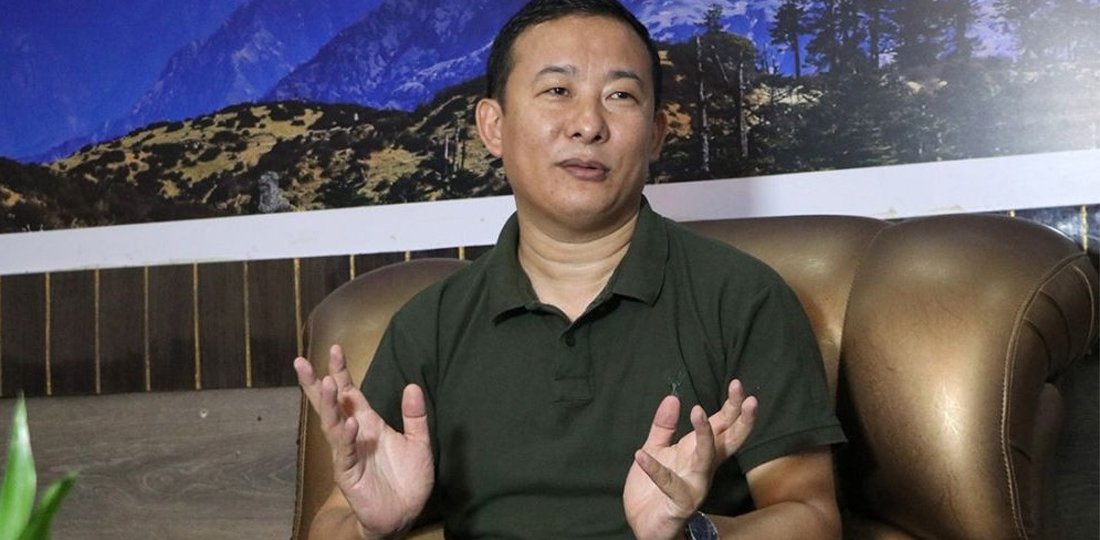 He believes that the centralized mentality of political party leadership and those in government leadership, along with the Singha Durbar-centric mentality of high-ranking officials, are the main challenges to federalism implementation. He argues that the delay in enacting laws related to federalism implementation and the division of shared list powers is causing questions, mistrust, and interference in each other's jurisdictions within federalism. He opines that federalism remains incomplete due to the failure to enact laws such as the Civil Service Act, Police Act, and laws related to land, water resources, education, and health in a timely manner. Mistrust Regarding Authority Remains: Analyst Subedi Political analyst Girdhari Subedi analyzes that the relationship between the three tiers of government has not yet become strong according to the principle of cooperation, coexistence, and coordination adopted by the Constitution of Nepal. He believes that although powers are divided constitutionally among the three tiers of government, in practice, there is still a struggle for power and mistrust. Despite expectations of effective implementation of federalism and improvement in inter-governmental relations after the formation of a new government, progress has not been as expected due to policy ambiguity. Subedi specifically accuses the federal government of trying to curtail powers in the fields of education and employee administration, contrary to the spirit of the constitution. He opines that although the constitution grants local levels the authority over education up to the secondary level, the federal government's attempt to retain this authority at the center through the Education Act or ordinances has created complications. Similarly, he states that teachers' unwillingness to be under the jurisdiction of local levels and the federal government's agreements to that effect have undermined the constitutional rights of local governments. Subedi also expresses dissatisfaction regarding the economic aspect of federalism, i.e., fiscal federalism. He states that the current budget system is still center-oriented, and the budget is concentrated on the priorities of the federal government rather than the needs of provinces and local levels. He argues that the ambiguity in the extraction and revenue sharing from natural resources like stones, gravel, and sand has weakened the spirit of federalism. Subedi points out that provinces and local levels are unable to fully utilize their resources due to the duplication and ambiguity of authority. Provincial Governments Say, 'We Couldn't Work According to the Spirit of Federalism' Jit Bahadur Sherchan, spokesperson and Finance Minister of Gandaki Province government, has stated that provincial governments are working as a bridge between the federal and local levels in the federal governance system.
 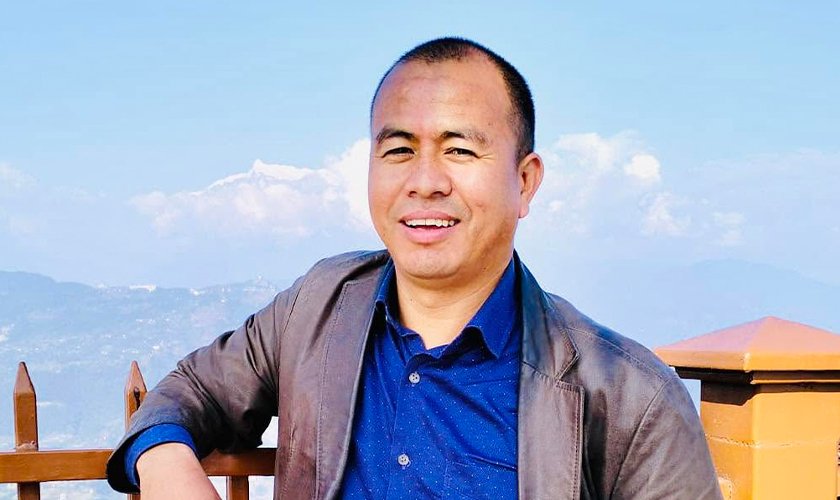 He says, 'Although provincial governments are accused of not being able to stand on their own feet, they have not been able to work as expected due to legal and structural obstacles.' Sherchan complains that the federal government's failure to enact necessary laws in a timely manner has directly affected the performance of provinces. He notes that despite the Provincial Police Act being drafted in 2076 BS, it could not be implemented because the federal government did not adjust the police, and it is difficult to implement many laws enacted by the province due to the lack of responsibility for peace and security under its jurisdiction. Regarding the shrinking size of provincial budgets, he states that the limited scope of revenue collection and the reduction in grants by the federal government are the main reasons. Despite this, he mentions that Gandaki Province has achieved significant success in infrastructure and social security, such as saving lives by airlifting pregnant women. Binod Kumar Shah, spokesperson and minister of Karnali Province government, analyzes that the 'highly centralized mentality' of political leadership and bureaucracy is the biggest obstacle to the effective implementation of federalism.
 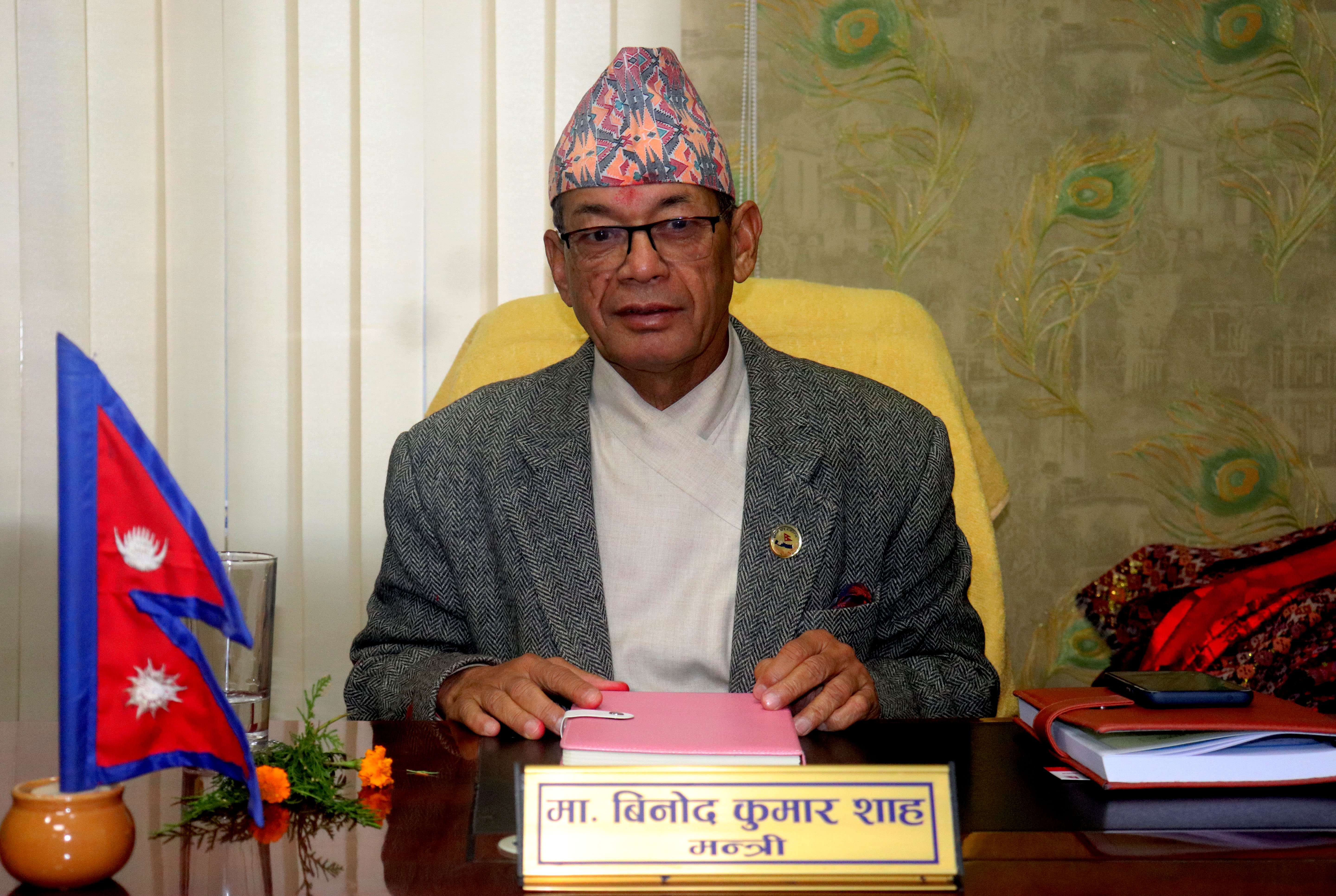 He states that the core spirit of federalism is 'self-governance' and 'shared governance', and its successful implementation can address Nepal's multi-ethnic and multi-lingual characteristics. Shah clarifies that there are serious social and regional reasons behind Nepal's move towards federalism. However, he opines that since political parties themselves are highly centralized, its direct impact is on the government's working style. He raises the question of whether provinces, while blaming the center, are repeating the same tendency in their dealings with local levels. He emphasizes that those who advocate for change at the center must also be able to change themselves at the provincial level and transfer power downwards. Krishna Bahadur GC, former Minister of Internal Affairs and Law of Karnali Province, believes that the main reason for the challenges seen in federalism implementation is not the administrative structure but the lack of political will.
 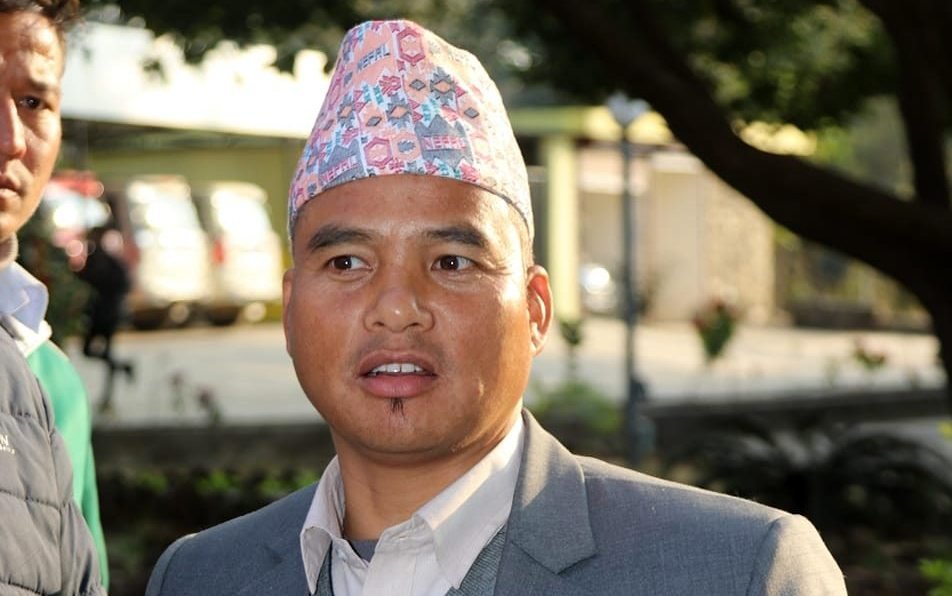 He states that problems are exacerbated by the lack of a clear vision among political leadership and the inability to accept federalism wholeheartedly. He argues that the situation where forces supporting federalism do not have a clear majority and are always caught in the game of minority and majority prevents the full utilization of jurisdictional areas. GC says, 'Administrative leadership needs to transform itself, but the fundamental problem lies with the political leadership. Until the political leadership corrects itself, its impact will continue for a long time.'
 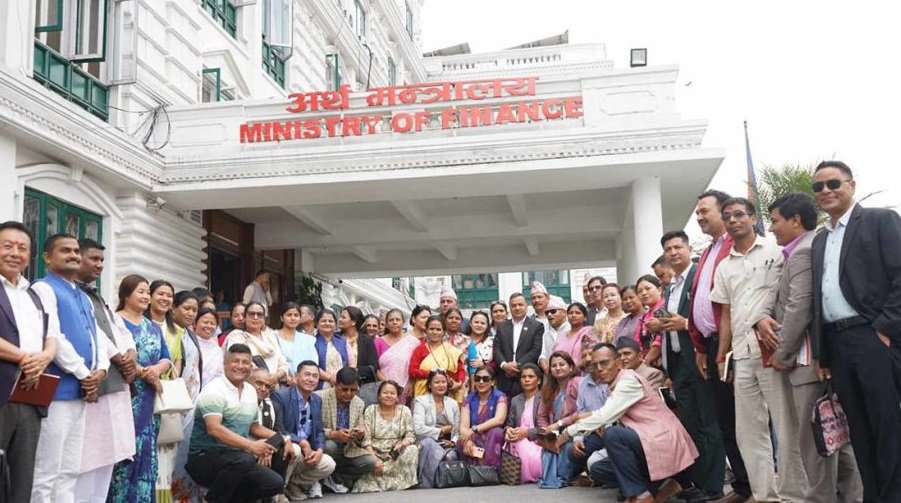 Local Governments Say, 'We Haven't Become Autonomous According to the Constitution, We Have to Rely on the Center' Mohamaya Dhakal, the mayor of Birendranagar Municipality, states that although the constitution calls local levels the 'government at the doorstep', it is difficult to achieve true good governance due to the lack of adequate authority and financial autonomy.
  She argues that the compulsion to rely heavily on the federal government's budget and conditional grants hinders working according to local needs. She says, 'When the budget comes with pre-defined project names from above, local priorities are overshadowed, and in some cases, the budget even becomes frozen.' Birendranagar is the capital of Karnali, so it has a population pressure, but the federal government sends budgets based only on permanent residency, which adds to the challenges in service delivery. She urges that federalism cannot succeed unless local governments are strong, and the center must trust local levels with resources and authority. Laws on Resource Utilization Not Clear Navraj Ojha, Chairman of the National Federation of Rural Municipalities, Gandaki, and Chairman of Rupa Rural Municipality, believes that although the internal income of local levels has increased after the implementation of federalism, they have not been able to become fully self-reliant due to legal and structural complexities.
 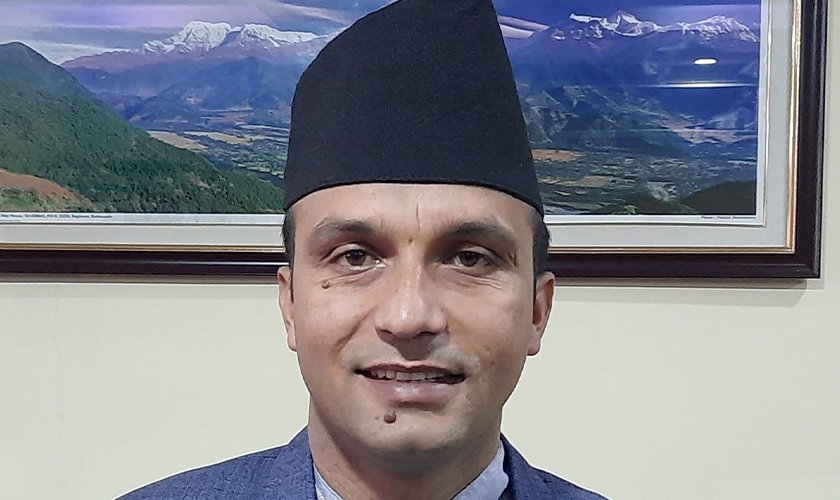 He states that although local governments are the closest to the people, they still face many obstacles in terms of resource mobilization and exercising authority. According to Ojha, although the revenue collection of municipalities has increased compared to the pre-federalism era, problems have arisen due to unclear laws regarding the distribution and utilization of natural resources. He mentions that legal ambiguities related to forests, natural resources, and land, in particular, hinder local levels from increasing income. Although the Forest Act states that local levels will receive 10 percent royalty, the method of its implementation is not clear, and the lack of sufficient authority for local governments in land use, land banks, and commercial use of public land makes it difficult to attract investors. Regarding fiscal federalism, Ojha criticizes the centralized mentality of the federal government. He states that the tendency of the federal government to retain a large portion of the total budget and send less than 10 percent of the budget to local levels hinders development. He alleges that federal MPs are still busy allocating budgets for small and pocket projects, but they are not trying to strengthen local levels, which are the main centers of implementation, financially. He argues that when local levels are weakened both in terms of budget and authority, citizens cannot receive the services they expect. Nevertheless, Ojha claims that local levels have performed better than the other two tiers of government in terms of service delivery. He states that local levels have made significant progress in improving health, providing free ambulance services, enhancing the quality of education, and expanding access to drinking water and rural roads. (With the support of the Province Bureau)
This specific news has been automatically translated by AI. As a result, there may be some inaccuracies or language errors.


-(2)_QJLjKxR87n.jpg)