Nepal Seeks UN Extension for LDC Graduation, Highlighting Grant-Based Development

- Krishna Poudel/News Agency Nepal
Kathmandu. The Government of Nepal has formally corresponded with the United Nations, requesting a three-year postponement of its graduation from Least Developed Country (LDC) status to a developing nation in 2026. The government has requested the postponement due to concerns about losing trade facilities and increasing economic risks.
The budget presented by the Rastriya Swatantra Party, which came to power with a new mandate after the Jan-Jan movement, has one-third of its share from foreign loans and grants. For resource management, the government has set a target of a budget deficit of approximately 6.5 kharba rupees by taking foreign loans and grants of 2 kharba 50 arba rupees and approximately 4 kharba rupees in domestic loans.
It is not specified how much of the 2 kharba 50 arba rupees in foreign loans and grants is loan and how much is grant. The government has also formed a committee to take foreign loans. The government's policy and program and budget priorities appear to emphasize loans over grants. However, the government has not paid much attention to how to make the work being done in the overall development sector by more than a hundred international non-governmental organizations active in Nepal effective.
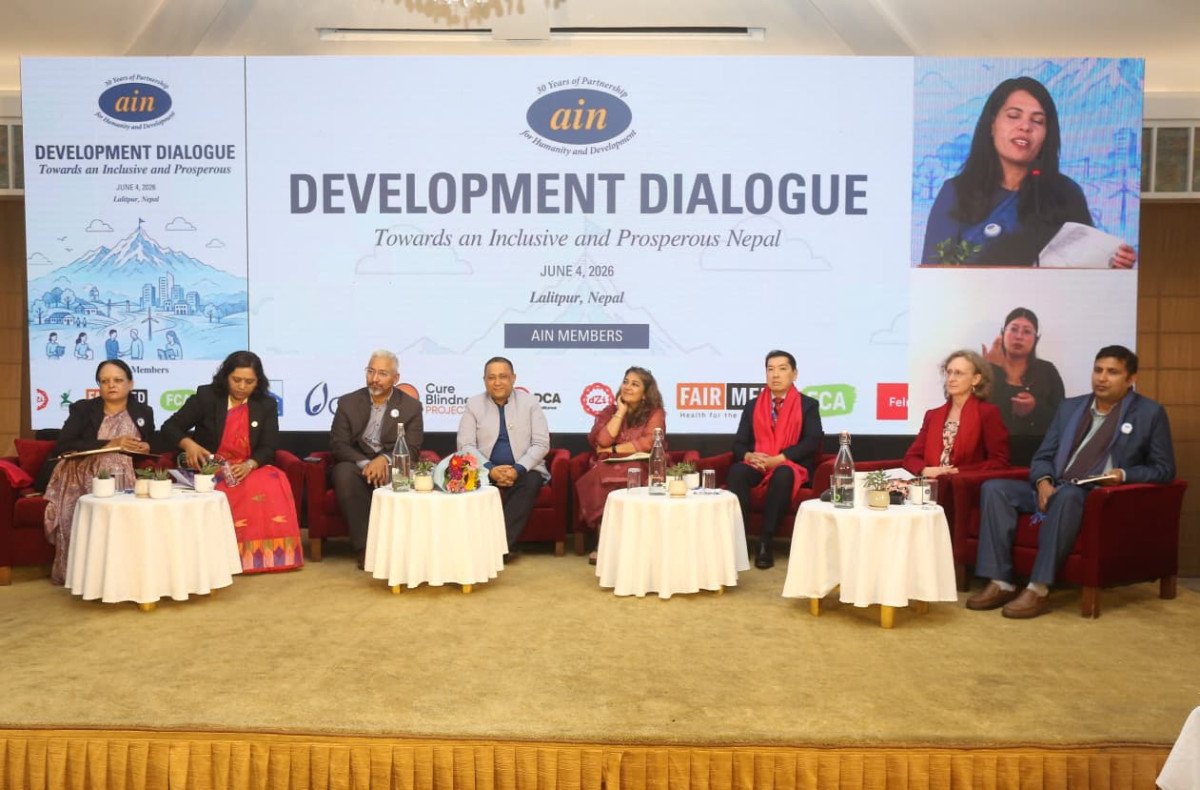
The annual progress report recently published by the Association of International NGOs in Nepal (AIN) shows its contribution in various dimensions of development is invaluable. The 102 international non-governmental organizations active in Nepal are operating development programs purely in a grant model, without adding any debt burden to Nepal's economy annually.
This type of debt-free investment has provided great relief to Nepal's national economy, overcoming the structural challenge of increasing debt burden in development partnerships and the long-term dependency structure it creates. By corresponding with the United Nations, the government is moving towards the implementation of the 16th periodic plan with the national resolve to graduate from LDC status by 2029. While discussions are ongoing about the nature of foreign aid and development partnerships during this transitional period, the achievements published by AIN present a different and sustainable development model.
Debt-free development and prosperity, a new economic roadmap, capital mobilization, and foreign exchange reserves have always been pressure points for a developing economy like Nepal. Addressing this reality, AIN is directly channeling development investment worth 20 arba rupees, or 150 million US dollars, annually into the national economy without debt. This process ensures capital access down to the rural level without creating any liability in the country's financial accounts.
‘Development without debt is the main basis for Nepal's economic transformation’, analyzing the published report, it is stated, ‘By mobilizing billions of rupees in development grants without the burden of foreign debt, we are supporting Nepal's economy, which helps in taking the country towards a middle-income country without increasing national debt.’ This capital mobilization is not just the distribution of external aid but has become a means of creating more than fifty thousand direct and indirect employments within the country, which helps in keeping the domestic labor market dynamic and reducing the rate of youth migration. In addition, it contributes to the state's internal resource management through the collection of annual revenue of 65 to 70 crore rupees through income tax of employees and source tax deduction in various procurement processes.
Development aid is effective only when a large part of it is channeled into the local community and local market. In this context, AIN has presented an effective picture of localization policy. Under this, about 75 percent of the total program budget is channeled through local non-governmental organizations in Nepal.
This practice has increased the institutional capacity of the local civil society on one hand and bridged the gap between international knowledge and local needs on the other. ‘We are acting as a ‘local engine’ by channeling 60 to 100 percent of the share directly to local businesses and non-governmental organizations’, AIN claims, ‘This leads to sustainable self-reliance by making the local market dynamic.’ Furthermore, the fact that more than 95 percent of leadership and managerial positions are held by Nepali manpower shows that the decision-making process incorporates Nepali identity and local sensitivities.
Nepal is a country at high risk of climate change, and the poor, women, and residents of geographically remote areas are the most affected. Understanding this sensitivity of environmental justice, biodiversity and the ecosystem have been protected by conserving more than 67 thousand hectares of forest and wetland. More than 88 thousand people have directly benefited from this. To cope with floods, landslides, and other natural disasters, emergency operation centers and modern early warning systems have been established in 17 local levels.
Using this technology, more than 97 thousand people have been safely relocated during disasters, and the risk of erosion has been minimized by protecting 4,900 meters of riverbanks. Plans such as agricultural insurance and climate-resilient farming systems have reduced the damage caused by floods, landslides, and unseasonal rains due to climate change at the local level.
Locals have benefited from climate-resilient plans. They have also succeeded in improving their economic condition by earning income from climate-resilient projects. This has brought a big change in the livelihood of those who struggle to make ends meet. A basis has been prepared for them to save for the future as well. In addition, access to clean energy has been provided to more than 8,700 households in the geographically backward remote Karnali and Himalayan regions, addressing both environmental protection and health improvement.
The success of development can only be measured by which segment of society benefits from it. Poverty, gender discrimination, and geographical remoteness are intertwined in Nepal's rural society. In the activities undertaken to address these multidimensional challenges, 50 to 80 percent of the beneficiaries are women and children. Among them, Dalits, Madhesis, persons with disabilities, and marginalized groups have 100 percent representation. This shows that development programs are not limited to the privileged class but have reached the doorstep of the marginalized communities who are in real need.
To transform the subsistence agricultural system towards commercial agriculture, 11 thousand small farmers have been organized into 507 producer groups, and collective savings of 1 crore 62 lakh rupees have been collected. This initiative appears to have played a significant role in breaking the structural barriers to financial access in rural areas. This campaign has put into practice the principle that women's economic self-reliance is the first step towards women's social empowerment. Through self-help groups run under community leadership, 4 crore 80 lakh rupees have been mobilized, enabling 3,437 marginalized women to start their own small and medium enterprises.
In addition, 54 community banks have been established in villages, providing concessional loans to more than 4,000 poor households. This initiative has freed the poor from the vicious cycle of high interest rates and provided economic independence at the local level. On the other hand, to address youth unemployment and labor market imbalance, 2,210 youths have been provided with vocational education and training, and more than 1,000 have been provided with workplace-based skills. In addition to traditional employment, this is attracting the younger generation towards climate-friendly micro-enterprises by creating more than 1,100 green jobs annually.
The basic infrastructure for sustainable development is education and health. The efforts made by the organizations affiliated with the Association of International NGOs in Nepal (AIN) appear to have had a significant impact on the public health system and the education sector. More than 570,000 citizens received health check-ups and free cataract surgeries in one year. To reduce the alarming rate of maternal and infant mortality in rural areas, 83 maternity centers have been physically and technically upgraded.
As a result, institutional deliveries by skilled health workers in the targeted areas have improved by 32 percent. To ensure women's reproductive rights and health security, more than 13,000 women have been provided with safe services, and more than 7,600 unsafe abortions have been prevented, which has had a significant impact on saving the lives of rural women. In the field of education, merely increasing school enrollment is not enough; improving the quality of learning has remained the main challenge. Keeping this in mind, special programs have been conducted to improve the early learning of more than 36,000 children to support the school education sector plan.
The establishment of libraries in 5,265 community schools and the training of more than 31,000 teachers in modern teaching methods have helped make the quality of community education competitive with the private sector. ‘We are making the 16th plan dynamic through social impact’, AIN claims, ‘This has resulted in work ranging from restoring the vision of more than 49,000 people to conserving more than 67,000 hectares of forest area.’
To invigorate local governance and citizen participation, 844 ward development organizations have been activated. The impact of their activism is beginning to be seen in the plans of local governments. 399 local plans operated by the organizations have been directly included in the annual budget of the local government. This process has served as a bridge to carry the voice of the grassroots to the policy level of Singha Durbar. The deepest discrimination in society arises from the lack of legal identity received from the state itself.
To break this cycle of lack of identity, legal counseling services have been facilitated to help 150 women obtain citizenship in a short period of 7 months. With citizenship, they have gained opportunities to open bank accounts, receive government nutrition allowances, and participate in other social security schemes of the state. This is a major achievement in the field of good governance and human rights. ‘We do not compete with the government, but rather play a complementary role in strengthening the national system’, AIN has pledged, ‘By channeling budgets at the local level, we have put the localization of federalism into practice.’ This is mentioned in AIN's annual progress report.
This specific news has been automatically translated by AI. As a result, there may be some inaccuracies or language errors.