Government's Two-Day Weekend Policy Increases Patient Load in Hospitals

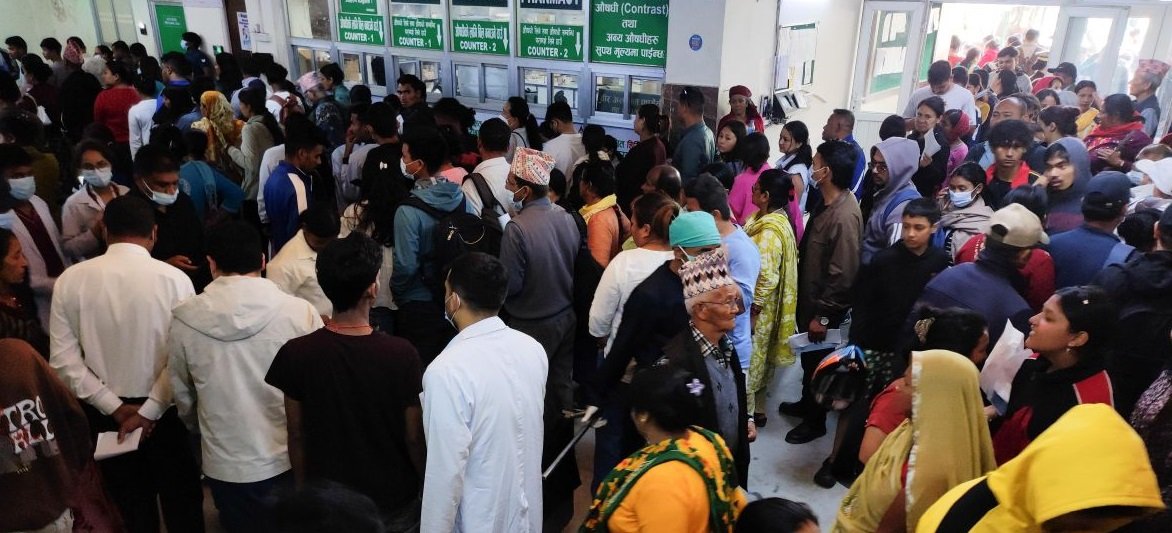
Kathmandu. The patient load in hospitals and health institutions has increased significantly since the government decided to give two public holidays a week.
Due to public holidays, OPD services are closed on Saturdays and Sundays in government hospitals, leading to an increase in patient load on Mondays. With the increased patient load, doctors are unable to give adequate time to patients.
According to Hari Pageni, Deputy Secretary at Bir Hospital, the country's oldest hospital, the quota system on tickets has been removed with the aim of reducing crowds. Pageni said, 'Currently, around 4,300 service recipients come on Mondays, which is a bit more. On other days, around 4,000 people come for treatment. We provide OPD services from 9 am to 5 pm from Monday to Friday.'
Pageni stated that the load of those mainly taking insurance services has increased. He informed that the number of people coming to Bir Hospital for insurance services has increased after insurance services were closed in private hospitals. At Bir Hospital, OPD tickets can be purchased daily from 7:30 am to 3:30 pm. Around 4,000 patients visit Bir Hospital daily for services, except on Mondays.
Shukraraj Tropical and Infectious Disease Hospital in Teku has been operating essential OPD services on Sundays. Dr. Anup Bastola, Director of the hospital, said that essential OPD services have been brought into operation on Sundays to administer anti-rabies injections.
Dr. Bastola informed that around 800 people come for anti-rabies injections on Sundays alone. He said, 'Doctors on rounds monitor the patients coming on Sundays.'
Approximately 1,300 patients visit Shukraraj Tropical and Infectious Disease Hospital daily for treatment.
Trauma Center sees an average of 385 service recipients daily. Dr. Rudra Marasini, Director of Trauma Center, said that the available manpower has been appropriately mobilized to manage the patient load. He said, 'It is overloaded, but we have utilized the available manpower appropriately.'
Nijamati Hospital has currently assigned one doctor the responsibility of seeing 35 new patients daily. Ranjana Nepal, Information Officer of the hospital, informed that this has been increased from 30 patients previously. Nepal said, 'General tickets can be purchased from 7 am to 2:30 pm. After that, arrangements have been made to purchase paying tickets from 2:30 pm.'
As per the policy of two public holidays a week, OPD services will remain closed on Saturdays and Sundays until further notice, while inpatient and emergency services will continue to operate as usual.
Nepal said, 'Except for the public holidays on Saturday and Sunday, there are very few holidays on other days. Very few service recipients come during those times.'
One thousand to 1,100 patients visit Nijamati Hospital daily for treatment.
Trauma Center sees an average of 385 service recipients daily. Dr. Rudra Marasini, Director of Trauma Center, said that the available manpower has been appropriately mobilized to manage the patient load. He said, 'It is overloaded, but we have utilized the available manpower appropriately.'
Trauma Center provides services from 9 am to 5 pm. With OPD services closed for two days, the government has stated that it will further expand the capacity of emergency services.
The Ministry of Health and Population had issued a notice on Baishakh 4 stating, 'In the context of the implementation of the provision of two public holidays on Saturdays and Sundays, keeping in mind the morale and welfare of the health workers and to ensure continuous patient care, as per the government's policy of two public holidays a week, all inpatient and emergency services, including scheduled surgeries on Sundays, will remain operational 24 hours a day, with rescheduling as per patient convenience.'
The ministry had directed hospitals to provide all possible services on holidays and to refer patients to nearby appropriate hospitals if services were not available, so that patients do not face any hardship. However, even now, patients are not able to receive services easily in hospitals.
This specific news has been automatically translated by AI. As a result, there may be some inaccuracies or language errors.