
Nepal-India Border Dispute Reignites Amidst Political Debate and Unimplemented Supreme Court Ruling
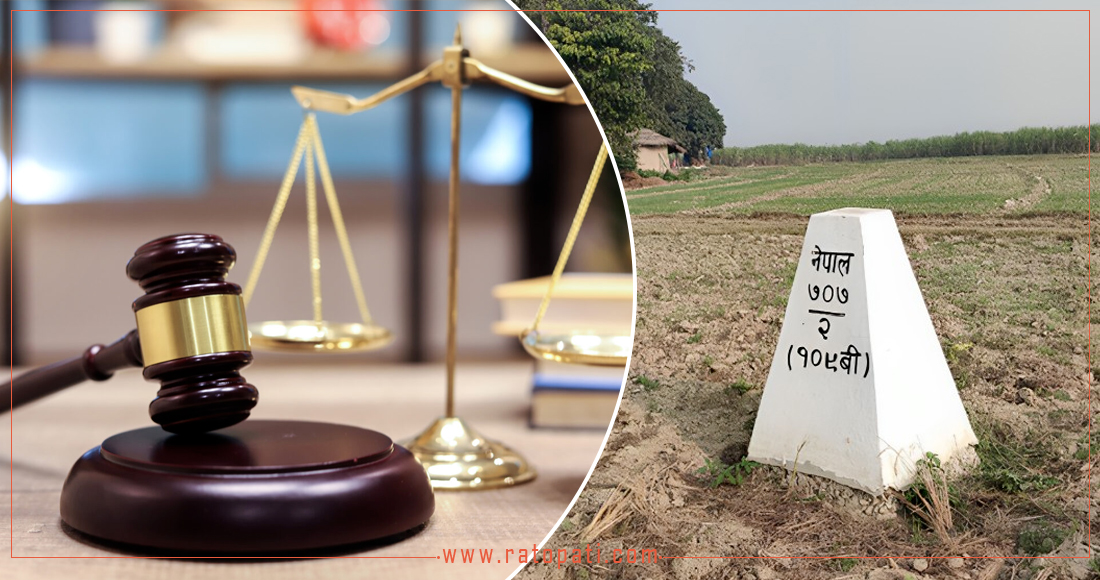
Kathmandu. The issue of the Nepal-India border dispute has once again come to the center of national politics. A controversial statement by Prime Minister Balen Shah has sparked debate in diplomatic and political circles, while a historic Supreme Court ruling made five years ago to resolve the same dispute remains shelved in government archives.
A five-year-old verdict was delivered by the Supreme Court on petitions filed by senior advocate Dr. Chandrakant Gyawali and border experts Buddhinarayan Shrestha, Bimal Gyawali, Liladhar Upadhyay, and Shashikumar Karki. The Supreme Court's verdict is unlikely to be implemented by Nepal alone.

The verdict, delivered by a joint bench of former Supreme Court Justice Prakashman Singh Raut and Justice Purushottam Bhandari, clarified that the border dispute between the two countries is not a matter to be resolved by demarcating the border from this or that location or by any specific method. 'Rather, the border with the neighboring country is linked to the question of Nepal's independence, nationality, and sovereignty. An independent nation has a defined border. Equal participation from both sides is necessary to resolve the border issue,' the full text of the verdict stated.
However, in recent times, the delay in implementing the directives issued in the Supreme Court's verdict regarding border resolution has also been due to the lack of dialogue with India. The Supreme Court itself stated in its verdict, 'The border is a shared issue between both countries, and the national border is an extremely sensitive matter. An appropriate environment for understanding each other's views, listening, and being heard should be created in this regard.'
The Supreme Court, in its mandamus, has directed to prevent illegal and criminal activities in the border areas and to systematize the movement system, based on Nepal's constitution, prevailing laws, international laws, and treaties between the two countries, to protect Nepal's independence, sovereignty, territorial integrity, nationality, self-reliance, dignity, the rights and interests of Nepali citizens, the security of the border, and the protection of Nepal's national interests. It has also directed to manage and regulate the open border based on mutual equality, respect, and reciprocal interests and concerns, including entering into further treaties and agreements as necessary.
Similarly, the Supreme Court issued a mandamus to clarify the disputed border areas of Nepal and demarcate the border based on treaties, agreements, and historical documents between Nepal and India, in accordance with Nepal's constitution and laws. It directed to pursue diplomatic initiatives with India, work towards an understanding, and resolve the dispute by demarcating the disputed areas in an appropriate manner through due process, ensuring that disputes do not arise again.
For the past few years, the implementation of the Supreme Court's mandamus has not been possible due to the lack of high-level talks with India aimed at resolving the border issue. Meanwhile, a few days ago, Prime Minister Balen Shah, standing at the parliament's rostrum, clearly stated that the border problem would be resolved through diplomatic dialogue.
India has also consistently stated that the border dispute between the two countries can be resolved through diplomatic dialogue. However, this dispute escalated after India constructed a trade route connecting to China via Kalapani, Limpiyadhura, and Lipulekh. In response, Nepal issued a map incorporating those territories. Since then, there has been no diplomatic dialogue between Nepal and India regarding the border dispute.
Recently, Prime Minister Balen's statement, 'India has encroached on a lot of land in Nepal, not just Nepal encroaching on India's land,' has become controversial. Following opposition from opposition parties to his statement, a statement issued by the spokesperson of the Ministry of Foreign Affairs clarified that the statement was primarily related to 'encroachment of the no-man's land' and 'cross-border occupation' or 'possession of land across the border.'
After the full text of the Supreme Court's verdict on the border dispute was released, the petitioner, senior advocate Dr. Chandrakant Gyawali, visited the Verdict Implementation Directorate to inquire about the status of the verdict's implementation. Following his repeated follow-ups regarding the implementation of the verdict, the Verdict Implementation Directorate sought a response from the government through the Attorney General's Office.
The Attorney General's Office summoned the secretaries of the Prime Minister's Office, the Ministry of Foreign Affairs, the Ministry of Defense, and others, who were made respondents regarding the implementation of the verdict on the border issue between the two countries. Senior advocate Dr. Chandrakant Gyawali states that during the discussion, the secretaries said that the issue related to the border dispute between the two countries should be discussed at the Prime Minister's level, and thus the Supreme Court's verdict reached the Prime Minister and Council of Ministers' Office and got stalled. According to him, the government can resolve the issue of implementing the Supreme Court's verdict through diplomatic initiatives.
The solution to Nepal's border security and national integrity issues does not seem to lie solely in the Prime Minister's statements or the opposition parties' protests in parliament. Experts say that it requires the legal roadmap laid out by the Supreme Court and diplomatic skill.
This specific news has been automatically translated by AI. As a result, there may be some inaccuracies or language errors.

_idatiPhCi3.jpg)



_7iFaN9CSkK.jpg)