Curriculum Review Taskforce Begins Work to Modernize School Education

-education-and-sport_c0BHyFjlfq.jpg)
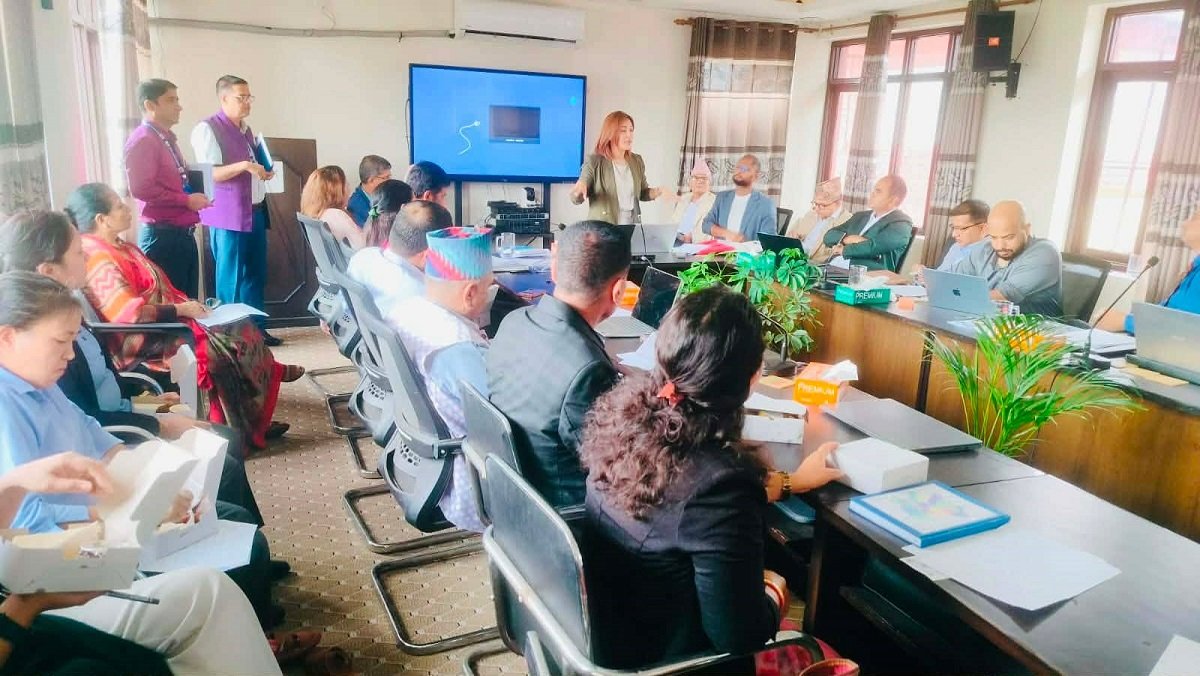
Kathmandu. The taskforce formed to review the school level curriculum has started its work. The taskforce has systematically started the work of reviewing the National Curriculum Framework 2076 to make it timely. The National Curriculum Development and Evaluation Council, in its 98th meeting chaired by the Minister of Education and Sports, Sasmita Pokharel, on the 11th of Baisakh, formed a taskforce under the convenership of Prof. Dr. Balchandra Luintel, Dean of Kathmandu University's School of Education. The review of the National Curriculum Framework 2076 is being undertaken as it completes its five-year cycle from the academic year 2080. "Our main concern will be what kind of human resources the curriculum will produce. The curriculum should also contribute to increasing social dignity, discipline, democratic values, beliefs, love, and affection," said coordinator Dr. Luintel, adding, "We are engaged in this work." The taskforce has planned to prepare a suggestion report within about five months, with the taskforce meeting including Education Minister Pokharel, National Planning Commission member responsible for education Reshu Aryal, and high officials from the Ministry of Education. Dr. Meenakshi Dahal, a member of the taskforce, stated that the taskforce will recommend a new National Curriculum Framework for the review and restructuring of school education. The members of the taskforce include Dr. Lekhnath Poudel, Dr. Dahal, Dr. Amina Singh, Pavitra Bahadur Gautam, Dr. Pramod Bhatta, Gyanendra Malla, Sagendra Shrestha, Richa Neupane, Revati Karki, and the member secretary is Yuvraj Poudel, Director General of the Curriculum Development Center. While the curriculum has been reviewed every five years, the plan is to make the curriculum timely according to the changing environment by restructuring school-level education with the formation of a new government after the elections, said taskforce coordinator Dr. Luintel. He informed that the taskforce will hold extensive discussions with relevant experts and stakeholders to include social and moral education in the curriculum to make students skilled and good for all aspects of life, not just mechanical (rote learning). Taskforce member Dr. Dahal informed that 'thematic' study has begun and preparations are underway to interact online and in person with various stakeholders. There have been voices demanding that the curriculum of education received by children should be practical, contemporary, quality, life-oriented, and relevant for the overall transformation of the country. The Curriculum Development Center has stated that continuous positive thinking and initiative from all concerned parties are necessary for its effective implementation. The guidance for school education has been developed by considering local and global needs, new educational trends in development, solutions to societal problems, and the environment. The framework of 2076 aimed to make learning effective by expanding early education, integrating life-oriented subjects, and widely using information and communication technology, with school-level management and operation at the local level. It is believed that the new framework will be further refined with concepts of communication, human rights promotion, and gender, as well as the languages, cultures, and life philosophies of various ethnic groups of Nepal, and the national and global context. The new framework will also address the remaining tasks of the Sustainable Development Goals to be completed by 2030. The Ministry of Education has stated that the National Curriculum Development and Evaluation Council meeting has also decided to discontinue internal examinations for students up to class 5 from the upcoming academic session. The Council meeting has formed a seven-member taskforce under the convenership of Director General Poudel to prepare an alternative evaluation system that does not cause psychological impact and pressure on students of that level and to implement an internal evaluation system in classes 4 and 5 as well. The government's policy and program for the upcoming fiscal year mention the review of curricula and evaluation systems at all levels. The program has pledged to make education up to the secondary level easily accessible. The policy and program include expanding employment-oriented education, increasing investment in public education, regulating education, and expanding the use of artificial intelligence (AI) and information technology.
This specific news has been automatically translated by AI. As a result, there may be some inaccuracies or language errors.