
Nepal's Development Projects and Industries Face Crisis Due to Global Oil Price Volatility and West Asian Conflict


Kathmandu. Major development projects and manufacturing industries in Nepal have fallen into serious crisis due to the ongoing conflict in West Asia and fluctuations in international petroleum prices.
According to data from the Department of Customs, approximately 300 billion rupees were spent on the import of major fuels alone in the first 10 months (Shrawan-Baishakh) of the current fiscal year 2082/83.
The price of plastic raw material (polymer), which is a component of petroleum products, has increased by up to 50 percent, causing domestic plastic industries to face high costs and supply shortages, thereby significantly increasing the cost of the overall industrial sector and infrastructure development.
Data shows that the import of petroleum products in Nepal was high in the first 10 months (Shrawan to Baishakh) of the current fiscal year 2082/83.
According to the latest foreign trade statistics released by the Department of Customs, over 300 billion rupees were spent on the import of major petroleum products such as diesel, petrol, LPG gas, and aviation fuel during this period.
While petroleum products have consistently held the largest share of the country's total imports, the data indicates that this trend has continued this year as well.
In Shrawan-Baishakh of 2082/83, petroleum products worth 299.5 billion rupees, amounting to 826.171152 million liters, were imported. This represents a 13.09 percent increase in import value compared to the same period last year, while the import volume decreased by 60.86 percent.
Last year, 2.110874871 billion liters of petroleum products were imported at a cost of 264.84 billion rupees.
How much of each petroleum product was imported?
Among petroleum products, diesel, which is imported the most in Nepal, has seen a slight decrease in import volume but a significant increase in price. While 1.147657 million kiloliters of diesel were imported in the same period last fiscal year, it decreased slightly to 1.144346 million kiloliters in the same period of the current fiscal year.
Despite a decrease of approximately 3,311 kiloliters in volume, the import value of diesel has increased from 102.38 billion rupees last year to 130.93 billion rupees this year. This is an increase of approximately 28.54 billion rupees compared to last year.
The import volume and value of petrol and aviation fuel (ATF) have both increased. Petrol imports increased from 612,012 kiloliters last year to 621,951 kiloliters this year, with the import value rising from 53.05 billion rupees to 58.64 billion rupees. Similarly, aviation fuel imports increased slightly from 177,929 kiloliters last year to 181,951 kiloliters, and its total value increased from 16.14 billion rupees to 20.80 billion rupees, according to the data.
Imports of cooking gas (LPG) and kerosene have seen a decrease in both volume and value. In the first 10 months of last year, 456.88 million kg of LPG gas were imported, which decreased to 443.137 million kg in the same period of the current year. Its import value also decreased from 51.81 billion rupees last year to 46.13 billion rupees. Kerosene imports also decreased from 10,802 kiloliters in the first 10 months of last year to 6,644 kiloliters this year, with its value falling from 970 million rupees to 620 million rupees.
Petroleum Product Import Comparison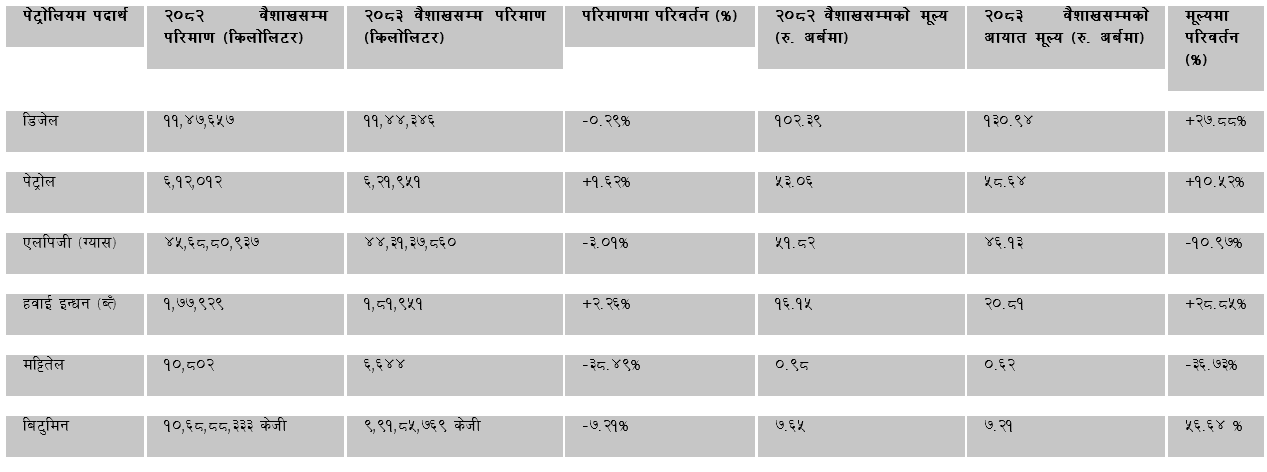
Source: Department of Customs
Decline in Bitumen Imports: Blacktopping Affected
Road blacktopping and major physical infrastructure projects are in crisis due to the impact on bitumen imports. With the decline in bitumen imports during the favorable weather for infrastructure development and road blacktopping, work on strategic roads, highways, and local infrastructure projects across the country has slowed down, and in some places, has come to a complete halt.
Due to supply disruptions and transportation issues in the West Asian region, the availability of bitumen in Nepal has decreased this year, severely affecting national development construction works.
West Asian conflict and increased international petroleum prices have put Nepal's plastic industry in serious crisis. Due to international market fluctuations and the rise in the dollar's value, the price of plastic raw materials has increased by nearly 50 percent, and it has become difficult to obtain supply according to demand.
According to data from the Department of Customs, 99.185769 million kg of bitumen were imported in the first 10 months (Shrawan-Baishakh) of the current fiscal year 2082/83, which is 7.702564 million kg (7.21 percent) less than in the same period of the previous fiscal year. In the same period last year, 106.888333 million kg of bitumen were imported.
A decrease in value is also observed; while bitumen worth 7.65 billion rupees was imported last year, this year it has decreased by 5.64 percent (approximately 430 million rupees) to 7.21 billion rupees.
The dry season from Falgun to Jestha is the suitable and final period for road blacktopping in Nepal. The import of more than 7.7 million kg of bitumen less during this main working season has directly impacted national pride projects and various urban development plans.
Due to the extreme shortage of bitumen in the market, construction entrepreneurs are demanding price adjustments and deadline extensions. This poses a risk of further extensions and increased cost estimates for infrastructure projects.
Plastic Demand Increased by 50%, Difficult to Obtain
The ongoing conflict in West Asia and the increase in international petroleum prices have plunged Nepal's plastic industry into a severe crisis. Due to international market fluctuations and the rise in the dollar's value, the price of plastic raw materials has increased by nearly 50 percent, and obtaining supply according to demand has become challenging.
According to Prabad Ghimire, President of the Nepal Plastic Manufacturers Association, due to the instability in the international market, the price of raw materials, which previously cost 1,000 rupees per unit, has now increased to 1,500 to 1,600 rupees.
Businessmen state that not only are raw materials becoming more expensive in the market, but there is also a significant shortage in supply relative to demand. 'Currently, there is not enough raw material in the market to meet demand,' said President Ghimire. 'The concerned agencies are unable to provide raw materials as per the demands of the industrialists.'
In Nepal, plastic raw materials are mainly imported from Saudi Arabia, Qatar, and India. However, significant price increases and transportation problems are currently being experienced in imports from all these countries.
According to Ghimire, this has directly impacted not just one type of plastic product but all kinds of plastic items. The production cost of all items, from small household goods to pipes used in construction and Hiltech water tanks, has increased significantly. As plastic is a component of petroleum products, any increase in international oil prices directly affects its price. Additionally, the recent increase in transportation costs has further increased the cost of raw materials.
Businessmen have complained that the government budget has not addressed the problems in this sector, and external circumstances have further exacerbated the crisis for industries.
The share of imported primary raw materials (polymers) for industries operating within the country is the largest. From Shrawan to Baishakh, 53.634167 million kg of polypropylene worth 8.202110 billion rupees have been imported.
Amidst this global crisis, the import volume and value of plastic in Nepal appear to be quite substantial. According to data released by the Department of Customs for the first 10 months (Shrawan-Baishakh) of the current fiscal year 2082/83, plastic and its finished products worth 58.07 billion rupees, amounting to 395.032453 million units (mainly kilograms), were imported during this period.
According to data from the Department of Customs, over 100 types of plastic raw materials and finished products are imported into Nepal under various headings.
The share of imported primary raw materials (polymers) for industries operating within the country is the largest. From Shrawan to Baishakh, 53.634167 million kg of polypropylene worth 8.202110 billion rupees have been imported.
Raw material for making melamine products (melamine resins) worth 1.627022 billion rupees, amounting to 46.041836 million kg, has been imported.
High-density and low-density polyethylene raw materials (polyethylene) exceeding 55 million kg of polyethylene raw materials have been imported, with a combined value exceeding 8.50 billion rupees.
PVC raw material worth 2.88 billion rupees, amounting to 26.402903 million kg, has been imported. Apart from raw materials, imports of sheets, films, and finished utensils required for packaging are also in the billions.
This specific news has been automatically translated by AI. As a result, there may be some inaccuracies or language errors.




-(2)_QJLjKxR87n.jpg)