Constitutional Amendment Debate: Task Force Studies Public Suggestions

Kathmandu. The 'Constitutional Amendment Debate Paper Preparation Task Force-2082' has stated that it will take time to prepare the debate paper on the issue of constitutional amendment as the suggestions received through various means are still under study. The task force, formed under the convenership of Prime Minister's Political Advisor Asim Shah, started collecting suggestions from Chaitra 25.
The task force published a notice on Jestha 8, giving seven days for the general public to submit suggestions. Secretary Leeladhar Subedi informed that 44,613 suggestions have been received through various means. Subedi stated that it will take time to study, integrate, and edit the received suggestions to prepare a draft, so it is not possible to say at this moment what kind of suggestions have been received.
"44,613 suggestions have been received from the public. The process of collecting suggestions from citizens has been completed. Suggestions from institutions and political parties will continue to be received," he told Ratopati. "The process of integrating and screening suggestions received through various channels is underway. It will take time to prepare the debate paper based on all suggestions. It is not possible to say when it will be completed."

The commission has sought suggestions on issues such as the form of governance, electoral system, federal structure, judicial system, provinces, local levels, and constitutional bodies. So far, the commission has sought written or unwritten suggestions from political party representatives, constitutional and legal experts, media experts and editors, and other stakeholders. The commission has proposed 7 subjects for constitutional amendment.
Form of Governance
Under this, the debate is on whether to move from the existing parliamentary system to a directly elected executive system. Proposals have been made for an executive president or prime minister, with either expert ministers or ministers from among the parliamentarians. The formation and accountability of the Council of Ministers have also been discussed.
Electoral System
This includes whether to adopt a directly elected, fully proportional, or mixed system. Priority has been given to 'None of the Above' (NOTA) / 'Right to Recall', and the voting rights of citizens residing abroad. Reforms to the legislative bodies at the federal, provincial, and local levels, and the roles of the National Assembly Chairperson and Vice-Chairperson are included.
Federalism
This includes structural reforms of federal, provincial, and local levels, and making administrative and financial federalism effective. The number of provinces, electoral system, number of representatives, and the role of provincial chiefs are under discussion. It is also debated whether to maintain the current party-based system in local levels or make them non-partisan. Additionally, there is a discussion on how to reform local judicial committees to reduce the burden of cases in the courts.
Judiciary
This includes reforms needed to create an independent, impartial, and capable judiciary. Issues such as the appointment, qualifications, and tenure of the Chief Justice, Supreme Court Justice, High Court Justice, and District Court Judge are included. There is a proposal to restructure the entire judiciary. Proposals have been made to end political interference in the judiciary and to reappoint judges at all levels. Issues related to the structural composition of the Judicial Council are also included. A proposal has been made on whether the Chief Justice should be a member of the Constitutional Council.
Constitutional Bodies
This includes the number of constitutional bodies, the process of appointing their office bearers, and balancing the autonomy and accountability of constitutional bodies.
Other Miscellaneous Issues
Issues such as making parliamentary sessions automatic, citizenship and rights of non-resident Nepalis, and the eligibility, age limit, and tenure of people's representatives are included. Experts can also provide written suggestions in a prescribed format on other issues they deem important, specifying which article is proposed for amendment, the current provision, the proposed amendment, and the theoretical and practical reasons.
The ruling party RSP has proposed a directly elected executive, a fully proportional electoral system, non-partisan local levels, restructuring of the judiciary, and significant changes in the provinces. Mohanlal Acharya, who is part of the task force from the party, stated that although these are proposals for discussion, they will proceed with the consensus of the constitution-making parties.
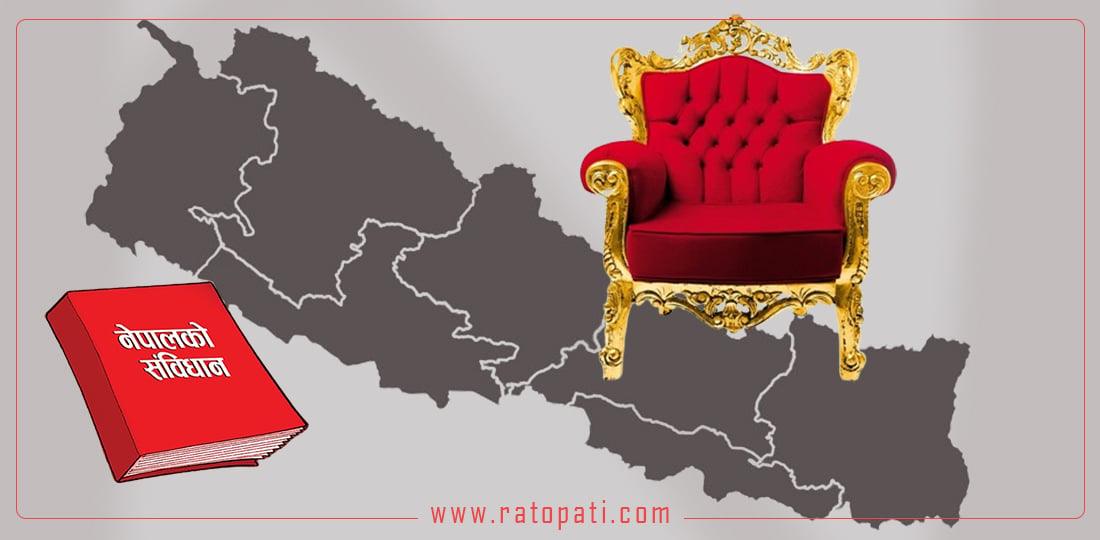
However, regarding constitutional amendment, the parties that were part of the constitution-making process appear skeptical about the proposals presented by the task force. While Article 274 of the constitution allows for amendment, opposition parties claim that the proposals presented by the task force are aimed at rewriting the constitution itself. Nevertheless, amending the constitution is not easy for the government, as provincial approval is also required. Article 274(8) of the constitution states that if approved by a majority of the provinces as per sub-article (5), the constitutional amendment bill must be ratified by a two-thirds majority of the federal parliament in session.
The main opposition party, Nepali Congress, has not yet sent a representative to the task force. The task force led by Vice-President Pushpa Bhusal has sought clarity regarding the suggestions for constitutional amendment. Bhusal stated that the constitution, built through long struggle, sacrifice, and dedication, cannot be amended on a whim.
"Constitutional amendment is not the agenda of one party; it is the agenda of all parties, civil society, and the people. Therefore, Congress has not participated because their representation is not in that structure," she said.
The Congress has clarified that it cannot seek solutions that go beyond the democratic system concerning the form of governance, electoral system, federalism, judiciary, local levels, and constitutional bodies. Congress has made the improved parliamentary system its bottom line.
CPN UML has just formed a constitutional amendment task force and has not yet provided written or unwritten suggestions to the task force. At a secretariat meeting held on Jestha 10, a 13-member constitutional amendment task force was formed under the convenership of Vice-Chairman Bishnu Prasad Paudel. Central office secretary Dr. Bhishma Raj Adhikari stated that the task force will provide suggestions to the task force only after completing the necessary preparations regarding the amendments required in the constitution.
The Communist Party of Nepal has also formed a constitutional amendment task force. At a central coordination committee meeting held on Baisakh 15, a task force was formed under the convenership of leader Dev Gurung. Task force member Prem Bahadur Singh informed that consultations and suggestions are being sought from various parties on the issue of constitutional amendment.
"Suggestions are being sought from various parties. A draft has not yet been prepared. The discussion is about amending the constitution as a whole, not just one aspect. We have not given our opinions and suggestions to the task force," Singh said.
The former Maoist Center had registered a 'Note of Dissent' on the form of governance, electoral system, and federal structure during the constitution-making process itself.
The Rastriya Prajatantra Party (RPP), the sixth largest party in parliament, has suggested abolishing the current system and reinstating the monarchy. Shyam Bahadur Shahi, who is the convenor of the constitutional amendment task force, informed that the party has suggested replacing the President with a King and abolishing the provinces.
"Under the form of governance, we have suggested that a King should be in place of the President. We have proposed making local levels more effective and abolishing the provinces," he said. "We have suggested making it a sanatana Hindu nation with religious freedom, abolishing the direct electoral system, and adopting a fully proportional system."
Similarly, regarding the judiciary, Shahi stated that a constitutional bench should not be chaired by the Chief Justice, and representatives from the Ministry of Law and the Nepal Bar Association are not necessary in the Judicial Council.
Madhesh-centric parties have stood in favor of federalism. They have stated that the role of the task force is questionable, making suggestions meaningless. The Janata Samajwadi Party (JSP) Nepal has submitted written suggestions for constitutional amendment.
Meanwhile, the Rastriya Janamorcha has suggested abolishing federalism. Chairman Chitra Bahadur KC informed that there is no point in the directly elected executive system as it has already failed.
"Federalism should be abolished. The country cannot afford the provinces. The center and local levels should be strengthened. Provinces can be kept as a coordinating body between the center and local levels. It will only handle administrative work. The republic must be saved. Local levels must be strengthened," KC said. "The directly elected executive has failed. The parliamentary system can be reformed. The judiciary has been unitary from the beginning. It has also gradually fallen under foreign control. The biggest challenge now is foreign interference."
Professor Krishna Khanal stated that the current constitution is based on republicanism, federalism, secularism, and inclusivity, and these four pillars should not be tampered with.
"The current constitution has four pillars: republicanism, federalism, secularism, and inclusivity. If even one of these is completely removed, the constitution will not function. Tampering with any one pillar means changing the entire system. There is a constitutional way to remove the system, but it does not seem practically feasible at present."
This specific news has been automatically translated by AI. As a result, there may be some inaccuracies or language errors.