Opposition Protests Rule Change on Constitutional Amendment


Kathmandu. Amidst the tense situation of the opposition parties surrounding the well during the House of Representatives meeting on Jestha 17, a provision regarding constitutional amendment has been included in Rule 140 of the House of Representatives Regulations 2083, passed by a majority. The opposition parties are protesting, claiming that the provision included in the regulations is an attempt to deviate from the constitutional provision.
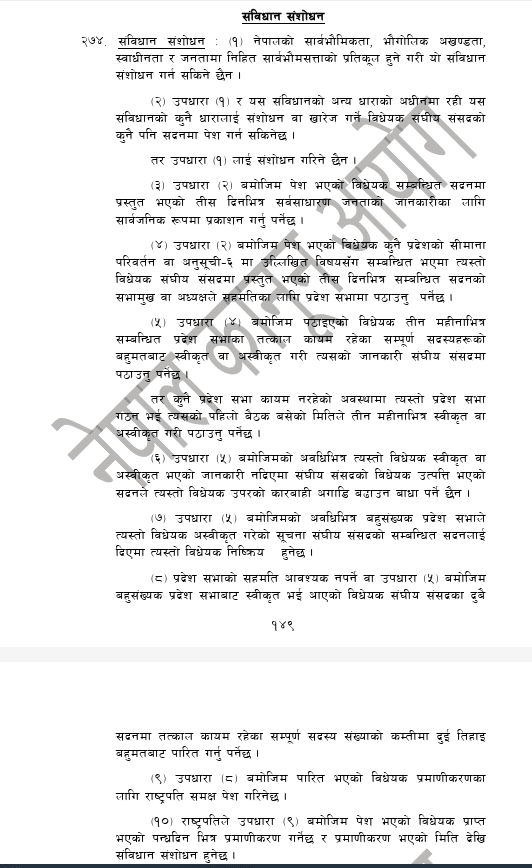
Article 274, Sub-article 8 of the Constitution of Nepal states, 'It shall be passed by at least a two-thirds majority of the total members of both houses of the Federal Parliament.'
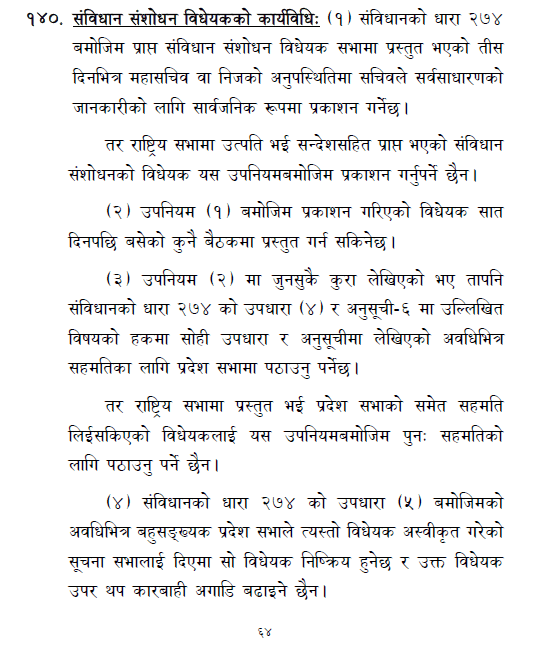
Rule 140, Sub-rule (11) of the House of Representatives Regulations also mentions the procedure for amending the constitution. Sub-rule (11) states, 'If a bill to amend the constitution, passed by the House and sent to the National Assembly, is received with a message, the Speaker shall certify the bill and send it to the President for authentication if the total votes received in favor of the proposal reach at least two-thirds of the total members of both houses.'
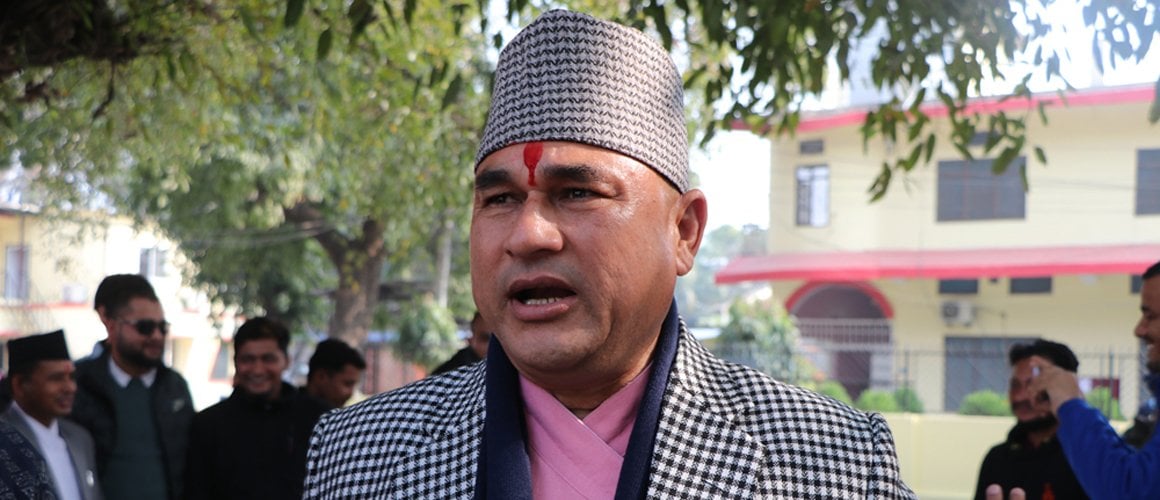
However, the opposition has accused the ruling party of 'cheating' in this sub-rule of the regulations. The House of Representatives had formed a committee to draft the regulations under the convenership of Rastriya Swatantra Party (RSP) MP Ganesh Parajuli. CPN UML MP Ain Mahar was also a member of that committee. Mahar accused the RSP, which has a single majority in the House of Representatives, of cheating and including that provision.
'We had agreed to incorporate the provisions of Article 274 of the Constitution and the House of Representatives Regulations 2079 verbatim in the draft regulations committee, so we proceeded without discussion,' Mahar told Ratopati. 'But the RSP friends added Sub-rule 11 by cheating. We were protesting by surrounding the well. They passed it by majority at that time, and we have an objection to that.'
This is the constitutional provision (See picture)
This is the regulation provision (Pictures)
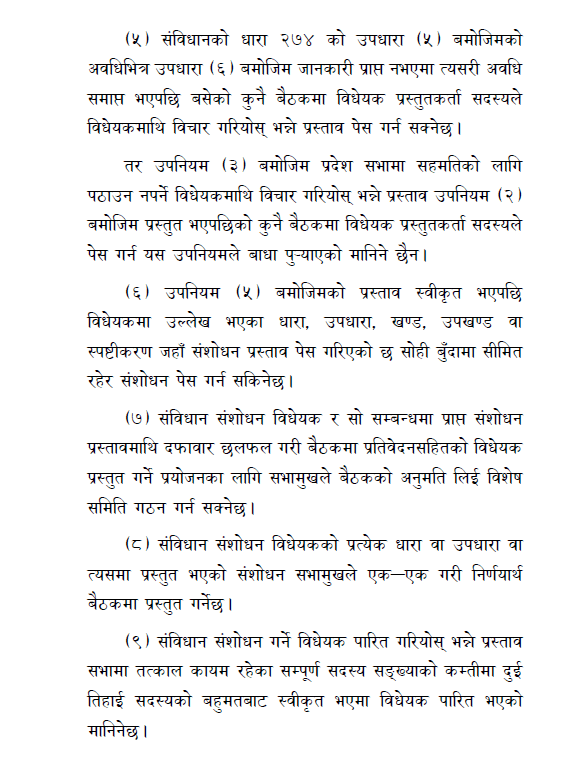
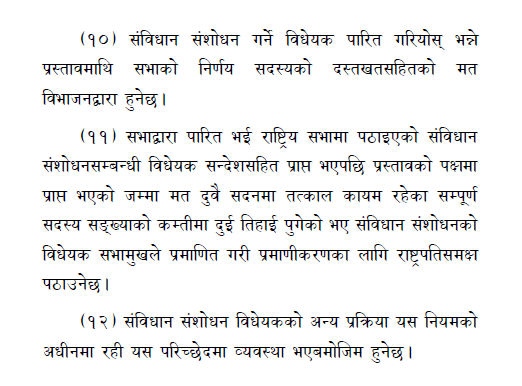
The constitution has a provision that it must be passed by at least a two-thirds majority of the total members of both houses of the Federal Parliament. Constitutional experts also say that it must be passed by a two-thirds majority from both the House of Representatives and the National Assembly. Most constitutional experts, including former Minister of Law, Justice and Parliamentary Affairs Govinda Bandi, Dr. Bipin Adhikari, are in favor of passing it by a two-thirds majority from both houses.
However, some, including senior advocate Gandhi Pandit, are saying that it is sufficient to convene a joint meeting of both houses and pass it by a two-thirds majority.
Currently, the opposition alleges that the RSP has included a provision in the regulations that strengthens the line of amending the constitution by convening a joint meeting of both houses and passing it by a two-thirds majority. In the 275-member House of Representatives, RSP alone has 182 seats. Even after subtracting the Prime Minister and the Speaker, who are from RSP, there are 180 seats. The required number for a two-thirds majority in the House of Representatives is 184 seats. Even without counting Prime Minister Balen Shah and Speaker Dol Prasad Aryal, if they find 4 more MPs, RSP has a high possibility of achieving a two-thirds majority.
On the other hand, RSP has no presence in the 59-member National Assembly. If there is no presence, there is no question of majority or two-thirds.
Furthermore, the term of National Assembly members does not end at the same time. Elections are held for one-third of the members every two years.
In one election, only 18 members of the National Assembly are elected. Elections were held only last Magh, so one has to wait until Magh of 84. Even if RSP wins all the seats in that election, it will not be a two-thirds majority, nor even a simple majority.
In other words, RSP has to wait another 4 years to achieve a two-thirds majority in the National Assembly (even if it wins all seats). Therefore, RSP is in a hurry to achieve a two-thirds majority by convening a joint session.
According to this, the total number of MPs from both houses is 334, and two-thirds of that is 223. In the House of Representatives, including the Prime Minister and the Speaker, RSP has 182 MPs. The RSP's strategy is to achieve a two-thirds majority by adding 41 more MPs. Leaders say that RSP's strategy is to bring 100% results in favor of the party in the National Assembly elections to be held in two years and to persuade other parties to achieve a two-thirds majority. However, no one is ready to give an official reaction on this.
This specific news has been automatically translated by AI. As a result, there may be some inaccuracies or language errors.