Intermediaries Defraud State Treasury Through E-Passport Procurement Variations


Kathmandu. Intermediary groups have been found to be defrauding the state treasury in the name of variations in the procurement and printing of electronic passports (e-passports).
This group, accused of evading taxes and committing capital flight by taking large sums of commission to Singapore through an offshore company, has now used the 'variation order' as a weapon to unnaturally increase costs, imposing an additional burden of billions on the state, facts have been revealed.
Recent details have exposed a serious conspiracy by intermediaries to neutralize competition in the procurement process, create artificial scarcity, and sign contracts at inflated prices through collusion, managing the resulting large sums of money abroad.
Expensive Procurement While Evading Competition, Loss of Up to $4 Per Passport
When the Department of Passports called for international tenders in 2020 for the supply of e-passports, personalization machines, and enrollment systems, the French company IDEMIA won the contract at a rate of approximately 10.13 US dollars per passport.
However, in mid-2022, even though there were more than 400,000 e-passports in stock in the Department of Passports' warehouse, instead of going for a new competitive tender, a variation order was issued through a cabinet decision under the influence of intermediaries, to print 2.8 million passports by IDEMIA itself.
As technology becomes cheaper in the global market, the average cost in the new e-passport procurement tender in 2025 has decreased to approximately 8.53 US dollars per booklet. According to experts, if the system cost is separated, the price of the booklet comes to less than 7 dollars.
This means that by purchasing passports through variation at the old rate in 2022, instead of going for a new tender, the state has lost an additional amount of 3 to 4 dollars per booklet. By this calculation, an additional burden of more than 1.50 billion rupees has been added to the state.
Proposal for More Expensive When It Should Be Cheaper
In November 2025, the Department of Passports still had more than two lakh passports in stock. At this time, IDEMIA made an unusually high proposal for a new variation order, at 15 US dollars per booklet, which is more expensive than the previous contract.
After considerable controversy and bargaining, the government finally decided to purchase approximately 7 lakh additional passports through a variation order at 10.53 US dollars per booklet. The fact that 10.53 dollars is paid for passports that can be obtained for less than 8 dollars in the market clearly shows the extent of the intermediaries' dominance in the public procurement process.
Offshore Network for Commission
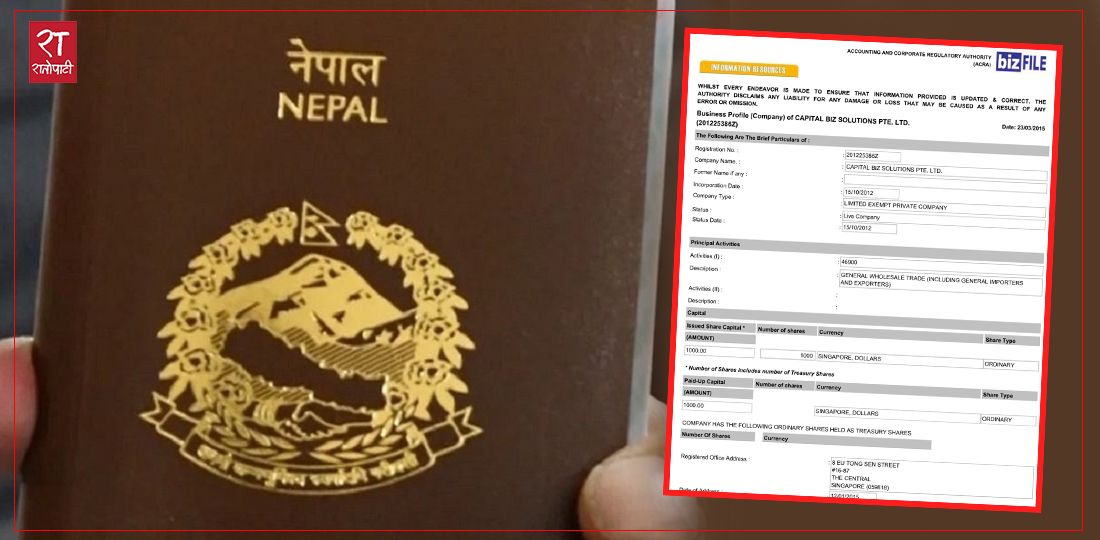
Sources claim that this large financial burden imposed on the state is not a normal administrative error but a planned design. It is through this additional amount increased via variation that intermediaries receive offshore commissions through Nepal's Delta Core Pvt. Ltd. and Singapore's Capital Biz Solution.
It has already been revealed that a network is active in transferring such illegal commissions from government technology and identity-related projects to Dubai via Hong Kong from Singapore.
Security Printing as a Weapon to Prevent Competition
It is claimed that the group including Siddharth Pandey has a strategic and influential role in the management of IDEMIA within Nepal and the intermediary network.
Fearing that other companies might get the contract at a lower price and their monopoly would be lost if a new competitive tender was called, this group has been misusing legal and policy loopholes.
According to sources, during the transitional period of passport procurement, Pandey strategically filed a Public Interest Litigation (PIL) arguing that the Department of Passports should print passports from a security printing company.
However, in reality, the security printing company lacks the physical infrastructure, budget, and skilled manpower to produce e-passports in large quantities. The Department of Passports itself has given a written response stating that the company is not yet technically ready.
Experts say that the main weapon of this intermediary group is to delay the new international tender process by filing cases under the guise of a nationalist agenda of printing domestically, and then using that shortage as an excuse to force the government to issue a variation order to the French company IDEMIA at an inflated price.
This specific news has been automatically translated by AI. As a result, there may be some inaccuracies or language errors.
_zDgGjQnBk0.jpg)