International Sagarmatha Day Celebrated Amidst Concerns for Mountain Guides


Kathmandu. Today is the 73rd anniversary of Sagarmatha ascent and the 18th International Sagarmatha Day. The world's highest peak Sagarmatha was successfully ascended for the first time on May 29, 1953. 73 years ago, at 11:15 AM today, Nepal's Tenzing Norgay Sherpa and New Zealand's Edmund Hillary first summited Sagarmatha.
Climber Hillary passed away on January 11, 2008. Norgay had left this earth 22 years earlier on May 9, 1986. Sagarmatha Day began to be celebrated in Nepal from 2008 in reference to Hillary's demise.
The government has been celebrating Sagarmatha Day every year with various programs. This year, International Sagarmatha Day is being celebrated with the slogan 'World's Highest Peak Sagarmatha: Nepal's Identity and Pride'. However, for years, complaints have been heard about the lack of attention to the safety, insurance, and fair wages of the guides who help climbers reach the summit. The increasing number of accidents and waste management in the Himalayas are also becoming equally concerning issues. The government, however, does not seem to be taking this seriously.
- 'Mountain guides are forced to go abroad due to lack of training and pension'
'International Sagarmatha Day' is a day of special significance for tourism professionals, but the story of the mountain guides who risk their lives to ensure safe journeys for tourists in the Himalayas is not so bright.
Experienced tourism professionals Aviral Rai and Pasang Kedar Sherpa, who have been climbing and guiding in the Himalayas for a long time, have raised serious questions about the safety, skills, and future of guides working in the mountains. They state that training is essential for safety and skilled manpower development.
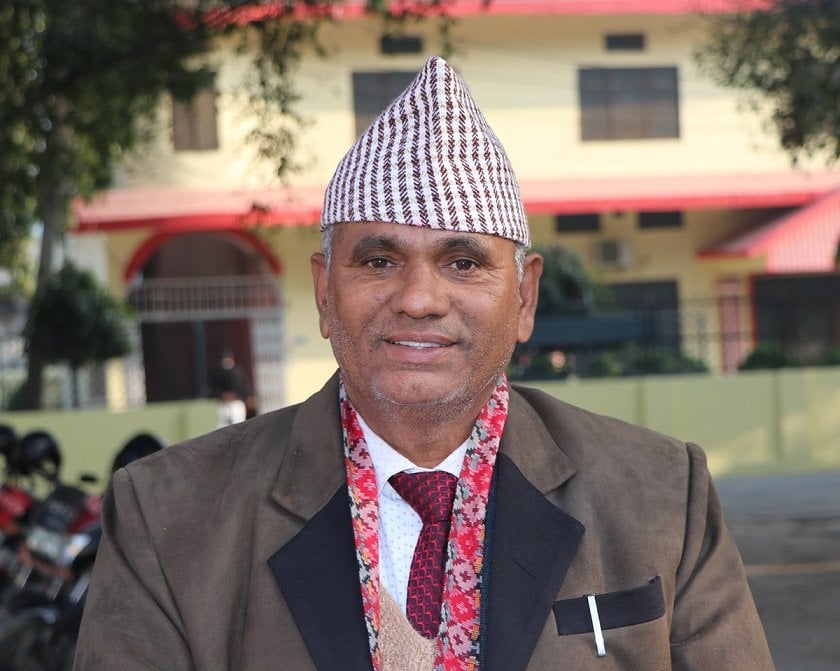
International Mountain Guide Aviral Rai says that it is extremely necessary to provide special training and safety education to guides working in the mountains. He is concerned that there has been no 'basic' and 'advanced' mountaineering course in Nepal for the past 7 years. He stated that accidents in the mountains are increasing due to the lack of training. He believes that the government should allocate a budget for the 'basic' and 'advanced' training of guides in collaboration with the 'Nepal Mountain Association'.
According to Aviral, a permanent resident of Thulung DudhKoshi Rural Municipality, Solukhumbu, accidents in the mountains can be reduced if there are well-trained guides. He says the government should pay attention to this matter as soon as possible. Due to being an experienced guide, he is the first choice for foreign tourists. Rai lamented, 'International-level remuneration and respect are only received after completing a professional course. There is no alternative to going abroad due to the lack of social security and pension systems in Nepal.'
As Rai says, it is not easy to complete an international-level course. It costs 30 to 35 lakh rupees to complete this course, but he experiences that it is very difficult to recover the investment.
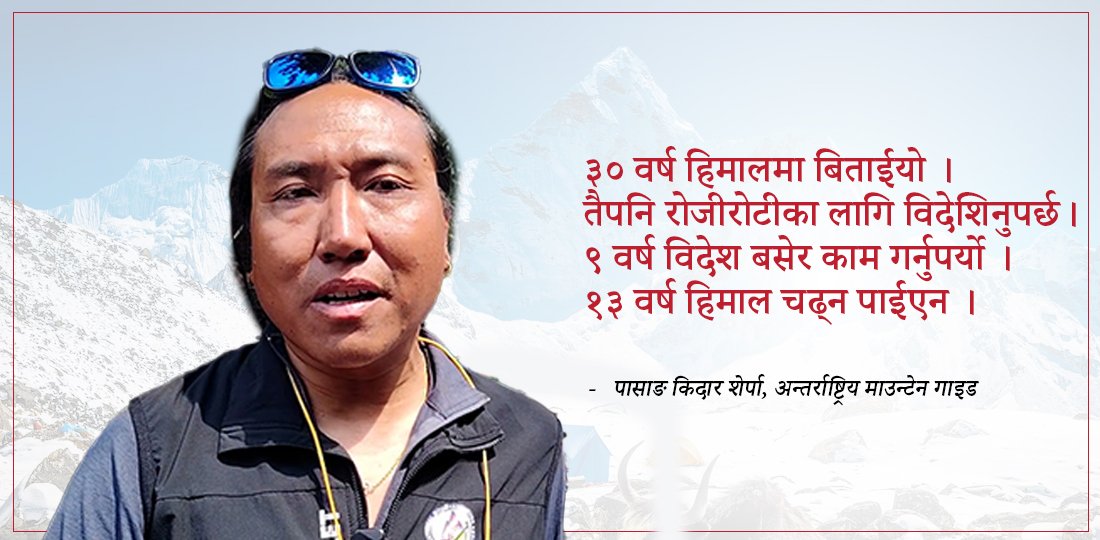
The experience of another experienced international mountain guide, Pasang Kedar Sherpa, is a bit different. Sherpa, who has spent more than 30 years in this field, is now forced to work as a guide in countries like Norway. In 2005, he went to America. He said that he was forced to live in America for 9 years because the income from his home country was not enough.
'The income from trekking and expeditions in Nepal is barely enough to cover household expenses. When working abroad, after paying taxes, there is also the benefit of pension in the social security fund, which is not available in Nepal,' Sherpa shared his experience.
According to Sherpa, who was born in Rolwaling, Dolakha, if the Government of Nepal provides a pension or social security system, skilled and experienced guides would not have to migrate abroad.
Sherpa entered the tourism sector at the age of 15. He has spent his entire life in the mountains at the age of 47. He indicates that if the current situation continues, it will be difficult to find skilled manpower in Nepal within the next 5-6 years.
Rai and Sherpa, who have dedicated their lives to the tourism sector, have a single voice: the state must provide pension or include those working in the mountains in the social security fund.
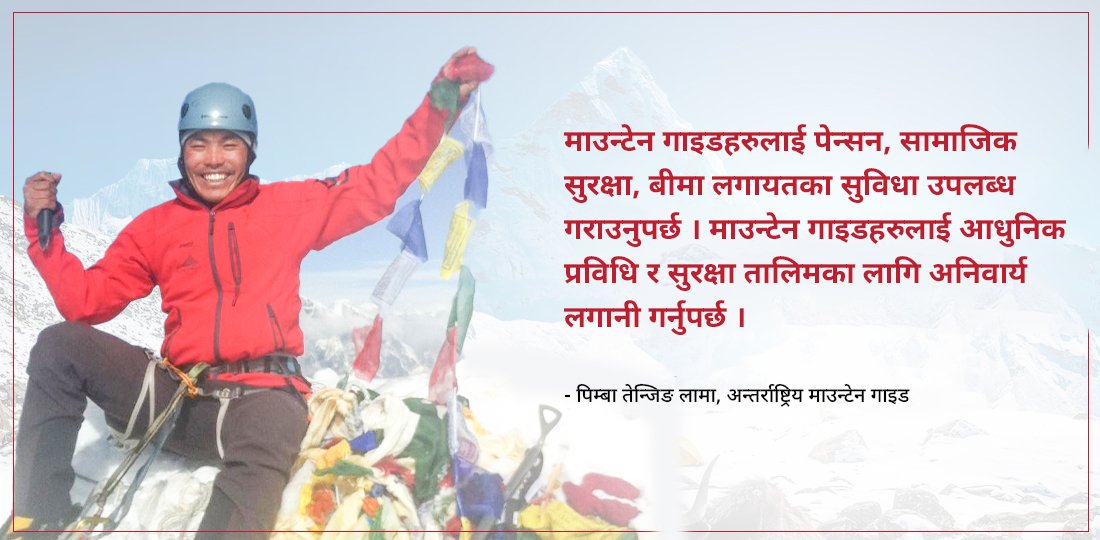
Pimba Tenzing Lama is a renowned international mountain guide in Nepal. He is particularly involved in the development and promotion of Nepal's mountaineering sector and the organization of adventure sports programs. He believes that the government should focus on preventing the exodus of skilled manpower rather than being limited to formal programs.
'Instead of just putting on a show and distributing awards, guides should be provided with fair wages, insurance, and social security funds,' Lama said. 'This profession is very insecure. The government should focus on producing skilled manpower.'
He emphasized that the government should increase the budget for mountain guide training.
Vivek Pandey, a tourism professional from Nuwakot, agrees with Lama. Pandey, who has been in the tourism sector for 17 years, advocates for increasing the insurance amount for mountain climbers. He has experience with the difficulty of rescuing someone by helicopter and bringing them to the capital when they fall ill in the mountains. 'The budget allocated for helicopter rescue and medical treatment should be increased,' Pandey said.
It seems that mountain guides will only be assured if they are provided with facilities such as pension, social security, and insurance by the government. Not only this, but the state also needs to invest mandatorily in modern technology and safety training for mountain guides.
If the Himalayas are the main backbone of Nepal's tourism, then these guides are their charioteers. They are enhancing the country's prestige in the tourism sector, but their own future appears uncertain and insecure. Let the Sagarmatha Day celebrated by the government not be limited to mere formality. Let the door for policy debate also be opened for the safety and bright future of the Himalayas' charioteers.
This specific news has been automatically translated by AI. As a result, there may be some inaccuracies or language errors.