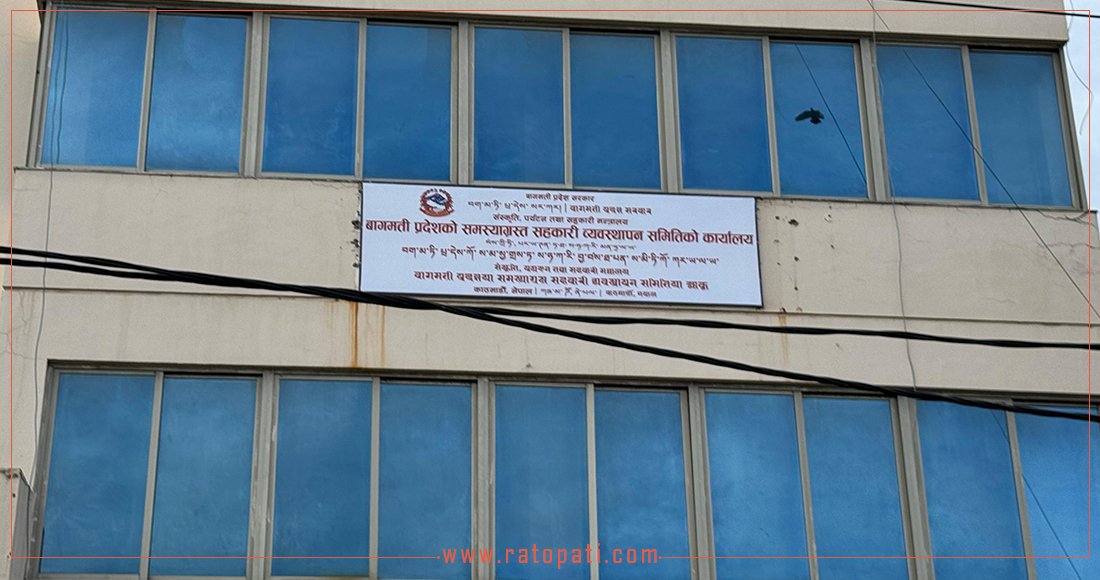
Government Commission Finds Cooperative Sector in Crisis Due to Financial Irregularities and Weak Regulation


Kathmandu. A high-level inquiry commission formed by the government has concluded that the cooperative sector is heading towards a crisis due to increasing financial irregularities, weak regulation, and activities contrary to the basic principles of cooperatives.
The report prepared by the commission formed by the government to investigate irregularities in cooperatives has concluded that although the cooperative sector is an important basis for Nepal's socialist-oriented economy, public trust has significantly eroded due to a lack of effective regulation and good governance.
According to the commission, although the Cooperative Act, 2048 BS and Cooperative Act 2074 BS provide the necessary legal basis, the sector has seen increased distortions and inconsistencies due to weak implementation. The report states that cooperative institutions have abandoned the core principles of member-centered service, mutual cooperation, and self-reliance, and have become excessively focused on savings and loan transactions.
The report shows a lack of clear division of authority and coordination between the federal, provincial, and local levels. The commission concluded that effective monitoring, inspection, and supervision have not been possible due to the multi-regulatory body structure. The report mentions a lack of skilled manpower, information systems, and technological capacity in the Cooperative Department and related bodies.
The commission has stated that cooperative institutions are expanding branches beyond their work areas, investing depositors' funds in risky sectors, and collecting deposits from external individuals rather than actual members. The report also mentions that some cooperatives have adopted excessively profit-oriented activities contrary to cooperative principles.
According to the report, there is a lack of clarity in the classification and regulation of cooperative institutions. Although registered under various names, most cooperative institutions have made savings and loan transactions their main business. Despite being registered as agricultural, dairy, consumer, labor, production, or multipurpose cooperatives, many institutions are practically focused on financial transactions, the report states.
The commission has suggested that cooperative institutions should be primarily classified into production and service business-related cooperatives, consumer cooperatives, and financial cooperatives. The report states that production cooperatives should focus on activities related to agriculture, dairy, vegetables, seeds, handicrafts, and small industries, while consumer cooperatives should be linked to community service and consumption. It has advised the government to focus financial cooperatives within a limited scope on savings and loan transactions.
Similarly, the commission has pointed out the need for a clear arrangement of authority and work areas among the federal, provincial, central, and national level federations. The report mentions that the presence of similar institutions and federations at various levels has created duplication, lack of coordination, and complexity in regulation.
Policy of Uncontrolled Branch Expansion Creating Problems
According to the commission, the policy of allowing primary cooperative institutions to expand branches uncontrollably has exacerbated the problem. The commission has determined that although there is a provision for approving service centers according to Rule 76 of the Cooperative Regulations, 2075 BS, branches and service centers have been expanded across the country by misusing this provision.
The report suggests that new cooperative institutions should not be registered, approval should not be given for opening new branches or service centers, and existing branches should be gradually closed. The commission stated that it is difficult to conduct effective monitoring because, although various information systems have been introduced, the data obtained is incomplete and unreliable. The report mentions that the lack of an integrated, real-time information system adds challenges in identifying and controlling problematic cooperatives.
The report also highlights the weak governance status of cooperative institutions. The commission stated that serious financial irregularities such as misuse of institutional resources by directors and managers, excessive control by one person, use of resources of one institution in another, false audits, and lack of transparency have been observed.
According to the commission, another significant weakness in the cooperative sector is seen in the auditing system. The report points out that financial discipline has weakened due to collusion between auditors and institutions, false financial statements, and a lack of effective internal controls.
The commission's conclusion is that the lack of necessary mechanisms to protect depositors' interests has further aggravated the problem. The report states that deposit insurance systems, credit information centers, and loan recovery mechanisms, similar to the banking sector, have not been effectively implemented in the cooperative sector. The commission stated that ordinary depositors are directly affected due to the complex and slow dispute resolution process.
The commission has mentioned that weaknesses in human resources and capacity development, lack of cooperative education and training, and lack of professional expertise have caused cooperative institutions to deviate from their basic principles. The report states that the social objectives of cooperatives have weakened as some cooperative institutions have become excessively focused on savings and loan transactions rather than their own objectives. The commission also mentioned that the excessive number of cooperatives makes effective regulation difficult.
According to the commission, the number of registered cooperative institutions has reached approximately 31,000, and the state mechanism is not capable of regularly monitoring and supervising so many institutions. Pointing out the need for consolidation among cooperatives of the same nature, the commission has suggested that institutions should only be allowed to operate based on minimum capital, technology, manpower, and financial capacity.
The commission has suggested that inactive and weak cooperative institutions should be encouraged to merge with capable institutions, and institutions that do not comply with regular audits, general assemblies, and financial discipline should be taken into liquidation. Furthermore, the commission stated that a risk assessment and audit report of the concerned institution should be mandatory before consolidation.
Recommendation to Tighten Registration and Expansion of Cooperative Institutions
According to the commission, policy and legal reforms are necessary for improvement. The commission has suggested tightening the registration and expansion of savings and loan cooperative institutions, controlling branch expansion, and preventing operations outside their work areas.
Similarly, the commission has recommended that the registration process should only proceed based on the financial status of the cooperative, the capacity of the directors, the ability to bear expenses, and risk assessment. The commission's conclusion is that strict monitoring is necessary on the trend of expanding service centers across the country by misusing cooperative principles and regulations.
The commission has stated that an effective regulatory structure, an integrated information system, strict governance arrangements, and the actual implementation of legal reforms are essential for the improvement of the cooperative sector. – News Agency Nepal
This specific news has been automatically translated by AI. As a result, there may be some inaccuracies or language errors.
_jxKX1kXOlf.jpg)


_htFaNqpIDJ.jpg)