Yarsagumba Collection Begins in Mustang's High-Altitude Lakes


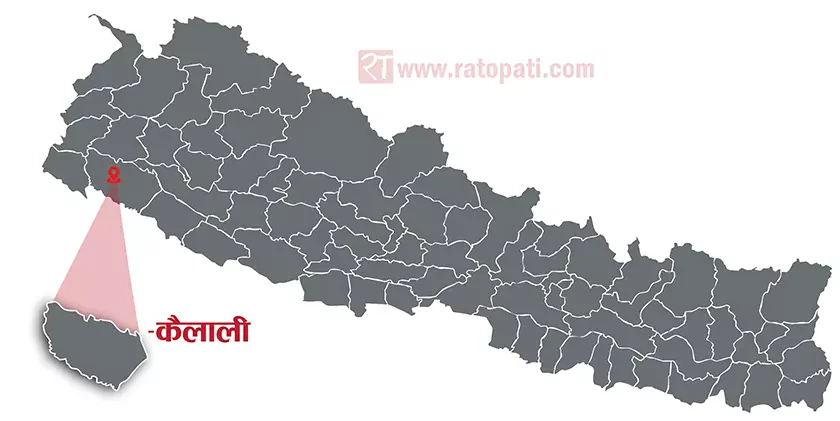
Mustang. Collection of valuable medicinal herb Yarsagumba, which has medicinal properties, has started in the high-altitude lakes of four out of Mustang's five local levels. Yarsa is being collected in large numbers in the high lakes, pastures, and meadows falling within the working areas of ACAP Jomsom and ACAP Lo-Manthang, under the Annapurna Conservation Area Project of the National Nature Conservation Trust. This wild medicinal herb is found at altitudes above four thousand meters above sea level.
Deepak Oli, Natural Resource Conservation Assistant at ACAP Jomsom, informed that people from the district and outside have started collecting Yarsa, which is done annually from Baishakh to Ashar, by obtaining permits (slips) after paying the fee set by the respective Conservation Area Management Committee (CMC). According to him, local CMCs must obtain prior written permission from the ACAP office to issue collection permits. Collection has already begun in the high lakes of Mustang's Thasang, Gharpagjong, Waragung Muktikshetra, and Loghekar Damodarkunda rural municipalities. Various committees in Thasang Rural Municipality had opened Yarsa collection in the high lakes since Baishakh 2.
Pawan Gurung, secretary of the Conservation Management Committee Jomsom in Gharpagjong Rural Municipality, informed that Yarsa collection was opened from Baishakh 25. According to him, Yarsa collection has been opened in the area from Chhatrabang Lake to Namkhulek, bordering Kungle Lake with Lupra Lake. The Jomsom committee issues permits to registered local residents of Kuriya from Dhumba, Samle, Thini, and Jomsom for four thousand rupees, and to those who have rented land from locals for six thousand rupees. So far, 65 people have obtained permits.
Similarly, the Muktinath Conservation Area Management Committee in Waragung Muktikshetra-1 opened Yarsa collection from Sunday. Lakpa Tsering Gurung, secretary of the committee, informed that the fee for collecting Yarsa in the high lakes under the committee has been set at three thousand rupees for local individuals and six thousand rupees for individuals from outside the district. In Muktinath, 165 people have already obtained permits for collecting Yarsa in Risamba Lake above Muktinath and Ner Jhang high lake above Lupra village, for a two-day trip. In the Muktinath area, 100 percent of those obtaining permits are from outside the district. Secretary Gurung stated that due to the low price of Yarsagumba last year, fewer collectors have come this year, and the number of collectors in Muktinath Lake has decreased by 50 percent compared to last year.
Umesh Poudel, Chief of ACAP Lo-Manthang, informed that the Jhong Conservation Management Committee of Waragung Muktikshetra-2 and the Surkhang Conservation Management Committee in Tangya, Loghekar Damodarkunda-5 in Upper Mustang have also opened Yarsa collection in the high lakes. According to him, Yarsa is not collected in Lo-Manthang Rural Municipality, and in Loghekar Damodarkunda, only the Surkhang Committee has opened Yarsa collection. Although permits have been distributed by ACAP-affiliated committees, Yarsa collection has been opened by the village societies themselves without ACAP coordination from villages like Marpha of Gharpagjong-2, and Chhenggur, Kagbeni, and Chusang under Waragung Muktikshetra.
To take Yarsagumba collected in Mustang's high lakes outside the district, revenue and fees must be paid to the concerned local level and conservation area management committee. Traders dealing in Yarsa must pay a revenue of thirty-one thousand rupees per kilogram for transportation outside the district, as per the rules of the Department of National Parks and Wildlife Conservation. According to Yarsa businessman Kaji Ram Gurung from Gorkha, its market price ranges from an average of fifteen lakh to twenty-five lakh rupees per kilogram, depending on quality. Government statistics show that five to seven kilograms of Yarsa are exported annually from the district after paying revenue. Eighty percent of the Yarsa produced in Nepal is exported to China and the rest to other countries.
With the start of the Yarsa season, ACAP has started using AI-equipped drone cameras this year to prevent wildlife poaching, forest fires, and undesirable activities in high lakes, pastures, and meadows. AI drone cameras are being used to control and identify all types of risks and crimes in high-altitude areas. In addition, ACAP conducts foot patrols with the presence of administration, police, and conservation area management committees to prevent criminal activities.
Yarsagumba, a medicinal herb found in the high lakes, pastures, and meadows of the Himalayan region, is a form of natural life and vegetation. Some people also call it a 'worm'. In the high lakes of the Himalayan region, a special type of butterfly larva (worm) lives underground. A fungus called 'Cordyceps' enters the worm's body. The fungus gradually develops inside the worm's body, kills the worm, and then resides within it. When the winter season begins, a small grass-like stalk emerges from the head of the dead worm and grows outwards. The object formed by the combination of the worm's body and the fungus growing above it is called Yarsagumba. In summary, its name is derived from the Tibetan meaning of Yarsa as summer grass and Gumba as winter worm.
The consumption of Yarsagumba found in the Himalayan region is considered useful for improving physical fitness, sexual potency, and immunity. Foreigners use Yarsagumba as a natural chemical for producing medicines, hence its consumption is high in the world market.
This specific news has been automatically translated by AI. As a result, there may be some inaccuracies or language errors.