Integrated Assessment Report Reveals Stark Performance Differences Among Local Governments


Kathmandu. It has been seven years since the federal governance system began in Nepal. 753 local governments are active with the constitutional vision of bringing 'Singha Durbar to the villages' and establishing public access to state resources. However, for the first time, an integrated assessment report has been released on how strong local governments have become institutionally and what standards of financial governance they have established in these seven years.
The integrated report for the fiscal year 2080/081 has been released. The 'Local Level Institutional Capacity Development Status Analysis and Area Identification Report' published by the Ministry of Federal Affairs and General Administration presents a picture of Nepal's federalism implementation that, on one hand, shows some beautiful colors of success, while on the other hand, it also exposes a frightening gap of governance and financial irregularities.
This report is a bit special and different compared to previous years. Previously, 'Local Level Institutional Capacity Self-Assessment' and 'Local Level Financial Governance Risk Assessment' were conducted separately to measure the performance of local levels. However, this time, the ministry has adjusted both these aspects and produced an integrated result through the 'Local Level Performance Assessment System'.
This integrated system has conducted a comprehensive health check of the governance arrangements, financial discipline, and service delivery of local governments. In this examination, with a total weight of 100 points, the results have been derived by giving 70 percent importance to institutional capacity and 30 percent to financial governance.
Nilkantha Excellent, Sonama Weak
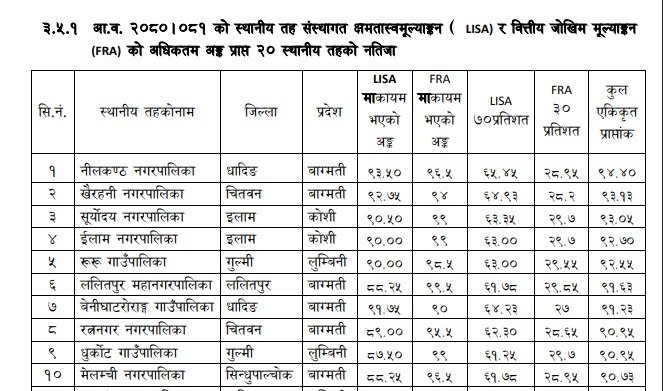
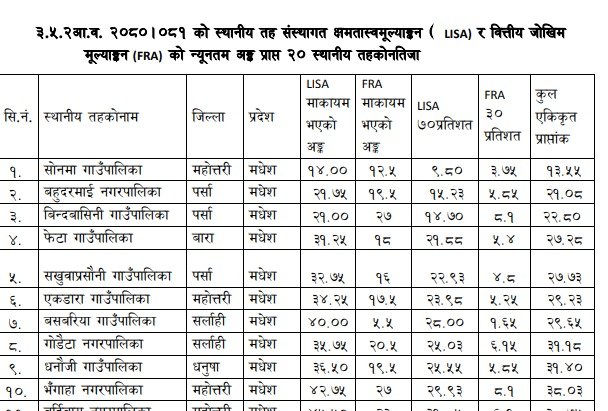
Looking at the results of the report at a glance, there appears to be a large gap in performance among the local levels of Nepal. There is Nilkantha Municipality in Dhading, which has become the best in governance and capacity nationwide by scoring 94.40 points. There is Sonama Rural Municipality in Mahottari district of Madhesh Province, which has only scored 13.55 points.
How many points for which municipality (photo)
The report has meticulously analyzed 10 different criteria of local governments, including sensitive areas such as governance arrangements, organization and administration, annual budget and plan formulation, financial and economic management, service delivery, judicial performance, physical infrastructure, social inclusion, environmental protection and disaster management, and cooperation and coordination.
Each of these 10 indicators has been evaluated with 10 points each. Among these 10 indicators, most local levels have been found to be very weak in the area of 'cooperation and coordination'. 78 local levels have received zero points in terms of building joint projects or policy coordination with the federal government, provinces, and neighboring local levels.
Analyzing the aspect of governance arrangements, many municipalities are still found to be merely process-oriented. Although some improvements have been seen in the operation of assemblies, the decision-making process of the executive, and the formulation of laws and regulations, their public disclosure and implementation aspects remain weak, as mentioned in the report. Particularly in some municipalities of Madhesh Province, the score for governance arrangements has been found to be extremely low.
In the area of organization and administration, mixed results have been obtained in indicators such as employee performance agreements, investment in capacity development, and the presence of the chief administrative officer. The assessment also includes instances where administrative work has come to a standstill in some remote municipalities due to a lack of staff.
Budget and Plan Formulation Still Traditional
In the context of annual budget and plan formulation, local levels are still seen to be stuck in traditional methods. While many municipalities have succeeded in timely presentation and approval of the budget, weaknesses have been observed in the localization of sustainable development goals and prioritization of projects.
The aspect of financial and economic management is even more disappointing. The accumulation of arrears, low share of internal revenue, and lack of budget discipline have become common problems for many municipalities. The report clarifies that many local levels are still fully dependent on federal grants, and the effort to stand on their own feet is very slow. The results of the financial governance risk assessment have placed many municipalities in the 'high risk' category, warning of potential financial crises in local levels in the future.
However, some positive signs have been observed in the area of service delivery. Access to personal event registration and health services has increased for citizens. Municipalities that have started online services using technology have received good scores. The aspect of judicial performance remains in the shadows. The report shows that our local governments are not yet mature enough to resolve local disputes and ensure justice for citizens, as judicial committees led by deputy mayors have received zero points in some municipalities.
More Budget for Infrastructure but No Focus on Quality
The report points out that although local governments have spent the most budget on physical infrastructure development, development based on quality and master plans has not been achieved. While road networks have expanded, municipalities have been found to be very weak in terms of environmental impact assessment and adherence to road jurisdiction, according to the report. The performance of municipalities in the area of social inclusion is also only average. According to the report, the allocated budget for target groups is not being utilized properly, and meaningful participation of women, Dalits, and persons with disabilities in decision-making processes is lacking.
The preparation of municipalities in the area of environmental protection and disaster management is even weaker. The lack of their own environmental laws and the ineffective mobilization of disaster management funds increase the risk of significant damage even in minor disasters.
Municipalities in Madhesh Province are Weak
Analyzing the provincial results, municipalities in Bagmati and Koshi provinces have received comparatively good scores. Municipalities like Nilkantha, Khairahani, and Ratnanagar in Bagmati Province have achieved excellent results nationwide. Tilottama and Devdaha municipalities in Lumbini Province have also been ahead in governance assessments. Municipalities in Madhesh Province have received weak scores in the assessment.
19 out of the 20 local levels with the lowest scores are from Madhesh Province. Despite geographical remoteness, remote municipalities in Karnali and Sudurpashchim have scored better than some accessible municipalities in Madhesh.
Municipalities with Weak Scores
The report has identified 10 priority areas for improvement in the coming days. Coordination and cooperation have been given the first priority, followed by physical infrastructure, social inclusion, environment, and disaster management. The conclusion of the report states: 'Now, the grants and support provided to local levels should be based on performance.
The federal government should adopt a policy of rewarding those who perform well and providing special rescue packages for capacity development to weak municipalities.'
This specific news has been automatically translated by AI. As a result, there may be some inaccuracies or language errors.



_Hd6sr8PGgB.jpg)