
Former President Bhandari and Former Vice President Pun Active in Party Politics

Kathmandu. Challenging the spirit and sentiment of the Janji movement, former President Bidya Devi Bhandari and former Vice President Nanda Bahadur Pun 'Pasang' have become active in party politics.
Former President Bhandari, who has served as the head of state, the country's highest position, announced her return to active politics in the CPN-UML on June 14 last year, coinciding with Madan Bhandari Jayanti. However, the door to active politics was closed when the Central Committee, at the proposal of Chairman KP Sharma Oli, decided to keep Bhandari's membership renewal 'pending'.
The secretariat meeting held at Oli's residence in Gundu decided to renew Bhandari's membership, which had been on hold for ten months. However, UML has not decided on what position Bhandari will be given in the party.
The UML Central Committee meeting held in August last year had decided not to renew Bhandari's membership.
The Janji movement, the party's severe defeat in the general elections, and the calls for leadership change within the party have put UML Chairman Oli in a defensive position. He, who had previously blocked Bhandari's membership renewal on his own directive, has now mysteriously made a 'U-turn' and opened the way for Bhandari's membership renewal.
Oli, who is in a defensive position both internally and externally, appears to be trying to maintain the balance of power in his favor by using the 'Bhandari card'. Bhandari, a former chairperson of UML, had served as a minister several times before becoming president. She was president from November 11, 2015, after the promulgation of the constitution, until February 29, 2023.
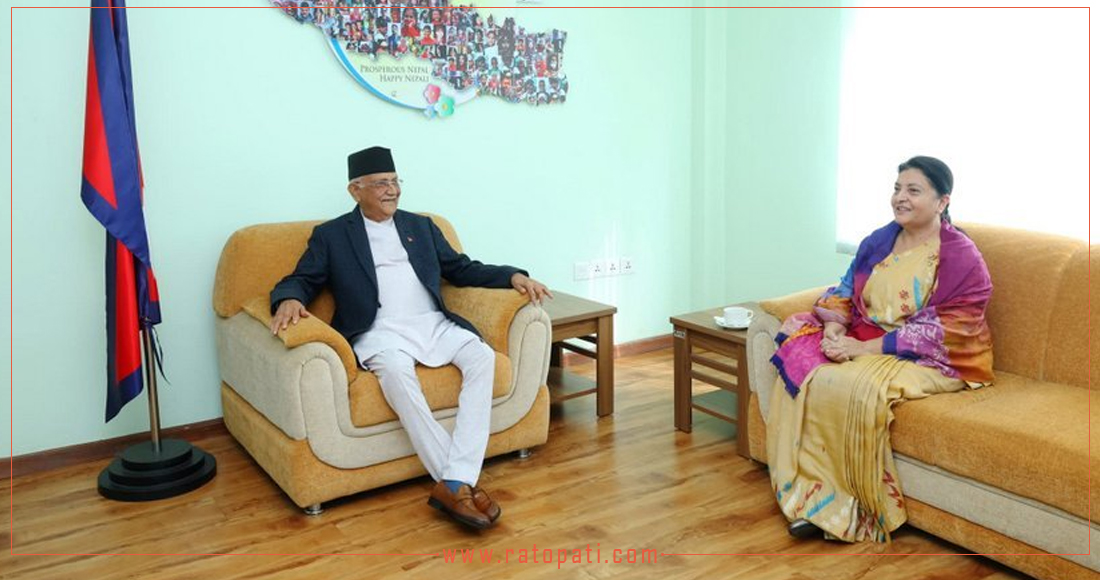
Meanwhile, former Vice President Pasang has been active in the former CPN (Maoist Centre) (now Communist Party of Nepal) since December 6, 2023. Pasang, who was the Deputy Commander of the former People's Liberation Army during the 10-year Maoist armed conflict, was made vice-chairman at the proposal of Chairman Pushpa Kamal Dahal 'Prachanda'.
Pasang is currently a member of the Central Coordination Committee of the CPN. Bhandari was President when Pasang was Vice President.
In 2017, when the leftists secured close to a two-thirds majority, Bhandari and Pasang were re-elected to their previous positions.
Many had suggested that individuals who have reached the country's highest positions should not return to active politics, forgetting the dignity of their office. There was opposition within the CPN-UML and the former Maoist Centre to the former President and former Vice President becoming active in politics again.
A leader from UML questioned why Bhandari's membership was initially blocked and why it was reopened now.
In other countries around the world, except for executive presidents, ceremonial heads of state are not seen returning to active politics. After their term ends, they live a dignified life and engage in social work. The Constitution of Nepal appears to be silent on whether former heads of state or vice-presidents can engage in active politics.
"Didn't KP Oli himself block the membership renewal last year? Why was it blocked for 10 months? Why was it reopened now? The country and the party suffered great damage because of Oli. If Vidya's membership had been renewed at that time, the party might not have suffered so much damage," the leader told RatoPati.
The leader alleged that Oli had blocked Bhandari's membership renewal before the Janji movement because he saw it as an obstacle to becoming party chairman and prime minister again, and asserted that he has now reopened Bhandari's membership renewal after finding himself in difficulty.
In other countries around the world, except for executive presidents, ceremonial heads of state are not seen returning to active politics. After their term ends, they live a dignified life and engage in social work. The Constitution of Nepal appears to be silent on whether former heads of state or vice-presidents can engage in active politics.
Although not binding under the constitution and prevailing laws, whether to engage in politics or not depends on the personal ethics of the individual concerned.
Nepali Congress General Secretary Gururaj Ghimire says it is not appropriate for former heads of state to return to party politics. He stated that the Congress has had a clear stance on this issue from the beginning.
"Firstly, it is not good for people who have reached a respected position to return to politics. In countries with executive presidents, ceremonial presidents live a dignified life in society even after their term ends," he said. "However, where to go? What to do or not to do? The right to make a sovereign decision rests with the individual. We have always had a clear perspective that former heads of state should not enter politics."
Dr. Ram Baran Yadav, the first president of the Republic of Nepal from the Congress, retired in 2015 after completing his seven-year term. Yadav did not return to active politics. Parmanand Jha, the first vice-president, has also not participated in active politics after leaving office.
Former minister and UML leader Ram Kumari Jhankri said that whether former heads of state or vice-presidents engage in active politics is a matter of individual ethics. She said that sometimes, when the party and the country are in crisis, a universally acceptable leadership can be brought in through institutional decisions.
"The issue of a person who has reached the country's most respected position entering active politics can be risky in itself. Sometimes, when the country and the party are in crisis, a universally acceptable person can be brought in through institutional decisions. However, the decision taken by the individual is important in this matter," said Jhankri.
Political analyst Shankar Tiwari clarified that the Janji upheaval has rendered the leadership of political parties irrelevant. "If we try to move forward without understanding the pressure of the situation, it would be against history and tradition," he said.
This specific news has been automatically translated by AI. As a result, there may be some inaccuracies or language errors.
_BSX4jxIBxx.jpg)
_CuZWldRsJU.jpg)

